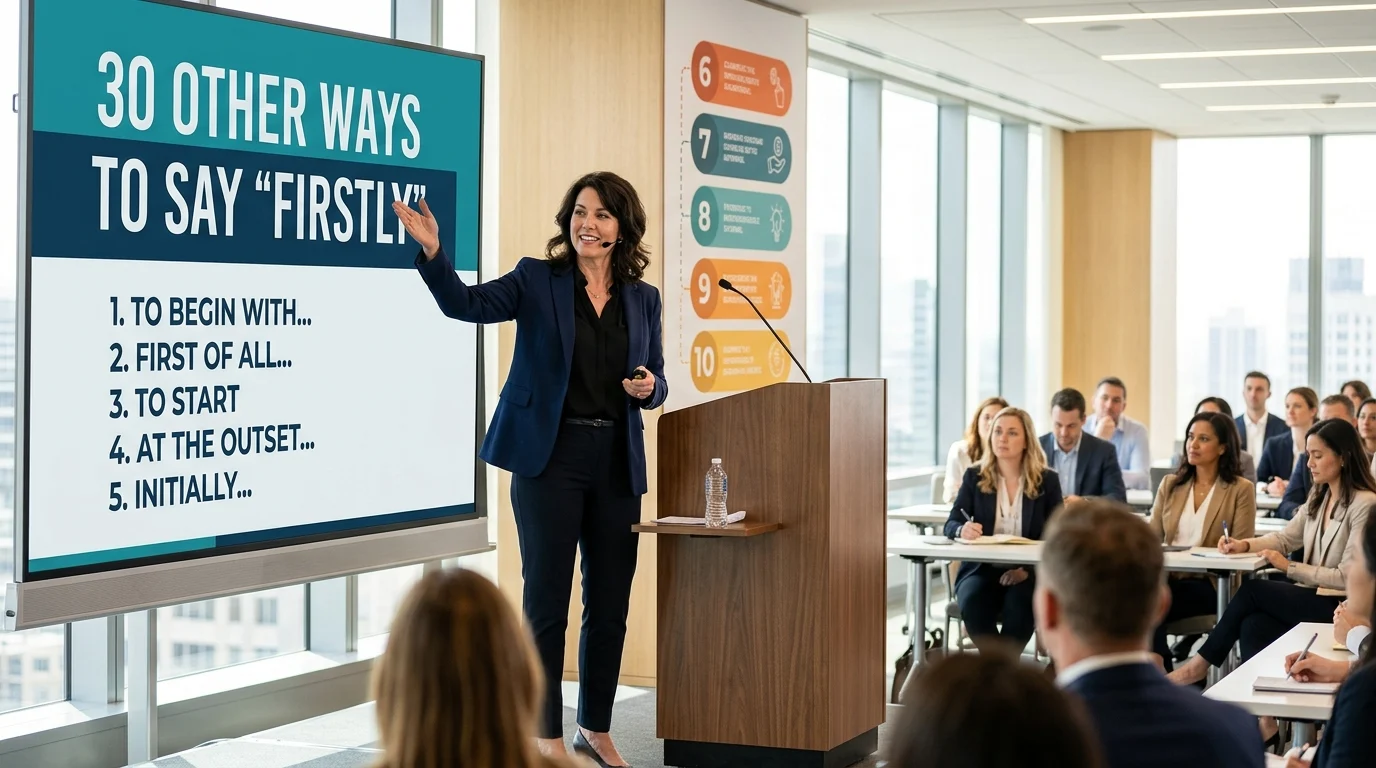
Using “firstly” to introduce your first point is perfectly acceptable, but relying on it in every presentation, email, or essay can make your English sound repetitive and mechanical. Professional communicators vary their language to keep listeners and readers engaged.
Learning diverse alternatives to firstly helps you sound more natural, sophisticated, and confident in your spoken and written English. Whether you’re delivering a business presentation, writing an academic paper, or simply explaining a process, having a rich vocabulary of professional transition phrases allows you to express yourself with precision and polish. Let’s explore 30 powerful alternatives that will elevate your communication.
Quick Categories
Formal Alternatives to “Firstly”
- Initially – at the beginning
- Primarily – in the first place
- First and foremost – most importantly, as a priority
- In the first instance – at the earliest stage
Professional Alternatives
- To begin with – starting the discussion
- For a start – to introduce the first point
- In the first place – originally or to begin with
- At the outset – at the very beginning
Casual Alternatives
- First off – informal way to start a list
- Starting off – beginning with
- Kicking off with – starting energetically
- Let’s start with – inviting engagement
Transitional Alternatives
- The first point is – clear structural marker
- To start – simple opening transition
- Beginning with – introductory marker
- One thing to note first – contextual opener
Pro Tip: In formal writing, use “first” instead of “firstly.” Many style guides consider “firstly” less elegant than “first” as an adverb introducing a sequence.
Common Mistakes Using “Firstly”
- Using “firstly” when you only have one point
❌ “Firstly, the project is on time.”
✅ “The project is on time.” (No need for “firstly” with only one point.) - Forgetting to follow with “secondly” or “finally”
❌ “Firstly, we need funding. The team is ready.”
✅ “Firstly, we need funding. Secondly, the team is ready.” - Mixing “firstly” with “second” inconsistently
❌ “Firstly, we should budget. Second, we should hire.”
✅ “First, we should budget. Second, we should hire.” - Overusing “firstly” in spoken English
❌ “Firstly, I’d like to thank everyone. Firstly, this project matters.”
✅ “First, I’d like to thank everyone. This project matters because…” - Using “firstly” in bullet points
❌ List with “Firstly,” “Secondly,” “Thirdly” in numbered lists
✅ Numbered lists already imply order; just state your points directly.
What Does “Firstly” Mean?
“Firstly” is an adverb used to introduce the first item in a list, the first point in an argument, or the first step in a sequence. It signals to your audience that you’re beginning a structured presentation of ideas.
Example Sentence: “Firstly, we need to review the budget before making any decisions.”
When to Use “Firstly”
Common Contexts:
- Presentations – structuring multiple points
- Academic writing – organizing arguments
- Instructional content – explaining steps
- Business meetings – listing priorities
- Essays and reports – logical sequencing
Spoken vs. Written:
- Spoken: Common in formal speeches and structured talks
- Written: Acceptable but “first” is often preferred in style guides
Formal vs. Informal:
- Formal: Use “first” or “to begin with” for more elegance
- Informal: “Firstly” and “first off” are both acceptable
“The words you choose to open your argument set the tone for everything that follows.”
Is It Professional or Polite to Say “Firstly”?
Polite? ✔️ Yes – It’s always polite to structure communication clearly.
Professional? ⚠️ Sometimes – While not incorrect, many style guides (including The Chicago Manual of Style) recommend “first” over “firstly” in formal writing.
Business Example: “Firstly, we should analyze market trends.”
Better option: “First, we should analyze market trends.”
Pros and Cons of Using “Firstly”
Pros:
- Clear structure – signals the start of a sequence
- Easy to understand – universally recognized
- Common usage – works in most contexts
- Sets expectations – prepares audience for multiple points
Cons:
- Considered less elegant – style guides often prefer “first”
- Overused – can sound mechanical
- Only works in sequences – pointless with one point
- Can feel too formal – may not suit casual conversations
“Strong openers capture attention. Varying your transitions keeps that attention throughout.”
Other Ways to Say “Firstly” (With Examples)
These alternatives will help you sound more fluent, confident, and natural in different situations. Use them according to tone, context, and audience to introduce your first point with style.
1. Phrase: First
Meaning: Before anything else.
Explanation: The simplest, most elegant alternative to “firstly” – preferred in formal writing.
Example Sentence: “First, let me thank everyone for their contributions.”
Best Use: All contexts
Worst Use: When you need emphasis
Tone: Direct, Professional
Context Variability: Professional – “First, we’ll review the quarterly results.”
2. Phrase: To Begin With
Meaning: Starting the discussion or explanation.
Explanation: Natural opening that works in both speaking and writing.
Example Sentence: “To begin with, let’s examine the core issue.”
Best Use: Presentations
Worst Use: Bullet points
Tone: Conversational, Structured
Context Variability: Professional – “To begin with, we need to establish clear goals.”
3. Phrase: First of All
Meaning: The very first point in a sequence.
Explanation: Adds slight emphasis to the first item in a list.
Example Sentence: “First of all, I want to address the main concern.”
Best Use: Emphatic openings
Worst Use: Formal academic writing
Tone: Emphatic, Direct
Context Variability: Casual – “First of all, let’s get the facts straight.”
4. Phrase: Initially
Meaning: At the beginning or in the early stages.
Explanation: Often implies a contrast with later developments.
Example Sentence: “Initially, we planned to launch in March, but we later revised the timeline.”
Best Use: Sequential narratives
Worst Use: Simple numbered lists
Tone: Formal, Temporal
Context Variability: Professional – “Initially, the project faced several challenges.”
5. Phrase: For Starters
Meaning: Used to introduce the first of several points.
Explanation: Common in casual and semi-formal conversations.
Example Sentence: “For starters, we need to increase our marketing budget.”
Best Use: Casual discussions
Worst Use: Formal reports
Tone: Casual, Approachable
Context Variability: Casual – “For starters, we should find a better venue.”
6. Phrase: First and Foremost
Meaning: Most importantly; before anything else.
Explanation: Combines priority with sequence – emphasizes importance.
Example Sentence: “First and foremost, we must ensure the safety of all employees.”
Best Use: Emphatic openings
Worst Use: Simple steps
Tone: Important, Priority-driven
Context Variability: Professional – “First and foremost, our customers come first.”
7. Phrase: In the First Place
Meaning: Originally or to begin with.
Explanation: Often used when questioning initial decisions.
Example Sentence: “Why did we approve this budget in the first place?”
Best Use: Reflective discussions
Worst Use: Introducing simple lists
Tone: Reflective, Questioning
Context Variability: Casual – “In the first place, we never agreed to those terms.”
8. Phrase: The First Point Is
Meaning: Clear marker of the first item in a list.
Explanation: Very direct, useful in structured presentations.
Example Sentence: “The first point is that we’re exceeding our targets.”
Best Use: Structured presentations
Worst Use: Casual conversation
Tone: Direct, Structured
Context Variability: Professional – “The first point is our revenue growth.”
9. Phrase: To Start
Meaning: At the beginning of a process.
Explanation: Simple, natural alternative.
Example Sentence: “To start, let’s gather all the necessary documents.”
Best Use: Process explanations
Worst Use: Formal writing
Tone: Action-oriented
Context Variability: Professional – “To start, we’ll create a project timeline.”
10. Phrase: At the Outset
Meaning: At the very beginning.
Explanation: Formal expression emphasizing the starting point.
Example Sentence: “At the outset, we must clarify our objectives.”
Best Use: Formal documents
Worst Use: Everyday speech
Tone: Formal, Deliberate
Context Variability: Professional – “At the outset, we identified key risks.”
11. Phrase: First Off
Meaning: Informal way to introduce the first topic.
Explanation: Very common in American casual speech.
Example Sentence: “First off, I want to thank everyone for coming.”
Best Use: Casual gatherings
Worst Use: Business reports
Tone: Casual, Friendly
Context Variability: Casual – “First off, let’s order some food.”
12. Phrase: Starting Off
Meaning: Beginning with something.
Explanation: Similar to “to begin with.”
Example Sentence: “Starting off, let me introduce our new team member.”
Best Use: Live presentations
Worst Use: Formal documents
Tone: Natural, Introductory
Context Variability: Casual – “Starting off with the good news…”
13. Phrase: Kicking Off With
Meaning: Starting energetically.
Explanation: Sports metaphor, energetic opening.
Example Sentence: “Let’s kick off with a review of last month’s performance.”
Best Use: Meetings, workshops
Worst Use: Formal writing
Tone: Energetic, Dynamic
Context Variability: Professional – “We’ll kick off with the quarterly update.”
14. Phrase: To Get Started
Meaning: To begin the process.
Explanation: Invites active engagement.
Example Sentence: “To get started, let’s review our current position.”
Best Use: Interactive sessions
Worst Use: Academic writing
Tone: Engaging, Collaborative
Context Variability: Professional – “To get started, please open your documents.”
15. Phrase: Before Anything Else
Meaning: Prioritizing the first point.
Explanation: Emphasizes priority over sequence.
Example Sentence: “Before anything else, we need to address the budget concerns.”
Best Use: Priority discussions
Worst Use: Simple lists
Tone: Important, Priority-driven
Context Variability: Professional – “Before anything else, let’s review safety protocols.”
“Variety in transitions demonstrates linguistic confidence and keeps your audience engaged.”
16. Phrase: As a Starting Point
Meaning: The beginning of a discussion or process.
Explanation: Often used in brainstorming or planning contexts.
Example Sentence: “As a starting point, let’s consider the customer feedback.”
Best Use: Planning discussions
Worst Use: Final conclusions
Tone: Exploratory, Open
Context Variability: Professional – “As a starting point, we’ll focus on three key areas.”
17. Phrase: For Openers
Meaning: An informal way to say “to begin.”
Explanation: Very casual, similar to “for starters.”
Example Sentence: “For openers, we need to improve our response time.”
Best Use: Casual meetings
Worst Use: Formal contexts
Tone: Casual, Friendly
Context Variability: Casual – “For openers, we should double-check the numbers.”
18. Phrase: Primarily
Meaning: In the first place; mainly.
Explanation: Implies both sequence and importance.
Example Sentence: “Primarily, we must focus on quality improvement.”
Best Use: Emphasizing primary importance
Worst Use: Simple sequence lists
Tone: Focused, Important
Context Variability: Professional – “Primarily, our goal is customer satisfaction.”
19. Phrase: In the Beginning
Meaning: At the start of something.
Explanation: Often used in storytelling or chronological explanations.
Example Sentence: “In the beginning, we faced many technical difficulties.”
Best Use: Narratives, case studies
Worst Use: Formal arguments
Tone: Narrative, Temporal
Context Variability: Professional – “In the beginning, our focus was strictly local.”
20. Phrase: At the Start
Meaning: At the beginning point.
Explanation: Simple, clear, and natural.
Example Sentence: “At the start, we’ll define our core objectives.”
Best Use: Process explanations
Worst Use: Emphatic statements
Tone: Clear, Direct
Context Variability: Professional – “At the start of each quarter, we review progress.”
21. Phrase: Let’s Begin With
Meaning: Inviting collaborative opening.
Explanation: Interactive and engaging.
Example Sentence: “Let’s begin with an overview of the project.”
Best Use: Team meetings
Worst Use: Formal writing
Tone: Inclusive, Engaging
Context Variability: Professional – “Let’s begin with the agenda for today.”
22. Phrase: We Should Start With
Meaning: Suggesting a starting point.
Explanation: Collaborative and practical.
Example Sentence: “We should start with the most urgent tasks.”
Best Use: Practical planning
Worst Use: Formal arguments
Tone: Collaborative, Practical
Context Variability: Professional – “We should start with the budget review.”
23. Phrase: I’d Like to Begin With
Meaning: Polite way to introduce the first point.
Explanation: Very polite and structured.
Example Sentence: “I’d like to begin with a thank you to our sponsors.”
Best Use: Formal speeches
Worst Use: Quick lists
Tone: Polite, Structured
Context Variability: Professional – “I’d like to begin with our achievements.”
24. Phrase: Allow Me to Start With
Meaning: Formal, courteous opening.
Explanation: Very formal and courteous.
Example Sentence: “Allow me to start with the positive developments.”
Best Use: Very formal settings
Worst Use: Casual conversation
Tone: Formal, Courteous
Context Variability: Professional – “Allow me to start with a brief introduction.”
25. Phrase: One Thing to Note First
Meaning: Highlighting something important before proceeding.
Explanation: Draws attention to significance.
Example Sentence: “One thing to note first is the change in leadership.”
Best Use: Context-setting
Worst Use: Simple sequential lists
Tone: Informative, Noteworthy
Context Variability: Professional – “One thing to note first is the updated policy.”
26. Phrase: Let’s Kick Things Off With
Meaning: Energetic, informal opening.
Explanation: Sports metaphor for a lively start.
Example Sentence: “Let’s kick things off with some good news!”
Best Use: Energetic meetings
Worst Use: Formal documents
Tone: Energetic, Enthusiastic
Context Variability: Casual – “Let’s kick things off with introductions.”
27. Phrase: To Launch
Meaning: To begin or initiate.
Explanation: Often used in business contexts.
Example Sentence: “To launch our discussion, let’s review the key findings.”
Best Use: Business presentations
Worst Use: Casual settings
Tone: Professional, Initiated
Context Variability: Professional – “To launch, we’ll outline our strategy.”
28. Phrase: For a Start
Meaning: To begin with; as a first step.
Explanation: Often implies more points will follow.
Example Sentence: “For a start, we could improve our social media presence.”
Best Use: Suggesting initial actions
Worst Use: Formal arguments
Tone: Suggestive, Practical
Context Variability: Casual – “For a start, let’s update our website.”
29. Phrase: We’ll Begin By
Meaning: Starting with a specific action.
Explanation: Clear and action-oriented.
Example Sentence: “We’ll begin by identifying our key priorities.”
Best Use: Planning sessions
Worst Use: Formal reports
Tone: Action-oriented, Clear
Context Variability: Professional – “We’ll begin by reviewing the data.”
30. Phrase: In the First Instance
Meaning: At the earliest stage or initially.
Explanation: Formal expression, common in legal and bureaucratic contexts.
Example Sentence: “In the first instance, we’ll contact all stakeholders.”
Best Use: Formal, official contexts
Worst Use: Everyday speech
Tone: Formal, Official
Context Variability: Professional – “In the first instance, please submit all paperwork.”
“The way you introduce your first point influences how your entire message is received.”
Mini Quiz: Test Your Knowledge
1. In an academic essay, which is most appropriate?
- A) First off
- B) First
- C) Let’s kick things off
- D) For starters
Answer: B – “First” is the preferred academic choice.
2. Which phrase emphasizes priority as well as sequence?
- A) Initially
- B) To begin with
- C) First and foremost
- D) For a start
Answer: C – “First and foremost” emphasizes the primary importance of your first point.
3. Your team is brainstorming casually. Which opener is best?
- A) In the first instance
- B) Primarily
- C) For starters
- D) At the outset
Answer: C – “For starters” is casual and appropriate for brainstorming.
4. Which alternative works for both spoken and written professional English?
- A) Kick off with
- B) To begin with
- C) First off
- D) For openers
Answer: B – “To begin with” works well in both spoken and written professional contexts.
Comparison Table: Top 10 Alternatives
| Phrase | Tone | Best Use |
|---|---|---|
| First | Direct, Professional | All formal contexts |
| To begin with | Natural, Structured | Presentations, meetings |
| First of all | Emphatic, Direct | Prioritizing the first point |
| Initially | Formal, Temporal | Chronological explanations |
| For starters | Casual, Approachable | Informal meetings |
| First and foremost | Important, Priority-driven | Emphasizing primary importance |
| In the first place | Reflective, Questioning | Questioning original decisions |
| At the outset | Formal, Deliberate | Legal, official contexts |
| First off | Casual, Friendly | Casual American speech |
| Primarily | Focused, Important | Strategic priorities |
FAQs
1. Is “firstly” grammatically correct?
Yes, “firstly” is grammatically correct as an adverb. However, many style guides prefer “first” when introducing a list of points.
2. What is the most formal alternative to “firstly”?
“In the first instance” and “at the outset” are among the most formal alternatives, suitable for legal, academic, and official documents.
3. Can I use “firstly” in professional emails?
Yes, but “first” or “to begin with” often sounds more polished and professional.
4. What’s the difference between “firstly” and “first”?
They have the same meaning, but “first” is shorter, more direct, and often preferred in formal writing. “Firstly” is more common in British English but is still considered less elegant by many style guides.
5. How can I avoid overusing “firstly” in presentations?
Vary your transitions using different alternatives like “to begin with,” “first of all,” “initially,” or “starting off.” You can also use structural statements like “the first point is” or “let’s start with.”
Conclusion
Mastering alternatives to firstly transforms your English from basic to sophisticated. The 30 alternatives we’ve explored give you the flexibility to introduce your first point with the perfect tone for any situation – whether you’re writing a formal academic paper, delivering a business presentation, or having a casual conversation.
The key to natural communication isn’t memorizing every possible alternative. It’s developing awareness of tone, formality, and context. Practice using these professional transition phrases in your daily communication. Notice how skilled communicators vary their language to maintain engagement. Soon, you’ll instinctively choose the perfect opening for every situation.