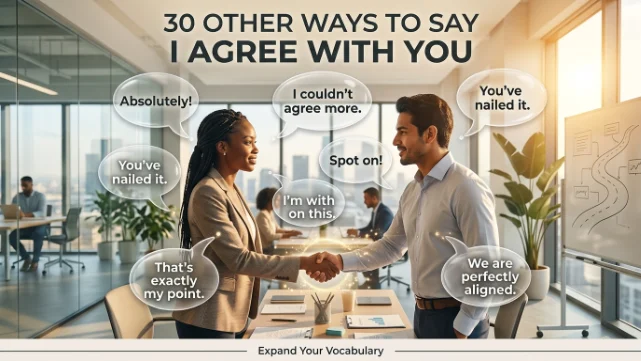
I agree with you means having the same opinion or viewpoint as someone else. Here are 5 top alternatives: I concur, absolutely, I couldn’t agree more, that’s exactly how I feel, you’re absolutely right.
The phrase “I agree with you” appears constantly in conversations, meetings, and written communication. While it’s perfectly correct, overusing it can make your English sound repetitive and basic, especially in professional settings where varied vocabulary demonstrates sophistication.
Learning diverse alternatives to I agree with you helps you express agreement in English with greater nuance, enthusiasm, and professionalism. Whether you’re in a boardroom, a classroom, or a casual conversation, having a rich vocabulary of professional reaction phrases allows you to show agreement at exactly the right level of formality and conviction. Let’s explore 30 powerful alternatives that will transform how you communicate your agreement.
Quick Categories
Formal Alternatives to “I Agree with You”
- I concur – I share the same opinion
- I’m in accord – I’m in agreement
- I’m of the same mind – I hold the same view
- That aligns with my thinking – that matches my perspective
Professional Alternatives
- I second that – I support that proposal
- That’s a valid point – I acknowledge your perspective
- You make a compelling argument – your reasoning is convincing
- I share your perspective – I see things the same way
Casual Alternatives
- Absolutely – completely yes
- Exactly – that’s precisely what I mean
- Tell me about it – I fully agree (often used when agreeing with a complaint)
- I’m with you on that – I share your position
Informal Expressions
- Right on – I agree wholeheartedly
- You said it – I completely agree
- I hear you – I understand and agree
- Same here – I feel the same way
Pro Tip: In professional settings, use formal and professional alternatives to demonstrate intellectual engagement. Save casual expressions for familiar colleagues and social situations.
Common Mistakes Using “I Agree with You”
- Using it too many times in one conversation
❌ “I agree with you. I agree with you. I agree with you.”
✅ Vary your agreement phrases naturally. - Using it when you actually mean “I understand”
❌ “I agree with you” (when you just understand, not truly agree)
✅ “I understand your point of view.” - Agreeing too quickly without thought
❌ “I agree with you” (before considering the full argument)
✅ “That’s an interesting point I hadn’t considered.” - Using it in written feedback without explanation
❌ “I agree with you.” (no context)
✅ “I agree with your proposal for the following reasons…” - Using it sarcastically
❌ “Oh, I agree with you so much.” (sarcastic tone)
✅ Be genuine and match your tone to your true feelings.
What Does “I Agree with You” Mean?
“I agree with you” is a statement expressing that you share the same opinion, belief, or viewpoint as another person. It indicates alignment of thought and is one of the most common ways to show consensus in English conversation.
Example Sentence: “I agree with you that we should invest more in renewable energy.”
When to Use “I Agree with You”
Common Contexts:
- Business meetings – supporting proposals
- Casual conversations – showing alignment with friends
- Debates and discussions – finding common ground
- Performance reviews – acknowledging feedback
- Written correspondence – confirming mutual understanding
Spoken vs. Written:
- Spoken: Very common and natural
- Written: Acceptable but can be improved with alternatives
Formal vs. Informal:
- Formal: Use sparingly; opt for more sophisticated alternatives
- Informal: Perfectly acceptable in everyday speech
“Agreement without nuance is agreement without credibility. Choose words that match your conviction.”
Is It Professional or Polite to Say “I Agree with You”?
Polite? ✔️ Yes – It’s perfectly polite and respectful.
Professional? ✔️ Acceptable – But more sophisticated alternatives demonstrate greater communication skill.
Business Example: “I agree with you about the quarterly targets.”
Better option: “I concur with your assessment of the quarterly targets.”
Pros and Cons of Using “I Agree with You”
Pros:
- Universal understanding – everyone knows what it means
- Direct and clear – no ambiguity
- Appropriate in most contexts – never offensive
- Simple and natural – easy for learners to use
Cons:
- Overused – sounds repetitive in long conversations
- Lacks enthusiasm – doesn’t convey how strongly you agree
- Minimal nuance – doesn’t show if you agree somewhat or completely
- Can sound passive – sometimes feels like you’re just going along
“The difference between good and great communication often lies in your vocabulary of agreement.”
Other Ways to Say “I Agree with You” (With Examples)
These alternatives will help you sound more fluent, confident, and natural in different situations. Use them according to tone, context, and audience to express agreement in English with precision.
1. Phrase: I Concur
Meaning: I share the same opinion.
Explanation: A formal, professional alternative often used in business writing.
Example Sentence: “I concur with your recommendation to expand into European markets.”
Best Use: Formal meetings
Worst Use: Casual conversations
Tone: Formal, Intellectual
Context Variability: Professional – “The board concurred with the CFO’s assessment.”
2. Phrase: I Couldn’t Agree More
Meaning: I agree completely and enthusiastically.
Explanation: Expresses strong, unwavering agreement.
Example Sentence: “I couldn’t agree more with your proposal to improve customer service.”
Best Use: Emphasizing strong agreement
Worst Use: Mild agreement situations
Tone: Enthusiastic, Strong
Context Variability: Professional – “I couldn’t agree more with your analysis.”
3. Phrase: That’s Exactly What I Was Thinking
Meaning: Our thoughts align perfectly.
Explanation: Shows you share the same thought process.
Example Sentence: “That’s exactly what I was thinking about the new office layout.”
Best Use: Brainstorming sessions
Worst Use: Formal written feedback
Tone: Collaborative, Relatable
Context Variability: Casual – “That’s exactly what I was thinking too!”
4. Phrase: I’m With You On That
Meaning: I share your position or opinion.
Explanation: Casual expression of support.
Example Sentence: “I’m with you on that – the policy needs to change.”
Best Use: Team discussions
Worst Use: Formal documents
Tone: Supportive, Friendly
Context Variability: Casual – “I’m with you on that proposal.”
5. Phrase: Absolutely
Meaning: Completely yes, I agree.
Explanation: A one-word alternative that shows full agreement.
Example Sentence: “Absolutely, that’s the best approach we’ve considered.”
Best Use: Quick agreement
Worst Use: Written formal documents
Tone: Enthusiastic, Direct
Context Variability: Professional – “Absolutely, let’s proceed with the plan.”
6. Phrase: You’re Absolutely Right
Meaning: You’re completely correct.
Explanation: Shows complete agreement with a hint of admiration.
Example Sentence: “You’re absolutely right about the need for better communication.”
Best Use: Acknowledging good points
Worst Use: Casual disagreements
Tone: Respectful, Confirming
Context Variability: Professional – “You’re absolutely right, I hadn’t considered that.”
7. Phrase: I Second That
Meaning: I support that proposal.
Explanation: Used when supporting someone else’s idea or motion.
Example Sentence: “I second that motion to extend the deadline.”
Best Use: Formal meetings
Worst Use: Casual conversations
Tone: Formal, Procedural
Context Variability: Professional – “I second that recommendation.”
8. Phrase: I Share Your View
Meaning: I have the same opinion.
Explanation: Professional, measured expression of agreement.
Example Sentence: “I share your view on the importance of sustainability.”
Best Use: Professional discussions
Worst Use: Very casual settings
Tone: Professional, Balanced
Context Variability: Professional – “I share your view on this matter.”
9. Phrase: That’s a Valid Point
Meaning: Your point is reasonable and well-founded.
Explanation: Acknowledges merit in someone’s argument.
Example Sentence: “That’s a valid point about the potential risks involved.”
Best Use: Constructive discussions
Worst Use: Enthusiastic agreement
Tone: Analytical, Respectful
Context Variability: Professional – “That’s a valid point, and we should address it.”
10. Phrase: You Make a Compelling Argument
Meaning: Your reasoning is persuasive and convincing.
Explanation: Shows respect and intellectual engagement.
Example Sentence: “You make a compelling argument for restructuring the department.”
Best Use: Debates, negotiations
Worst Use: Everyday conversations
Tone: Respectful, Intellectual
Context Variability: Professional – “You make a compelling argument for your approach.”
11. Phrase: I’m in Agreement
Meaning: I am in a state of agreement.
Explanation: A slightly more formal way to say “I agree.”
Example Sentence: “I’m in agreement with the committee’s decision.”
Best Use: Formal statements
Worst Use: Casual conversations
Tone: Formal, Official
Context Variability: Professional – “We are in agreement on the contract terms.”
12. Phrase: I Feel the Same Way
Meaning: I have the same feeling or opinion.
Explanation: Often used for emotional or value-based agreement.
Example Sentence: “I feel the same way about the importance of work-life balance.”
Best Use: Personal and professional contexts
Worst Use: Highly formal writing
Tone: Empathetic, Connected
Context Variability: Professional – “I feel the same way about our company values.”
13. Phrase: My Thoughts Exactly
Meaning: That’s precisely what I think.
Explanation: Shows strong alignment in thinking.
Example Sentence: “My thoughts exactly – we need to hire more developers.”
Best Use: Brainstorming, quick agreement
Worst Use: Formal documents
Tone: Enthusiastic, Aligned
Context Variability: Casual – “My thoughts exactly on that issue.”
14. Phrase: That Makes Perfect Sense
Meaning: Your argument is logical and clear.
Explanation: Acknowledges sound reasoning.
Example Sentence: “That makes perfect sense – I hadn’t seen it that way.”
Best Use: Understanding and agreement
Worst Use: When you only partially agree
Tone: Analytical, Approving
Context Variability: Professional – “That makes perfect sense for our situation.”
15. Phrase: I See Things the Same Way
Meaning: I have the same perspective.
Explanation: A clear, neutral way to show agreement.
Example Sentence: “I see things the same way regarding the project timeline.”
Best Use: Professional contexts
Worst Use: Emotional or personal matters
Tone: Neutral, Professional
Context Variability: Professional – “I see things the same way as the team.”
16. Phrase: That’s How I Feel Too
Meaning: I have the same emotional response.
Explanation: Used for agreement about opinions or feelings.
Example Sentence: “That’s how I feel too about the new company policy.”
Best Use: Personal and emotional contexts
Worst Use: Formal business writing
Tone: Personal, Relatable
Context Variability: Casual – “That’s how I feel too, honestly.”
17. Phrase: Tell Me About It
Meaning: I completely agree (often with complaints).
Explanation: Expresses strong agreement, usually about something negative.
Example Sentence: “Tell me about it – the traffic has been terrible this week.”
Best Use: Casual conversations
Worst Use: Professional contexts
Tone: Empathetic, Familiar
Context Variability: Casual – “Tell me about it, I know exactly what you mean.”
18. Phrase: Right On
Meaning: I agree completely.
Explanation: An enthusiastic, informal expression of agreement.
Example Sentence: “Right on, I think that’s the best solution we’ve found.”
Best Use: Casual, enthusiastic contexts
Worst Use: Professional situations
Tone: Enthusiastic, Informal
Context Variability: Casual – “Right on, that makes so much sense!”
19. Phrase: You Said It
Meaning: I completely agree with what you said.
Explanation: Used to strongly reinforce someone else’s statement.
Example Sentence: “You said it – we really need to improve our customer service.”
Best Use: Casual agreement
Worst Use: Formal documents
Tone: Strong, Endorsing
Context Variability: Casual – “You said it, that’s exactly right.”
20. Phrase: I Hear You
Meaning: I understand and agree with your point.
Explanation: Expresses that you’ve heard and processed the information.
Example Sentence: “I hear you – we definitely need to increase our budget.”
Best Use: Active listening contexts
Worst Use: Formal writing
Tone: Attentive, Understanding
Context Variability: Professional – “I hear you, and I think you’re right.”
“The most persuasive people know when to say ‘I concur’ and when to say ‘Exactly!'”
21. Phrase: That’s a Great Point
Meaning: That’s an excellent and valuable observation.
Explanation: Shows agreement and appreciation for someone’s contribution.
Example Sentence: “That’s a great point about the importance of user experience.”
Best Use: Meetings, discussions
Worst Use: Strong disagreement contexts
Tone: Appreciative, Collaborative
Context Variability: Professional – “That’s a great point to consider.”
22. Phrase: I Take Your Point
Meaning: I understand and acknowledge your position.
Explanation: Shows you’ve considered and accepted someone’s argument.
Example Sentence: “I take your point about the need for more training.”
Best Use: Professional discussions
Worst Use: Enthusiastic agreement
Tone: Measured, Considered
Context Variability: Professional – “I take your point and agree it needs attention.”
23. Phrase: That’s Absolutely Right
Meaning: That’s completely correct.
Explanation: Strong, unambiguous agreement.
Example Sentence: “That’s absolutely right – we need to act now.”
Best Use: Emphasizing agreement
Worst Use: Mild agreement situations
Tone: Decisive, Confirming
Context Variability: Professional – “That’s absolutely right, I fully agree.”
24. Phrase: We’re on the Same Page
Meaning: We have mutual understanding and agreement.
Explanation: Often used in team contexts.
Example Sentence: “We’re on the same page about the project requirements.”
Best Use: Team alignment
Worst Use: Formal documents
Tone: Collaborative, Aligned
Context Variability: Professional – “We’re on the same page, let’s move forward.”
25. Phrase: That Aligns with My Thinking
Meaning: Your thoughts match my own.
Explanation: Professional way to express agreement.
Example Sentence: “That aligns with my thinking about our market strategy.”
Best Use: Strategic discussions
Worst Use: Casual conversations
Tone: Strategic, Professional
Context Variability: Professional – “That aligns with my thinking on this issue.”
26. Phrase: You’ve Got a Point There
Meaning: You’re right about that.
Explanation: Acknowledges that someone has made a valid observation.
Example Sentence: “You’ve got a point there about the pricing strategy.”
Best Use: Friendly discussions
Worst Use: Formal meetings
Tone: Friendly, Conceding
Context Variability: Casual – “You’ve got a point there, I hadn’t thought of that.”
27. Phrase: I See Your Point
Meaning: I understand and agree with your perspective.
Explanation: Shows empathy and agreement.
Example Sentence: “I see your point about the challenges of remote work.”
Best Use: Empathetic conversations
Worst Use: Formal writing
Tone: Understanding, Empathetic
Context Variability: Professional – “I see your point and agree it’s a concern.”
28. Phrase: Precisely
Meaning: That’s exactly right.
Explanation: A single word showing precise agreement.
Example Sentence: “Precisely, that was my exact concern as well.”
Best Use: Quick, emphatic agreement
Worst Use: Formal documents
Tone: Emphatic, Precise
Context Variability: Professional – “Precisely, that’s the issue.”
29. Phrase: I’m of the Same Mind
Meaning: I have the same opinion.
Explanation: Formal, somewhat literary expression.
Example Sentence: “I’m of the same mind regarding the expansion strategy.”
Best Use: Formal writing
Worst Use: Everyday speech
Tone: Formal, Articulate
Context Variability: Professional – “I’m of the same mind on this matter.”
30. Phrase: True
Meaning: That’s correct; I agree.
Explanation: Very short, informal agreement.
Example Sentence: “True, we should definitely consider that option.”
Best Use: Quick agreement
Worst Use: Professional contexts
Tone: Casual, Brief
Context Variability: Casual – “True, that’s a really good idea.”
“The best communicators match their agreement to their audience – formal with executives, warm with colleagues, enthusiastic with friends.”
Mini Quiz: Test Your Knowledge
1. In a formal business meeting, which is most appropriate?
- A) Right on
- B) I concur
- C) Tell me about it
- D) You said it
Answer: B – I concur is professional and formal.
2. A colleague makes a very strong point you completely agree with. Which is best?
- A) I take your point
- B) That’s a valid point
- C) I couldn’t agree more
- D) I’m of the same mind
Answer: C – I couldn’t agree more expresses strong enthusiasm.
3. You’re in a casual conversation with a friend. Which is most natural?
- A) I concur with your assessment
- B) We are in agreement
- C) That aligns with my thinking
- D) Absolutely
Answer: D – Absolutely is natural and friendly.
Comparison Table: Top 10 Alternatives
| Phrase | Tone | Best Use |
|---|---|---|
| I concur | Formal, Professional | Business meetings |
| I couldn’t agree more | Enthusiastic, Strong | Strong agreement |
| You make a compelling argument | Respectful, Intellectual | Debates, negotiations |
| I’m in agreement | Formal, Official | Formal statements |
| I second that | Procedural, Supportive | Supporting proposals |
| We’re on the same page | Collaborative, Aligned | Team contexts |
| Absolutely | Enthusiastic, Direct | Quick, emphatic agreement |
| I’m with you on that | Supportive, Friendly | Team discussions |
| Tell me about it | Empathetic, Familiar | Casual, complaint contexts |
| That’s a valid point | Analytical, Respectful | Constructive discussions |
FAQs
1. What is the most professional way to say I agree with you?
“I concur” and “I’m in agreement” are the most professional alternatives. They sound sophisticated and appropriate for formal business contexts.
2. Can I say “I agree with you” in a formal email?
Yes, but consider using “I concur” or “I’m in agreement” for a more professional tone. “I agree with you” is acceptable but somewhat basic.
3. What does “I couldn’t agree more” mean?
It means you completely and enthusiastically agree. It’s used to express strong, unqualified agreement with someone.
4. How do you show agreement without saying I agree?
Use phrases like “That makes perfect sense,” “You make a compelling argument,” or “That aligns with my thinking.”
5. Is “I hear you” the same as agreeing?
Not necessarily – “I hear you” means “I understand,” but it can imply agreement depending on context. It’s often a good way to acknowledge someone’s point before agreeing.
Conclusion
Mastering alternatives to I agree with you is essential for effective professional and social communication. The 30 alternatives we’ve explored allow you to express agreement in English with the right tone, enthusiasm, and formality for every situation.
Remember that the most skilled communicators don’t just agree – they engage. They show they’ve truly listened by choosing words that match their level of conviction and respect for the other person’s ideas. Practice using these alternatives to I agree with you in your daily conversations, meetings, and emails. Your vocabulary will grow, your professional reputation will strengthen, and your relationships will deepen.