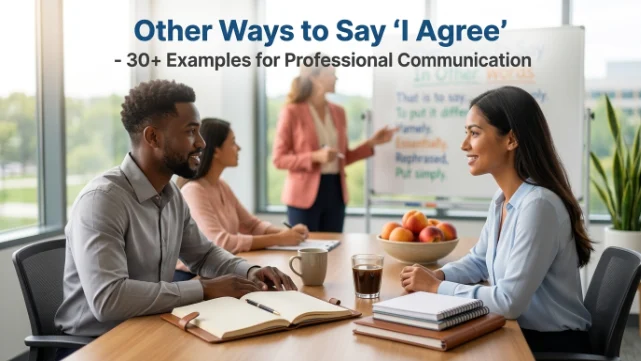
Looking for alternatives to “I agree”? Here are 5 top options: I concur, I share your view, Absolutely, You’re right, and I’m with you on that. Each works in different contexts from formal boardroom discussions to casual everyday conversations.
“I agree” is one of the most frequently used phrases in everyday English conversations, meetings, and written communication. Whether you’re responding to a colleague’s suggestion, supporting a friend’s opinion, or acknowledging a valid point, “I agree” seems to be the default response.
However, using the same phrase repeatedly can make your English sound monotonous and limited. Learning alternatives to “I agree” will help you express agreement with greater nuance, professionalism, and confidence. This comprehensive guide provides 30 powerful alternatives that will transform how you show support and alignment in conversations.
Quick Categories
Formal Alternatives to “I Agree”
- I concur
- I am in agreement
- That is correct
- I share your perspective
Casual Alternatives
- Absolutely
- Totally
- For sure
- Right on
Professional Alternatives
- I share your view
- That aligns with my thinking
- I support that position
- You have my full support
Informal Expressions
- I’m with you
- Tell me about it
- My thoughts exactly
- Preach
Pro Tip: The way you express agreement can influence how others perceive your professionalism and emotional intelligence. Match your tone to your audience and setting.
Common Mistakes Using “I Agree”
1. Using it too frequently in professional settings
- ❌ “I agree with everything you said.”
- ✅ “I support your recommendation and see its merit.”
2. Forgetting to add context
- ❌ “I agree.” (vague and unhelpful)
- ✅ “I agree with your analysis of the market trends.”
3. Using it when you actually partially agree
- ❌ “I agree completely.” (when you have reservations)
- ✅ “I agree with the main points, though I’d like to discuss one detail.”
4. Misusing it in written communication without elaboration
- ❌ Email: “I agree.”
- ✅ Email: “I agree with your proposal and look forward to implementing it.”
5. Using it sarcastically without clear tone cues
- ❌ “Oh, I agree.” (unclear intent)
- ✅ Use a neutral or positive alternative to avoid misinterpretation.
What Does “I Agree” Mean?
“I agree” means having the same opinion or holding the same view as another person. It expresses acceptance, alignment, and acceptance of an idea, suggestion, or statement. The phrase indicates consensus or shared understanding.
Example Sentence: “I agree that we should postpone the meeting until next week.”
When to Use “I Agree”
Common contexts:
- Responding to suggestions in meetings
- Acknowledging valid points in conversations
- Supporting team decisions
- Confirming shared understanding
- Expressing alignment with opinions
Spoken vs Written:
- Spoken: Very common and natural in all conversation
- Written: Acceptable but can be enhanced with alternatives
Formal vs Informal:
- Formal: Use sparingly; opt for “I concur” or “I support that position”
- Informal: Widely accepted and natural
“The way you agree can be just as important as the agreement itself.”
Is It Professional or Polite to Say “I Agree”?
Polite? ✔️ Yes—it’s generally respectful and considerate.
Professional? ⚠️ It depends—it’s acceptable but often too brief for professional communication.
Business-style example:
- ❌ Email: “I agree with your proposal.”
- ✅ Email: “I fully support your proposal and believe it aligns well with our objectives.”
Pros and Cons of Using “I Agree”
Pros:
- Simple and instantly understood by all
- Direct and unambiguous
- Polite and non-confrontational
- Appropriate in almost all contexts
Cons:
- Overused to the point of losing impact
- Can sound like going along without conviction
- May appear lazy in professional writing
- Lacks emotional engagement and enthusiasm
Other Ways to Say “I Agree” (With Examples)
These alternatives will help you sound more fluent, confident, and natural in different situations. Use them according to tone, context, and audience to express agreement with precision and appropriate emotional weight.
1. Phrase: I concur
Meaning: I share the same opinion; I agree formally.
Explanation: The most direct formal alternative, often used in professional contexts.
Example Sentence: “I concur with your assessment of the quarterly results.”
Best Use: Formal meetings
Worst Use: Casual texts
Tone: Professional, formal
Context Variability: Professional / written
2. Phrase: I share your view
Meaning: My perspective aligns with yours.
Explanation: Indicates you hold the same position without absolute rigidity.
Example Sentence: “I share your view that we should invest in new technology.”
Best Use: Collaborative conversations
Worst Use: Brief acknowledgments
Tone: Respectful, collaborative
Context Variability: Professional / spoken
3. Phrase: That aligns with my thinking
Meaning: Your thoughts correspond well with mine.
Explanation: Suggests natural compatibility of ideas rather than forced agreement.
Example Sentence: “Your approach aligns with my thinking on how to handle the situation.”
Best Use: Strategic discussions
Worst Use: Casual small talk
Tone: Analytical, professional
Context Variability: Professional / written
4. Phrase: Absolutely
Meaning: I completely agree without reservation.
Explanation: A strong, enthusiastic expression of total agreement.
Example Sentence: “Absolutely—that’s exactly what we should do.”
Best Use: Showing enthusiasm
Worst Use: Formal written communication
Tone: Enthusiastic, strong
Context Variability: Casual / spoken
5. Phrase: You’re right
Meaning: I acknowledge the correctness of your position.
Explanation: A direct and simple way to concede or support another’s point.
Example Sentence: “You’re right—I hadn’t considered that perspective.”
Best Use: Everyday conversations
Worst Use: Formal reports
Tone: Honest, direct
Context Variability: Casual / spoken
6. Phrase: I’m with you on that
Meaning: I support your position or opinion.
Explanation: Casual expression showing solidarity and shared opinion.
Example Sentence: “I’m with you on that—we definitely need more resources.”
Best Use: Team discussions
Worst Use: Formal documents
Tone: Friendly, supportive
Context Variability: Casual / spoken
7. Phrase: I support that position
Meaning: I advocate for the same stance or proposal.
Explanation: Professional way to express agreement while emphasizing advocacy.
Example Sentence: “I support that position and will help implement it.”
Best Use: Decision-making meetings
Worst Use: Quick acknowledgments
Tone: Professional, committed
Context Variability: Professional / spoken
8. Phrase: That makes sense
Meaning: Your point is logical and reasonable.
Explanation: Acknowledges the validity of reasoning behind an opinion.
Example Sentence: “That makes sense given the budget constraints we face.”
Best Use: Analytical discussions
Worst Use: Strong emotional agreement
Tone: Reasonable, measured
Context Variability: Professional / casual
9. Phrase: Precisely
Meaning: That’s exactly right; I agree completely.
Explanation: Emphasizes the exact accuracy of the other person’s point.
Example Sentence: “Precisely—that’s the core issue we need to address.”
Best Use: Confirming detailed points
Worst Use: Casual small talk
Tone: Precise, confident
Context Variability: Professional / spoken
10. Phrase: Exactly
Meaning: I agree with complete precision.
Explanation: A natural, emphatic way to show total agreement.
Example Sentence: “Exactly! That’s exactly what I was about to say.”
Best Use: Conversations
Worst Use: Formal writing
Tone: Emphatic, natural
Context Variability: Casual / spoken
“Showing agreement with the right phrase demonstrates emotional intelligence and engagement.”
11. Phrase: I couldn’t agree more
Meaning: I agree completely and enthusiastically.
Explanation: Emphasizes total alignment without any reservations.
Example Sentence: “I couldn’t agree more with your recommendation.”
Best Use: Strong support
Worst Use: Formal business writing
Tone: Enthusiastic, strong
Context Variability: Professional / casual
12. Phrase: No doubt about it
Meaning: I am completely certain and agree entirely.
Explanation: Expresses agreement with total confidence and conviction.
Example Sentence: “No doubt about it—she’s the best candidate for the role.”
Best Use: Confident affirmations
Worst Use: Professional documents
Tone: Confident, casual
Context Variability: Informal / spoken
13. Phrase: I see eye to eye with you
Meaning: We have the same perspective and viewpoint.
Explanation: Emphasizes mutual understanding and shared opinion.
Example Sentence: “I see eye to eye with you on the expansion strategy.”
Best Use: Personal/professional relationships
Worst Use: Quick responses
Tone: Friendly, diplomatic
Context Variability: Professional / casual
14. Phrase: Right you are
Meaning: You’re definitely correct.
Explanation: A slightly old-fashioned but charming way to agree.
Example Sentence: “Right you are—we should begin the project immediately.”
Best Use: Friendly banter
Worst Use: Formal business
Tone: Charming, warm
Context Variability: Casual / spoken
15. Phrase: My thoughts exactly
Meaning: You’ve expressed what I was thinking.
Explanation: Shows you share the same opinion and appreciate their articulation.
Example Sentence: “My thoughts exactly—I’ve been saying that for weeks.”
Best Use: Expressing shared perspective
Worst Use: Formal settings
Tone: Affirming, friendly
Context Variability: Casual / spoken
16. Phrase: I’m with you
Meaning: I support you and share your opinion.
Explanation: A shorter, more casual version of “I’m with you on that.”
Example Sentence: “I’m with you—let’s proceed with the new strategy.”
Best Use: Team support
Worst Use: Written formal communication
Tone: Supportive, casual
Context Variability: Casual / spoken
17. Phrase: Fair point
Meaning: That’s a reasonable and valid argument.
Explanation: Acknowledges the validity of someone’s opinion while maintaining neutrality.
Example Sentence: “Fair point—I hadn’t considered the additional costs.”
Best Use: Debates and discussions
Worst Use: Emotional agreement
Tone: Diplomatic, fair
Context Variability: Professional / casual
18. Phrase: That’s a great point
Meaning: Your point is excellent and deserves recognition.
Explanation: Both agrees and compliments the quality of the insight.
Example Sentence: “That’s a great point about customer retention strategies.”
Best Use: Group discussions
Worst Use: Brief responses
Tone: Encouraging, respectful
Context Variability: Professional / spoken
19. Phrase: Tell me about it
Meaning: I agree from personal experience.
Explanation: Expresses agreement through shared experience or empathy.
Example Sentence: “Tell me about it—the traffic was terrible this morning.”
Best Use: Casual sharing
Worst Use: Formal communication
Tone: Empathetic, casual
Context Variability: Informal / spoken
20. Phrase: Preach
Meaning: I strongly agree with what you’re saying.
Explanation: Modern informal expression of enthusiastic support.
Example Sentence: “Preach! That’s exactly what I’ve been trying to tell everyone.”
Best Use: Social media, casual friends
Worst Use: Professional settings
Tone: Enthusiastic, informal
Context Variability: Casual / spoken
21. Phrase: For sure
Meaning: Definitely; I completely agree.
Explanation: A casual, friendly way to show agreement.
Example Sentence: “For sure—that sounds like the perfect plan.”
Best Use: Everyday conversations
Worst Use: Professional writing
Tone: Friendly, casual
Context Variability: Casual / spoken
22. Phrase: Totally
Meaning: I agree completely.
Explanation: A very common, enthusiastic casual agreement.
Example Sentence: “Totally—I feel exactly the same way.”
Best Use: Informal conversations
Worst Use: Business meetings
Tone: Enthusiastic, casual
Context Variability: Casual / spoken
“Your ability to express agreement gracefully is a sign of sophisticated communication.”
23. Phrase: I’m in full agreement
Meaning: I agree completely with every aspect.
Explanation: More formal and comprehensive expression of agreement.
Example Sentence: “I’m in full agreement with the proposed timeline.”
Best Use: Formal documents
Worst Use: Casual conversations
Tone: Professional, complete
Context Variability: Professional / written
24. Phrase: That’s spot on
Meaning: You’re exactly right.
Explanation: Agreement that acknowledges precision and accuracy.
Example Sentence: “That’s spot on—you’ve captured the core issue.”
Best Use: Confirming accurate points
Worst Use: Formal writing
Tone: Confident, friendly
Context Variability: Professional / casual
25. Phrase: Right on
Meaning: I strongly agree; you’re exactly right.
Explanation: Classic phrase for enthusiastic agreement.
Example Sentence: “Right on! That’s exactly what I was going to say.”
Best Use: Informal support
Worst Use: Professional contexts
Tone: Enthusiastic, supportive
Context Variability: Casual / spoken
26. Phrase: I’m of the same mind
Meaning: I hold the same opinion.
Explanation: More formal way to express shared thinking.
Example Sentence: “I’m of the same mind regarding the restructuring plan.”
Best Use: Professional discussions
Worst Use: Quick agreements
Tone: Formal, thoughtful
Context Variability: Professional / written
27. Phrase: I feel the same way
Meaning: My feelings or opinions match yours.
Explanation: Emotional, personal expression of agreement.
Example Sentence: “I feel the same way about the changes to our work environment.”
Best Use: Personal/professional relationships
Worst Use: Formal documents
Tone: Emotional, personal
Context Variability: Professional / casual
28. Phrase: I think we’re on the same page
Meaning: We share understanding and agreement.
Explanation: Emphasizes mutual understanding and alignment.
Example Sentence: “I think we’re on the same page about the project direction.”
Best Use: Team alignment
Worst Use: Quick responses
Tone: Collaborative, friendly
Context Variability: Professional / spoken
29. Phrase: You’ve got a point
Meaning: Your argument is valid and I agree.
Explanation: Acknowledges the value of someone’s opinion.
Example Sentence: “You’ve got a point—we should reconsider the timeline.”
Best Use: Constructive conversations
Worst Use: Strong agreement
Tone: Respectful, measured
Context Variability: Professional / casual
30. Phrase: That’s how I see it too
Meaning: I share your perspective and interpretation.
Explanation: Emphasizes shared viewpoint or interpretation.
Example Sentence: “That’s how I see it too—we need more transparency.”
Best Use: Personal and professional settings
Worst Use: Brief acknowledgments
Tone: Affirming, clear
Context Variability: Professional / casual
31. Phrase: Consider it done (in response to instructions)
Meaning: I agree and will follow through.
Explanation: Agreement coupled with commitment to action.
Example Sentence: “Consider it done—I’ll start drafting the proposal today.”
Best Use: Task acknowledgment
Worst Use: Opinion agreement
Tone: Committed, proactive
Context Variability: Professional / casual
32. Phrase: I second that
Meaning: I support the motion or opinion.
Explanation: Typically used to support a proposal or idea that someone has just suggested.
Example Sentence: “I second that motion to extend the deadline.”
Best Use: Meeting discussions
Worst Use: Casual chat
Tone: Supportive, formal
Context Variability: Professional / spoken
“Mastering different ways to agree will make you a more effective communicator in any setting.”
Mini Quiz / Self-Check
Question 1: Which alternative is most appropriate for a formal boardroom meeting?
- A) Totally
- B) I concur
- C) Tell me about it
- D) For sure
Answer: B) I concur
Question 2: You want to show enthusiastic agreement with a friend’s weekend plan. Which phrase fits best?
- A) I support that position
- B) I concur with your assessment
- C) Absolutely—I’m in
- D) That aligns with my thinking
Answer: C) Absolutely—I’m in
Question 3: Which phrase would be best in an email to a client?
- A) I’m with you on that
- B) Right on
- C) I share your view on this matter
- D) Tell me about it
Answer: C) I share your view on this matter
Question 4: You partially agree with a colleague but want to be diplomatic. What should you say?
- A) I agree completely
- B) Preach
- C) Fair point—I’d like to add one consideration
- D) Totally
Answer: C) Fair point—I’d like to add one consideration
Comparison Table: Top Alternatives
| Phrase | Tone | Best Use |
|---|---|---|
| I concur | Formal | Boardroom meetings |
| Absolutely | Enthusiastic | Showing strong support |
| I share your view | Professional | Collaborative discussions |
| You’re right | Direct | Everyday conversations |
| I’m with you | Supportive | Team alignment |
| That makes sense | Measured | Analytical discussions |
| My thoughts exactly | Affirming | Shared perspective |
| Fair point | Diplomatic | Debates and discussions |
| I’m in full agreement | Formal | Written agreements |
| Right on | Casual | Enthusiastic support |
FAQs
1. Is it unprofessional to say “I agree” at work?
Not unprofessional, but it’s often too brief. Using alternatives like “I support that position” or “I share your view” shows more engagement and thoughtfulness in professional settings.
2. What’s the best way to agree in a business email?
Use professional alternatives with context. For example: “I fully support your proposal and believe it aligns well with our strategic objectives.”
3. How can I show agreement without sounding like I’m just agreeing to please someone?
Provide a brief reason or add your perspective. Instead of “I agree,” say “I agree because the data supports this approach,” which shows thoughtful alignment.
4. Is “absolutely” too casual for professional communication?
It’s acceptable in spoken professional contexts like meetings or phone calls but is too casual for formal written communication. Use it appropriately based on the setting.
5. What’s the most formal way to say “I agree”?
“I concur” is the most direct formal alternative. “I am in full agreement” and “I support that position” are also highly professional options.
Conclusion
Mastering alternatives to “I agree” will significantly improve your English communication skills. From the formal “I concur” to the enthusiastic “Absolutely,” each phrase helps you express agreement with appropriate tone and impact. The right choice demonstrates your emotional intelligence and professional awareness.
Start incorporating three new phrases into your daily conversations this week. Pay attention to context formal vs informal, professional vs casual and choose your words accordingly. Effective communication isn’t just about agreeing it’s about agreeing with style and precision.