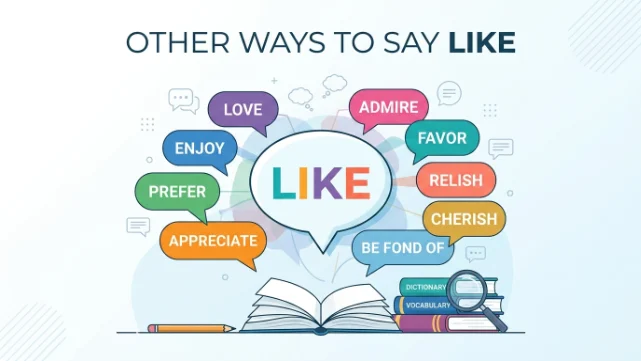
Looking for alternatives to “like”? Here are 5 top options: such as, for instance, similar to, comparable to, and akin to. Each works in different contexts from professional writing to everyday conversation.
The word “like” is one of the most versatile and frequently used words in English. We use it to compare, to give examples, to express preference, and sometimes even as a filler word. But overusing “like” can make your speech sound repetitive, informal, or even hesitant.
Learning alternatives to “like” will help you express excitement in English with greater clarity, add precision to your comparisons, and sound more professional in both spoken and written communication. This guide gives you 30 powerful alternatives that will elevate your English instantly.
Quick Categories
Formal Alternatives to “Like”
- Such as
- For instance
- As
- In the manner of
Casual Alternatives
- Sort of
- Kind of
- Around
- Roughly
Professional Alternatives
- Similar to
- Comparable to
- Analogous to
- Consistent with
Informal Expressions
- Just like
- The same as
- No different than
- Almost like
Pro Tip: Replace vague filler “like” with precise phrases. Instead of “It’s like a dream,” try “It resembles a dream” or “It feels dreamlike.”
Common Mistakes Using “Like”
- Using “like” as a filler in every sentence
- ❌ “I was, like, really surprised, like, by the news.”
- ✅ “I was really surprised by the news.”
- Confusing “like” with “as” in comparisons
- ❌ “She runs like a professional athlete does.”
- ✅ “She runs as a professional athlete does.” (when followed by clause)
- Overusing “like” to give examples
- ❌ “We need supplies like pens, paper, and folders.”
- ✅ “We need supplies such as pens, paper, and folders.” (more formal)
- Using “like” to mean “approximately” in formal writing
- ❌ “The project will take like 3 months.”
- ✅ “The project will take approximately 3 months.”
- Misplacing “like” in comparison structures
- ❌ “He acts like a child sometimes.”
- ✅ “He sometimes acts like a child.” (better placement)
What Does “Like” Mean?
“Like” is a preposition, verb, and conjunction. As a preposition, it means “similar to” or “in the same way as.” As a verb, it means “to find pleasant or agreeable.” As a conjunction (informal), it means “in the same way that.”
Example Sentence (preposition): “She sings like a professional.”
When to Use “Like”
Common contexts:
- Making comparisons
- Giving examples
- Expressing preferences
- Approximating quantities
- Describing similarities
Spoken vs Written:
- Spoken: Very common, often as filler
- Written: Acceptable but can be vague; stronger alternatives exist
Formal vs Informal:
- Formal: Use “such as,” “for example,” “similar to”
- Informal: Use “like” freely but avoid overuse
“Replacing filler ‘like’ with intentional alternatives instantly boosts your credibility.”
Is It Professional or Polite to Say “Like”?
Polite? ✔️ Yes—it’s generally neutral.
Professional? ❌ No (in most cases)—it’s too casual for formal reports, proposals, or client communication.
Business-style example:
- ❌ “Our strategy is like our competitor’s.”
- ✅ “Our strategy is comparable to our competitor’s.”
Pros and Cons of Using “Like”
Pros:
- Simple and universally understood
- Natural in casual conversation
- Versatile across many uses
- Quick and easy to say
Cons:
- Overused as a filler, weakening impact
- Vague and imprecise in professional contexts
- Can sound childish or uncertain
- Not suitable for academic or formal writing
Other Ways to Say “Like” (With Examples)
These alternatives will help you sound more fluent, confident, and natural in different situations. Use them according to tone, context, and audience to express similarity, give examples, or show preference.
1. Phrase: Such as
Meaning: Used to introduce specific examples.
Explanation: The formal, standard way to give examples.
Example Sentence: “We offer many services, such as consulting and training.”
Best Use: Formal writing
Worst Use: Casual speech
Tone: Professional, precise
Context Variability: Professional / written
2. Phrase: For instance
Meaning: As an example.
Explanation: Clear and explicit way to illustrate a point.
Example Sentence: “Several countries, for instance, France and Italy, have adopted this policy.”
Best Use: Explanations
Worst Use: Quick conversation
Tone: Academic, formal
Context Variability: Professional / written
3. Phrase: Similar to
Meaning: Having qualities in common.
Explanation: Direct comparison highlighting shared traits.
Example Sentence: “Our approach is similar to theirs, but we focus on sustainability.”
Best Use: Comparisons
Worst Use: Vague contexts
Tone: Analytical, neutral
Context Variability: Professional / casual
4. Phrase: Comparable to
Meaning: Worth comparing; similar in degree or quality.
Explanation: Suggests equivalence or parity.
Example Sentence: “This model’s performance is comparable to the leading brand.”
Best Use: Professional analysis
Worst Use: Personal opinions
Tone: Measured, formal
Context Variability: Professional / written
5. Phrase: Akin to
Meaning: Of a similar character or kind.
Explanation: Formal, slightly literary way to say “similar to.”
Example Sentence: “His leadership style is akin to a mentor rather than a boss.”
Best Use: Formal descriptions
Worst Use: Everyday chat
Tone: Sophisticated, elevated
Context Variability: Professional / written
6. Phrase: Sort of
Meaning: To some extent; somewhat.
Explanation: Casual way to express approximation or hesitation.
Example Sentence: “I’m sort of tired, but I can still work.”
Best Use: Casual speech
Worst Use: Professional writing
Tone: Relaxed, informal
Context Variability: Casual / spoken
7. Phrase: Kind of
Meaning: Somewhat; rather.
Explanation: Similar to “sort of,” used for hedging.
Example Sentence: “It’s kind of complicated to explain.”
Best Use: Informal conversation
Worst Use: Formal documents
Tone: Casual, hesitant
Context Variability: Casual / spoken
8. Phrase: Around
Meaning: Approximately; about.
Explanation: Used for estimating numbers or time.
Example Sentence: “We’ll need around 50 participants for the study.”
Best Use: Informal estimates
Worst Use: Exact figures
Tone: Neutral, conversational
Context Variability: Casual / spoken
9. Phrase: Roughly
Meaning: Approximately; not exactly.
Explanation: Similar to “around” but implies less precision.
Example Sentence: “The project will cost roughly $10,000.”
Best Use: Estimates
Worst Use: Formal reports
Tone: Practical, informal
Context Variability: Casual / professional
10. Phrase: As
Meaning: In the role of; in the same way as.
Explanation: Formal alternative when followed by a clause.
Example Sentence: “She works as a consultant for the firm.”
Best Use: Formal comparisons
Worst Use: Casual filler
Tone: Professional, precise
Context Variability: Professional / written
“Your choice of comparison word shapes how people perceive your professionalism.”
11. Phrase: In the manner of
Meaning: In a style similar to.
Explanation: Highly formal and descriptive.
Example Sentence: “The building was designed in the manner of classical architecture.”
Best Use: Academic descriptions
Worst Use: Daily speech
Tone: Formal, descriptive
Context Variability: Professional / written
12. Phrase: Resembling
Meaning: Having a similarity to.
Explanation: Active verb form for comparison.
Example Sentence: “Her painting is resembling a famous masterpiece.”
Best Use: Visual descriptions
Worst Use: Abstract concepts
Tone: Analytical, precise
Context Variability: Professional / casual
13. Phrase: Parallel to
Meaning: Similar and occurring at the same time.
Explanation: Emphasizes correspondence or alignment.
Example Sentence: “Our findings are parallel to those of the earlier study.”
Best Use: Research comparisons
Worst Use: Emotional contexts
Tone: Academic, formal
Context Variability: Professional / written
14. Phrase: Equivalent to
Meaning: Equal in value, amount, or meaning.
Explanation: Indicates exact equality.
Example Sentence: “One dollar is equivalent to about 0.85 euros.”
Best Use: Quantitative comparisons
Worst Use: Subjective opinions
Tone: Precise, formal
Context Variability: Professional / written
15. Phrase: Analogous to
Meaning: Similar in certain respects.
Explanation: Often used in scientific or conceptual comparisons.
Example Sentence: “The brain is analogous to a computer in many ways.”
Best Use: Technical explanations
Worst Use: Simple conversation
Tone: Intellectual, formal
Context Variability: Professional / written
16. Phrase: Consistent with
Meaning: In agreement or harmony with.
Explanation: Shows alignment between two things.
Example Sentence: “The results are consistent with our initial hypothesis.”
Best Use: Research and data
Worst Use: Personal anecdotes
Tone: Formal, reliable
Context Variability: Professional / written
17. Phrase: Just like
Meaning: Exactly similar to.
Explanation: Emphasizes direct comparison.
Example Sentence: “She dances just like her mother.”
Best Use: Emotional comparisons
Worst Use: Formal writing
Tone: Warm, informal
Context Variability: Casual / spoken
18. Phrase: The same as
Meaning: Identical to.
Explanation: Strongest comparison, implying exactness.
Example Sentence: “My opinion is the same as yours.”
Best Use: Affirming agreement
Worst Use: Vague similarities
Tone: Direct, neutral
Context Variability: Professional / casual
19. Phrase: No different than
Meaning: Not any different from.
Explanation: Emphasizes lack of distinction.
Example Sentence: “This approach is no different than the previous one.”
Best Use: Asserting similarity
Worst Use: Delicate comparisons
Tone: Blunt, casual
Context Variability: Informal / spoken
20. Phrase: Almost like
Meaning: Very similar but not exactly.
Explanation: Expresses near-similarity.
Example Sentence: “The texture is almost like velvet.”
Best Use: Describing sensations
Worst Use: Technical precision
Tone: Descriptive, casual
Context Variability: Casual / spoken
21. Phrase: In the same way
Meaning: In an identical manner.
Explanation: Formal way to draw parallel actions.
Example Sentence: “In the same way, we can apply this principle to marketing.”
Best Use: Logical arguments
Worst Use: Brief comments
Tone: Structured, formal
Context Variability: Professional / written
22. Phrase: Along the lines of
Meaning: Similar in type or direction.
Explanation: Casual expression for approximation.
Example Sentence: “I was thinking of something along the lines of a workshop.”
Best Use: Brainstorming
Worst Use: Formal proposals
Tone: Suggestive, informal
Context Variability: Casual / spoken
23. Phrase: Reminiscent of
Meaning: Evoking memories of something similar.
Explanation: Emotional, nostalgic comparison.
Example Sentence: “The aroma is reminiscent of fresh-baked bread.”
Best Use: Descriptive writing
Worst Use: Business reports
Tone: Poetic, evocative
Context Variability: Professional / casual
“Precise alternatives to ‘like’ transform vague statements into compelling arguments.”
24. Phrase: Approximating
Meaning: Close in value or form but not exact.
Explanation: Formal verb for estimation.
Example Sentence: “We are approximating the final cost at $5,000.”
Best Use: Budgeting
Worst Use: Casual chat
Tone: Analytical, formal
Context Variability: Professional / written
25. Phrase: Bearing resemblance to
Meaning: Having a likeness to.
Explanation: More formal than “resembling.”
Example Sentence: “The design bears resemblance to mid-century modern style.”
Best Use: Art and design critiques
Worst Use: Everyday talk
Tone: Formal, descriptive
Context Variability: Professional / written
26. Phrase: In common with
Meaning: Sharing characteristics with.
Explanation: Highlights shared attributes.
Example Sentence: “In common with other startups, we value agility.”
Best Use: Group comparisons
Worst Use: Simple statements
Tone: Neutral, professional
Context Variability: Professional / written
27. Phrase: Similarly
Meaning: In a similar way.
Explanation: Adverb for comparing actions or ideas.
Example Sentence: “Similarly, the second phase will focus on testing.”
Best Use: Connecting ideas
Worst Use: Describing objects
Tone: Logical, formal
Context Variability: Professional / written
28. Phrase: In a similar vein
Meaning: Along the same lines; related to.
Explanation: Idiomatic phrase for connected ideas.
Example Sentence: “In a similar vein, we should consider customer feedback.”
Best Use: Expanding points
Worst Use: Short replies
Tone: Engaging, formal
Context Variability: Professional / written
29. Phrase: As if
Meaning: As though; in a way that suggests.
Explanation: Used for hypothetical comparisons.
Example Sentence: “He acted as if he knew the answer.”
Best Use: Describing behavior
Worst Use: Formal reports
Tone: Imaginative, casual
Context Variability: Casual / spoken
30. Phrase: Equal to
Meaning: The same in value or quantity.
Explanation: Direct quantitative comparison.
Example Sentence: “The benefits are equal to the costs in this scenario.”
Best Use: Financial analysis
Worst Use: Personal traits
Tone: Precise, formal
Context Variability: Professional / written
31. Phrase: Like unto
Meaning: Similar to (archaic, poetic).
Explanation: Very formal, biblical or literary tone.
Example Sentence: “The city is like unto a paradise.”
Best Use: Creative writing
Worst Use: Modern business
Tone: Poetic, archaic
Context Variability: Creative / written
32. Phrase: The way
Meaning: In the manner that.
Explanation: Focuses on process or method.
Example Sentence: “She handled the situation the way a leader would.”
Best Use: Behavioral comparisons
Worst Use: Object comparisons
Tone: Descriptive, neutral
Context Variability: Professional / casual
“Mastering alternatives to common words is the hallmark of an advanced English speaker.”
Mini Quiz / Self-Check
Question 1: Which phrase is most appropriate for a formal business report when giving examples?
- A) Like
- B) Such as
- C) Kind of
- D) Sort of
Answer: B) Such as
Question 2: You want to say two products are very similar in quality. Which is most professional?
- A) They’re like each other.
- B) They’re comparable to each other.
- C) They’re sort of the same.
- D) They’re just like each other.
Answer: B) They’re comparable to each other.
Question 3: Which alternative is best for approximating a number in casual conversation?
- A) Roughly
- B) Equivalent to
- C) Consistent with
- D) Analogous to
Answer: A) Roughly
Question 4: You’re giving a presentation and want to avoid filler “like.” Which word should you avoid as a filler?
- A) Such as
- B) Similarly
- C) Like (when used unnecessarily)
- D) For instance
Answer: C) Like (when used unnecessarily)
Comparison Table: Top Alternatives
| Phrase | Tone | Best Use |
|---|---|---|
| Such as | Professional | Giving examples |
| For instance | Formal | Illustrating points |
| Similar to | Analytical | General comparisons |
| Comparable to | Measured | Quality comparisons |
| Akin to | Sophisticated | Formal descriptions |
| Sort of | Casual | Hedging in speech |
| Around | Neutral | Estimating numbers |
| As | Professional | Role comparisons |
| Resembling | Descriptive | Visual likeness |
| Consistent with | Formal | Data alignment |
FAQs
1. Is it unprofessional to use “like” in emails?
Using “like” to compare or give examples in emails is acceptable in informal internal messages but avoid it in formal external correspondence. Instead, use “such as” or “similar to” for a professional tone.
2. How can I stop using “like” as a filler?
Practice pausing instead of saying “like.” Record yourself speaking and identify where you use it. Replace with silence or use more precise words like “um” (but sparingly). Building vocabulary alternatives also reduces filler reliance.
3. What’s the difference between “like” and “as” in comparisons?
Use “like” before a noun or pronoun (“She runs like a cheetah”). Use “as” before a clause with a verb (“She runs as a cheetah does”). In formal writing, “as” is preferred for clauses.
4. Can I use “like” in academic writing?
Generally, no. Academic writing prefers “such as,” “for example,” or “similar to.” Use “like” only in informal parts like personal anecdotes if permitted.
5. What’s the best alternative to “like” when estimating numbers?
Use “approximately,” “roughly,” or “around” in spoken English. For formal documents, “approximately” or “an estimated” is best.
Conclusion
Mastering alternatives to “like” will immediately improve your clarity and professionalism. From formal “such as” to casual “sort of,” each alternative gives you the flexibility to match your tone to any situation. Stop relying on this overused word and start expressing yourself with precision.
Practice using one or two new alternatives each day maybe start with “similar to” and “such as.” Soon, you’ll naturally choose the right word without thinking. Your English will sound more sophisticated, and people will take you more seriously.