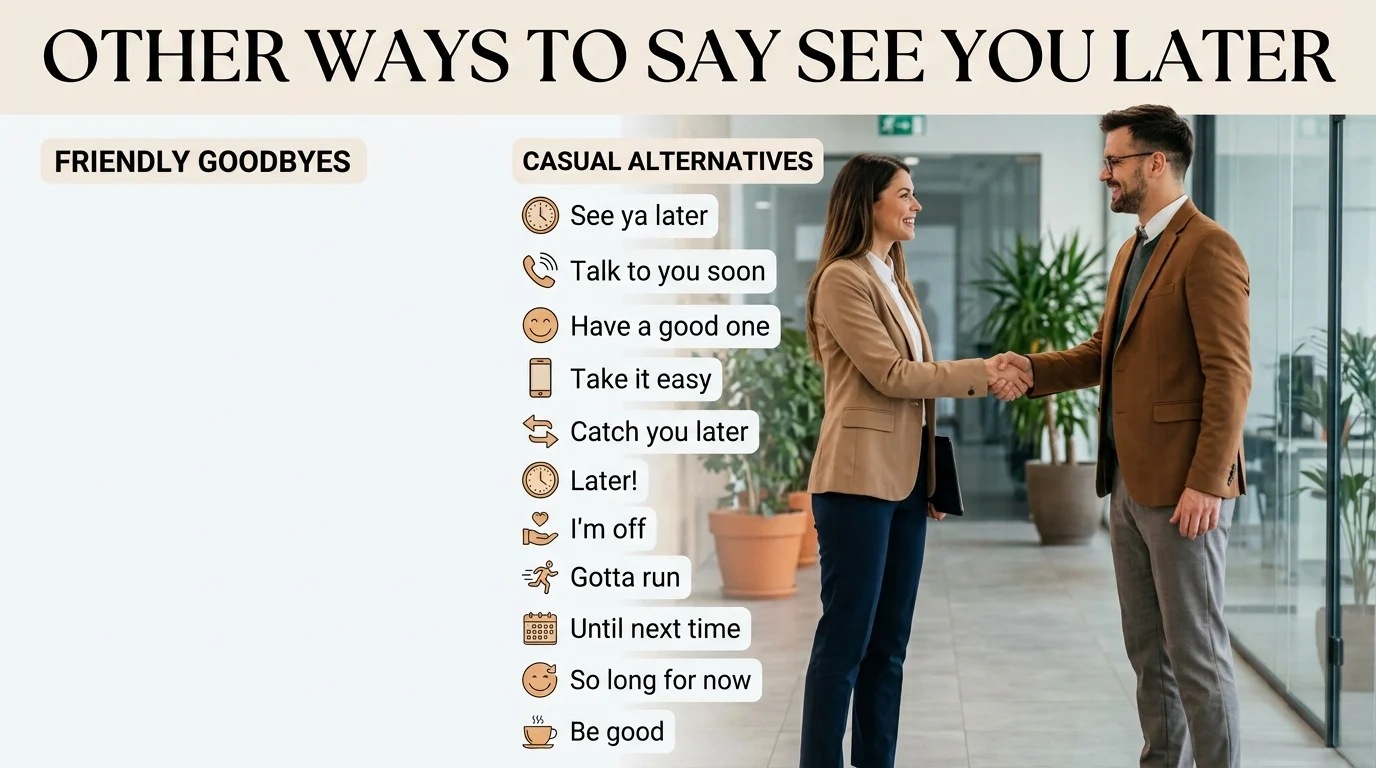
Looking for alternatives to “see you later”? Here are 5 powerful options: catch you later, until next time, see you soon, farewell, and take care. These alternatives help you say goodbye more naturally in different contexts.
“See you later” is one of the most common parting phrases in English, but using it repeatedly can make your goodbyes feel routine and impersonal. Whether you’re ending a business meeting, saying goodbye to friends, or concluding a professional call, knowing alternatives to “see you later” will make your farewells more memorable and appropriate.
Learning to express farewells in various ways helps you sound more fluent and culturally aware. By expanding your vocabulary with synonyms, you can express excitement in English more effectively and adapt your tone to any situation. Mastering these alternatives will transform your goodbyes from basic to brilliant.
Quick Categories
Formal Alternatives to “See You Later”
- Until we meet again
- Farewell
- I look forward to our next meeting
- Until next time
- Goodbye for now
Casual Alternatives
- Catch you later
- See you soon
- Take care
- See you around
- Later
Professional Alternatives
- Looking forward to seeing you again
- Until our next discussion
- I’ll see you at the next meeting
- See you on [day/time]
- Until then
Informal Expressions
- Later gator
- See ya
- Peace out
- Catch you on the flip side
- Toodles
What Does “See You Later” Mean?
See you later means an informal farewell expression indicating you expect to see the person again at some unspecified future time. It’s a friendly, casual way to end a conversation while acknowledging the possibility or expectation of future interaction.
As a phrase, it’s typically used as an interjection at the end of conversations. It can be shortened to “see ya later” or simply “later” in very casual settings.
Example: “Thanks for the coffee, Sarah. See you later!”
When to Use “See You Later”
- Social gatherings – saying goodbye to friends and acquaintances
- Workplace settings – ending casual conversations with colleagues
- Online meetings – concluding video calls with team members
- Service interactions – parting with shop assistants, waitstaff, etc.
- Family situations – leaving relatives after a visit
Spoken vs Written
- Spoken: Used frequently in daily conversation and phone calls
- Written: Appears in emails, messages, and social media comments
Formal vs Informal
- Formal: Best avoided in business correspondence; use “until next time” instead
- Informal: Perfect for daily conversations and friendly messages
Is It Professional or Polite to Say “See You Later”?
Saying “see you later” is generally polite but can be too casual for professional situations. In formal business contexts, it’s better to use more specific alternatives that demonstrate appropriate workplace communication.
Professional Example: “I look forward to our next meeting on Thursday.”
| Aspect | Rating |
|---|---|
| Polite? | ✔️ Yes |
| Professional? | ❌ No (in most formal cases) |
Common Mistakes Using “See You Later”
1. Using it when you won’t actually see the person later
Mistake: “See you later” (to someone you’ll never see again)
Correction: “It was lovely meeting you. Take care.”
2. Being too informal in professional contexts
Mistake: “Catch you later!” (ending a client call)
Correction: “I look forward to speaking with you again soon.”
3. Not varying your farewells
Mistake: Using “see you later” with everyone in all situations
Correction: Choose context-appropriate alternatives for better communication.
4. Using it when you don’t know the person well
Mistake: “See you later!” (to a business acquaintance you just met)
Correction: “It was a pleasure meeting you. Until next time.”
5. Saying it too abruptly
Mistake: Just “see you later” without any warm-up
Correction: “Thanks for your time. See you later.”
Pros and Cons of Using “See You Later”
Pros
- Simple and natural – Easy to use in most situations
- Friendly tone – Creates warmth and approachability
- Common usage – Widely recognized in English-speaking regions
- Versatile – Works in many casual and semi-formal contexts
Cons
- Too informal for work – May not be suitable for professional contexts
- Overused – Lacks personality and impact
- Vague – Doesn’t specify when you’ll meet again
- Not suitable for formal writing – Can sound unprofessional in official correspondence
Other Ways to Say “See You Later” (With Examples)
These alternatives will help you sound more fluent, confident, and natural in different situations. Use them according to tone, context, and audience to express excitement, admiration, or approval.
Formal Alternatives
1. Phrase: Until we meet again
Meaning: A formal farewell indicating hope for future encounters.
Explanation: Used in formal, often emotionally significant situations.
Example: “Thank you for your hospitality. Until we meet again.”
Best Use: Formal farewells
Worst Use: Daily casual conversations
Tone: Formal, sincere
Context Variability: Professional: “Until we meet again at the conference.”
2. Phrase: Farewell
Meaning: A formal expression of goodbye.
Explanation: Classic formal farewell often used for longer partings.
Example: “Farewell, and may your journey be successful.”
Best Use: Departures, formal events
Worst Use: Quick goodbyes
Tone: Formal, dignified
Context Variability: Formal writing: “I bid you farewell.”
3. Phrase: I look forward to our next meeting
Meaning: Expressing anticipation for future professional interaction.
Explanation: Professional way to end a meeting or conversation.
Example: “Thank you for the productive discussion. I look forward to our next meeting.”
Best Use: Business contexts
Worst Use: Personal settings
Tone: Professional, eager
Context Variability: Professional: “I look forward to our next meeting in March.”
4. Phrase: Until next time
Meaning: A polite way to end an interaction, implying future contact.
Explanation: Neutral, versatile formal farewell.
Example: “Excellent presentation. Until next time.”
Best Use: Professional and social events
Worst Use: Close friends
Tone: Formal, polite
Context Variability: Professional: “Until next time, take care.”
5. Phrase: Goodbye for now
Meaning: A temporary farewell.
Explanation: Formal yet approachable way to say goodbye.
Example: “It was wonderful chatting with you. Goodbye for now.”
Best Use: Meetings, events
Worst Use: Casual chats
Tone: Formal, temporary
Context Variability: Professional: “Goodbye for now. I’ll be in touch.”
6. Phrase: Until we speak again
Meaning: A formal way to end a conversation, expecting future communication.
Explanation: Often used at the end of calls or meetings.
Example: “Thank you for your time. Until we speak again.”
Best Use: Telephone conversations
Worst Use: Text messages
Tone: Formal, anticipatory
Context Variability: Professional: “Until we speak again, good luck with the project.”
7. Phrase: I bid you farewell
Meaning: A very formal expression of goodbye.
Explanation: Used in highly formal or ceremonial contexts.
Example: “I bid you farewell and wish you every success.”
Best Use: Ceremonial occasions
Worst Use: Everyday conversation
Tone: Very formal, theatrical
Context Variability: Formal: “I bid you farewell as you begin this new chapter.”
Pro Tips Box for Formal Alternatives
Use formal alternatives when ending business emails, professional meetings, or any situation requiring polished communication. These expressions demonstrate sophistication and cultural awareness in professional settings.
Casual Alternatives
8. Phrase: Catch you later
Meaning: A casual way to say goodbye with the expectation of meeting again.
Explanation: Very common informal alternative to “see you later.”
Example: “Great catching up! Catch you later.”
Best Use: Friends, colleagues
Worst Use: Formal business situations
Tone: Casual, friendly
Context Variability: Casual: “Catch you later, man!”
9. Phrase: See you soon
Meaning: Expressing the expectation of meeting in the near future.
Explanation: Friendlier and more specific than “see you later.”
Example: “Looking forward to next weekend. See you soon!”
Best Use: Friends, family
Worst Use: Professional emails
Tone: Warm, anticipatory
Context Variability: Casual: “See you soon, I hope!”
10. Phrase: Take care
Meaning: A warm farewell expressing concern for someone’s wellbeing.
Explanation: Can be used in both casual and semi-formal situations.
Example: “It was great to see you. Take care!”
Best Use: Almost any casual setting
Worst Use: Professional client calls
Tone: Warm, caring
Context Variability: Casual: “Take care of yourself.”
11. Phrase: See you around
Meaning: A casual goodbye, especially when you expect to see someone informally.
Explanation: Used for casual meetups in shared spaces.
Example: “I’ll probably see you at the gym. See you around!”
Best Use: Shared spaces, neighborhoods
Worst Use: Formal settings
Tone: Casual, informal
Context Variability: Casual: “See you around the office.”
12. Phrase: Later
Meaning: A very casual shortened form of “see you later.”
Explanation: Extremely informal, often used among close friends.
Example: “Later! Have a good one.”
Best Use: Close friends
Worst Use: Professional environments
Tone: Very casual, friendly
Context Variability: Casual: “Later, dude!”
13. Phrase: Goodbye
Meaning: The standard, neutral farewell.
Explanation: Works in most situations but can feel formal or cold.
Example: “Goodbye! Thanks for everything.”
Best Use: General situations
Worst Use: Close friends (too formal)
Tone: Neutral, standard
Context Variability: Casual: “Goodbye, everyone!”
14. Phrase: Bye for now
Meaning: A friendly but temporary farewell.
Explanation: Casual and warm, indicating you’ll connect again.
Example: “I’ve got to go. Bye for now!”
Best Use: Friendly conversations
Worst Use: Business meetings
Tone: Friendly, warm
Context Variability: Casual: “Bye for now, I’ll call you later.”
Pro Tips Box for Casual Alternatives
Use casual alternatives when saying goodbye to friends, family, or colleagues you know well. These expressions make your farewells sound more natural and help you express excitement in English with authentic warmth.
Professional Alternatives
15. Phrase: Looking forward to seeing you again
Meaning: Expressing positive anticipation for future professional interaction.
Explanation: Professional, warm, and appropriate for business contexts.
Example: “Thank you for the meeting. Looking forward to seeing you again.”
Best Use: Business meetings
Worst Use: Personal relationships
Tone: Professional, positive
Context Variability: Professional: “Looking forward to seeing you again at the conference.”
16. Phrase: Until our next discussion
Meaning: A professional way to end a meeting or call.
Explanation: Formal and appropriate for business contexts.
Example: “Great insights. Until our next discussion.”
Best Use: Professional meetings
Worst Use: Social settings
Tone: Formal, professional
Context Variability: Professional: “Until our next discussion, please review the materials.”
17. Phrase: I’ll see you at the next meeting
Meaning: A specific professional farewell referencing a known future event.
Explanation: Clear and professional when a future meeting is scheduled.
Example: “Let’s wrap up for today. I’ll see you at the next meeting.”
Best Use: Scheduled professional events
Worst Use: Social situations
Tone: Professional, specific
Context Variability: Professional: “I’ll see you at the next meeting on Friday.”
18. Phrase: See you on [day/time]
Meaning: A professional farewell specifying the next meeting time.
Explanation: Effective for planning and accountability.
Example: “Excellent work. See you on Thursday at 10 AM.”
Best Use: Scheduled appointments
Worst Use: Social events
Tone: Professional, organized
Context Variability: Professional: “See you on Monday morning.”
19. Phrase: Until then
Meaning: A professional way to end a discussion with future context.
Explanation: Often used in emails and formal communications.
Example: “I’ll consider your suggestions. Until then.”
Best Use: Professional communications
Worst Use: Casual conversations
Tone: Formal, professional
Context Variability: Professional: “Until then, I’ll proceed with the plan.”
20. Phrase: Have a good day
Meaning: A polite, professional way to end an interaction.
Explanation: Professional and widely used in service and business contexts.
Example: “Thank you for your time. Have a good day.”
Best Use: Customer service, meetings
Worst Use: Formal letters
Tone: Professional, polite
Context Variability: Professional: “Have a good day, and thank you for your business.”
21. Phrase: Have a great week
Meaning: A professional farewell extending across the week.
Explanation: Warm and professional for Friday or late-week conversations.
Example: “Great discussing this. Have a great week.”
Best Use: Friday meetings
Worst Use: Monday conversations
Tone: Professional, warm
Context Variability: Professional: “Have a great week, and I’ll see you Friday.”
22. Phrase: Thank you and goodbye
Meaning: A professional farewell that combines gratitude with parting.
Explanation: Polite and appropriate for business settings.
Example: “Thank you for your support. Thank you and goodbye.”
Best Use: Professional closings
Worst Use: Casual settings
Tone: Professional, grateful
Context Variability: Professional: “Thank you and goodbye for now.”
Pro Tips Box for Professional Alternatives
In workplace settings, choose specific farewells that acknowledge the professional relationship. Phrases like “looking forward to seeing you again” or “until our next discussion” demonstrate appropriate professional reaction phrases and emotional intelligence.
Informal Expressions
23. Phrase: Later gator
Meaning: A playful, rhyming farewell phrase.
Explanation: Very informal, often used among close friends.
Example: “After while, crocodile! Later gator!”
Best Use: Close friends
Worst Use: Any professional setting
Tone: Playful, informal
Context Variability: Casual: “Later gator! See you tomorrow.”
24. Phrase: See ya
Meaning: A very casual shortened version of “see you.”
Explanation: Extremely informal, common in texting and daily speech.
Example: “See ya! I’ll message you later.”
Best Use: Friends, family
Worst Use: Formal settings
Tone: Very casual, friendly
Context Variability: Casual: “See ya at the game!”
25. Phrase: Peace out
Meaning: A very informal way to say goodbye, popular in some social circles.
Explanation: Casual and sometimes humorous.
Example: “Great hanging out. Peace out!”
Best Use: Young friends, casual settings
Worst Use: Professional environments
Tone: Casual, trendy
Context Variability: Casual: “Peace out, everyone!”
26. Phrase: Catch you on the flip side
Meaning: A retro, informal way of saying “see you later.”
Explanation: Playful and somewhat dated but still used casually.
Example: “I’m heading out. Catch you on the flip side!”
Best Use: Friends
Worst Use: Professional settings
Tone: Playful, informal
Context Variability: Casual: “Catch you on the flip side, man!”
27. Phrase: Toodles
Meaning: A light-hearted, slightly whimsical way to say goodbye.
Explanation: Very informal and playful.
Example: “Toodles! Have a wonderful day.”
Best Use: Friends, family
Worst Use: Professional contexts
Tone: Playful, whimsical
Context Variability: Casual: “Toodles, see you later!”
28. Phrase: I’m off
Meaning: A casual way to announce you’re leaving.
Explanation: Suggests departure without a specific farewell.
Example: “I’m off to work! See you later.”
Best Use: Friends, family
Worst Use: Professional settings
Tone: Casual, abrupt
Context Variability: Casual: “I’m off, catch you later.”
29. Phrase: Smell you later
Meaning: A humorous, very informal way to say goodbye.
Explanation: Playful and often used among close friends.
Example: “Smell you later! Don’t forget to call.”
Best Use: Close friends
Worst Use: Any formal situation
Tone: Humorous, very casual
Context Variability: Casual: “Smell you later, buddy!”
30. Phrase: Gotta go
Meaning: A very casual way to end a conversation and leave.
Explanation: Indicates urgency or need to depart.
Example: “Gotta go! My meeting starts in five minutes.”
Best Use: Quick goodbyes
Worst Use: Professional emails
Tone: Casual, urgent
Context Variability: Casual: “Gotta go, call you later!”
Pro Tips Box for Informal Expressions
Use informal expressions only with close friends and in very relaxed social settings. These alternatives to “see you later” add personality to your communication and help you express excitement in English with genuine authenticity.
Comparison Table: Top Alternatives
| Phrase | Tone | Best Use |
|---|---|---|
| Until we meet again | Formal | Formal farewells |
| Looking forward to seeing you again | Professional | Business meetings |
| Catch you later | Casual | Friends, colleagues |
| Take care | Warm | Almost any casual setting |
| Farewell | Formal | Departures, events |
| Until next time | Professional | Events, meetings |
| See you soon | Casual | Friends, family |
| Later | Very Casual | Close friends |
| Have a good day | Professional | Customer service |
| I bid you farewell | Very formal | Ceremonial occasions |
Mini Quiz / Self-Check
1. Which phrase would be most appropriate in a formal business proposal conclusion?
a) Catch you later
b) I look forward to our next meeting
c) See you around
d) Later gator
Answer: b) I look forward to our next meeting
2. Which phrase is too informal for an official company event?
a) Until we meet again
b) Farewell
c) See ya
d) Until next time
Answer: c) See ya
3. Which phrase suggests you expect to see someone in a shared workspace?
a) See you later
b) See you around
c) See you soon
d) Farewell
Answer: b) See you around
4. Which phrase would be most appropriate when ending a client call?
a) Later
b) Peace out
c) Thank you and goodbye
d) Toodles
Answer: c) Thank you and goodbye
FAQs
1. What is the most professional way to say “see you later”?
The most professional alternatives are “I look forward to our next meeting,” “Until we meet again,” and “Until next time.” These phrases demonstrate appropriate workplace communication.
2. Is “see you later” appropriate in professional emails?
It’s best to avoid “see you later” in formal emails. Use alternatives like “I look forward to speaking with you again” or “Until next time” to sound more professional.
3. What does “catch you later” mean?
“Catch you later” is a casual alternative to “see you later,” meaning you’ll connect or meet with someone again at a future, often unspecified time. It’s commonly used among friends and colleagues.
4. How can I say goodbye more professionally?
Use specific professional farewells like “Looking forward to seeing you again,” “Until our next discussion,” or “I’ll see you at the next meeting.” These alternatives demonstrate emotional intelligence in professional reaction phrases.
5. What’s the difference between “see you later” and “see you soon”?
“See you later” is vague about timing, while “see you soon” implies the meeting will happen in the near future. Both are informal expressions in English commonly used in daily conversation.
Conclusion
Expanding your vocabulary with alternatives to “see you later” will significantly enhance your English communication skills. You’ll sound more fluent, professional, and culturally aware in various contexts. The key is understanding the subtle differences in tone and choosing the right expression for each situation.
Remember to practice using these alternatives daily. Pay attention to the context and your audience, and you’ll naturally develop the confidence to choose the most appropriate farewell in any situation. Your English will become more nuanced, sophisticated, and engaging.