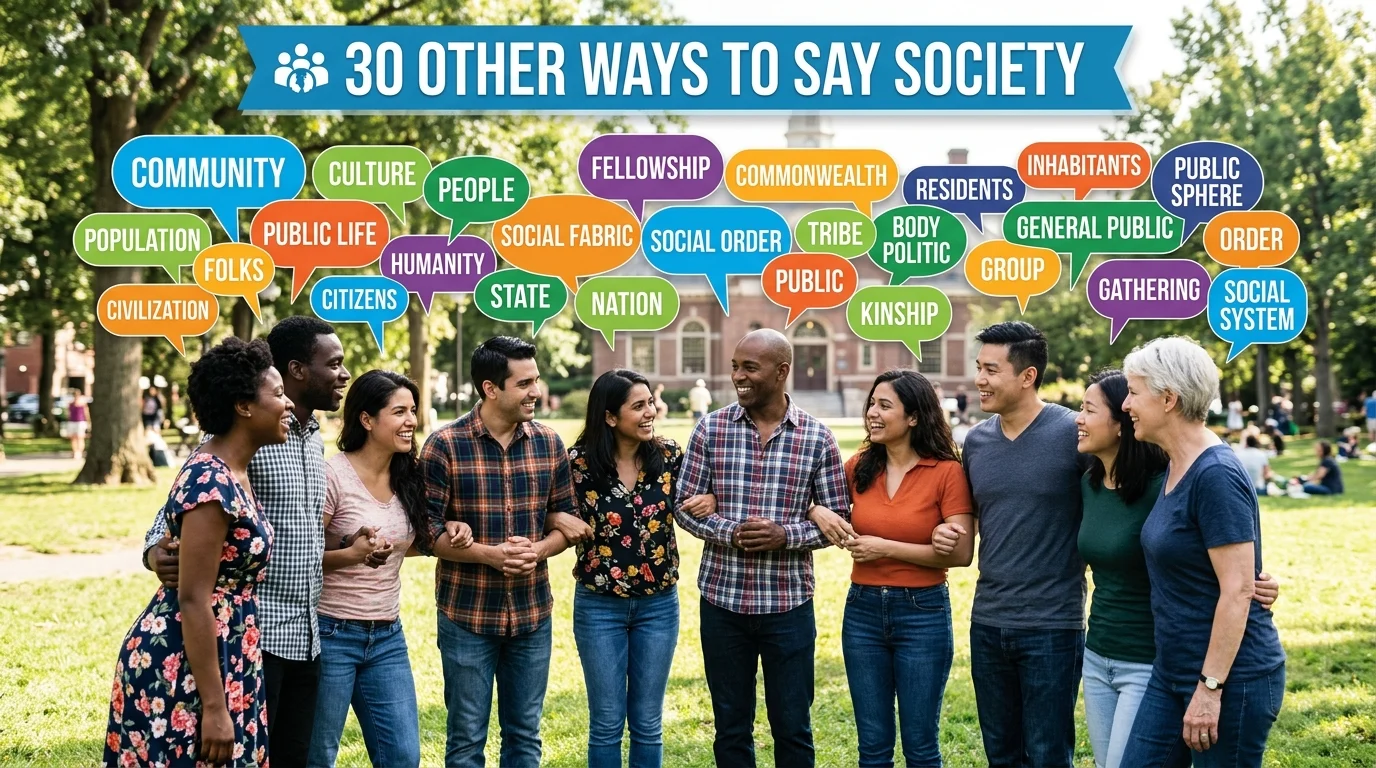
Society refers to a community of people living together or sharing common customs, laws, and organizations. Here are 5 top alternatives: community, civilization, culture, population, public.
The word “society” appears constantly in academic writing, news reports, professional discussions, and everyday conversations. While it’s a fundamental English noun, relying on it too heavily can make your writing sound repetitive and imprecise.
Learning diverse alternatives to society helps you express yourself with greater nuance and sophistication. Whether you’re writing a research paper, giving a presentation, or discussing social issues, having a rich vocabulary of professional reaction phrases and alternatives to society allows you to match your tone perfectly to any context. Let’s explore 30 powerful alternatives that will elevate your English communication.
Quick Categories
Formal Alternatives to “Society”
- Civilization – an advanced stage of social development
- Commonwealth – a political community formed for the common good
- Community – a group sharing common interests or location
- Polity – an organized society with a political structure
- Nation – a large body of people united by common descent or history
Professional/Academic Alternatives
- Population – the inhabitants of a particular place
- Demographic – a particular sector of a population
- Public – the people in general
- Constituency – a body of voters or supporters
- Culture – the customs and achievements of a particular group
Casual/Everyday Alternatives
- People – ordinary individuals
- Folks – informal term for people in general
- Crowd – a large group of people
- Circle – a group connected by shared interests
- Scene – informal for a particular social environment
Descriptive/Contextual Alternatives
- Humanity – all human beings collectively
- Mankind – the human race (dated but still used)
- Citizenry – all citizens of a place
- Inhabitants – people living in a place
- Populace – the general public or common people
Pro Tip: In academic writing, precision matters. Choose “civilization” for historical contexts, “population” for statistical analysis, and “culture” for anthropological discussions.
Common Mistakes Using “Society”
- Using it when you mean “community”
❌ “My local society is very friendly.”
✅ “My local community is very friendly.” - Confusing “society” with “social”
❌ “Society media is popular”
✅ “Social media is popular” - Using it too broadly
❌ “Society believes this is wrong” (who specifically?)
✅ “The general public believes this is wrong” - Forgetting the collective noun agreement
❌ “Society are responsible”
✅ “Society is responsible” (in American English) - Using it when you mean “organization”
❌ “I joined a photography society” is correct, but “I joined a photography club/association” may be more specific
What Does “Society” Mean?
“Society” is a noun referring to a group of people who share a common culture, territory, or set of institutions. It can also mean an organization or club formed for a particular purpose.
Example Sentence: “Modern society faces numerous challenges related to technology and mental health.”
When to Use “Society”
Common Contexts:
- Academic writing – sociology, history, political science
- News reporting – discussing social trends and issues
- Professional discussions – corporate social responsibility
- Philosophical debates – exploring social structures
- Everyday conversation – discussing community issues
Spoken vs. Written:
- Spoken: Common in formal speeches and discussions
- Written: Frequent in essays, reports, and articles
Formal vs. Informal:
- Formal: Appropriate in academic and professional writing
- Informal: Can sound too academic in casual conversation
“The words you choose to describe groups reflect how you understand human connection.”
Is It Professional or Polite to Say “Society”?
Polite? ✔️ Yes – It’s neutral and respectful.
Professional? ✔️ Yes, but with caveats – It’s professional in academic and formal contexts but can be vague in business settings.
Business Example: “Our company contributes positively to society through sustainable practices.”
Better option: “Our company contributes positively to local communities through sustainable practices.”
Pros and Cons of Using “Society”
Pros:
- Established term – universally understood
- Academic credibility – appropriate in scholarly work
- Neutral tone – neither too formal nor too casual
- Broad coverage – encompasses many meanings
Cons:
- Can be vague – lacks specificity
- Overused in certain fields – sounds repetitive
- May sound pretentious – in casual conversation
- Western-centric bias – sometimes carries cultural assumptions
“Precision in language shows precision in thought. Don’t settle for ‘society’ when a more specific term exists.”
Other Ways to Say “Society” (With Examples)
These alternatives will help you sound more fluent, confident, and natural in different situations. Use them according to tone, context, and audience to express social concepts with nuance.
1. Phrase: Community
Meaning: A group of people sharing a common location, interest, or identity.
Explanation: More personal and specific than “society.”
Example Sentence: “The local community came together to support the food bank.”
Best Use: Local contexts
Worst Use: Global discussions
Tone: Personal, Connected
Context Variability: Professional – “Our business serves the surrounding community.” Casual – “I love my neighborhood community.”
2. Phrase: Civilization
Meaning: An advanced state of human society with developed culture and institutions.
Explanation: Implies historical and cultural achievement.
Example Sentence: “Ancient civilizations developed complex systems of governance.”
Best Use: Historical contexts
Worst Use: Everyday conversation
Tone: Academic, Historical
Context Variability: Professional – “The study of civilization reveals patterns of human development.”
3. Phrase: Culture
Meaning: The customs, arts, and achievements of a particular group.
Explanation: Focuses on shared values and practices.
Example Sentence: “Corporate culture affects employee satisfaction.”
Best Use: Anthropological contexts
Worst Use: Statistical analysis
Tone: Descriptive, Analytical
Context Variability: Professional – “We’re building a culture of innovation.”
4. Phrase: Population
Meaning: The people living in a particular place.
Explanation: Statistical and demographic term.
Example Sentence: “The population of the city has grown rapidly.”
Best Use: Data/statistical contexts
Worst Use: Cultural discussions
Tone: Neutral, Statistical
Context Variability: Professional – “The population survey shows changing trends.”
5. Phrase: Public
Meaning: The people in general.
Explanation: Common in policy and service contexts.
Example Sentence: “Public opinion is divided on the issue.”
Best Use: Policy discussions
Worst Use: Private contexts
Tone: Neutral, Official
Context Variability: Professional – “We must consider public safety.”
6. Phrase: Nation
Meaning: A large body of people united by common descent, history, or culture.
Explanation: Implies political or cultural unity.
Example Sentence: “The nation celebrates its independence day every July.”
Best Use: Political contexts
Worst Use: Local discussions
Tone: Patriotic, Formal
Context Variability: Professional – “The nation’s economy is growing steadily.”
7. Phrase: Humanity
Meaning: All human beings collectively.
Explanation: Universal and philosophical term.
Example Sentence: “Climate change poses a threat to all of humanity.”
Best Use: Global contexts
Worst Use: Local issues
Tone: Philosophical, Universal
Context Variability: Professional – “Our mission serves humanity.”
8. Phrase: Populace
Meaning: The people who live in a particular place.
Explanation: Formal term for the general population.
Example Sentence: “The local populace welcomed the new initiative.”
Best Use: Formal writing
Worst Use: Casual conversation
Tone: Formal, Official
Context Variability: Professional – “The populace has expressed their concerns.”
9. Phrase: Citizenry
Meaning: All citizens of a particular place.
Explanation: Emphasizes political participation and rights.
Example Sentence: “An informed citizenry is essential for democracy.”
Best Use: Political contexts
Worst Use: Non-political settings
Tone: Civic, Democratic
Context Variability: Professional – “We need an engaged citizenry.”
10. Phrase: People
Meaning: Human beings in general or a specific group.
Explanation: The simplest and most versatile alternative.
Example Sentence: “People are becoming more environmentally conscious.”
Best Use: Almost any context
Worst Use: Formal academic writing (sometimes too simple)
Tone: Neutral, Inclusive
Context Variability: Professional – “Our company serves people worldwide.” Casual – “People in my neighborhood are friendly.”
11. Phrase: Commonwealth
Meaning: A political community formed for the common good.
Explanation: Often used for nations or states with shared governance.
Example Sentence: “The Commonwealth of Nations includes 56 member states.”
Best Use: Political/governance contexts
Worst Use: Everyday conversation
Tone: Formal, Political
Context Variability: Professional – “The commonwealth promotes economic cooperation.”
12. Phrase: Polity
Meaning: An organized society with a political structure.
Explanation: Academic term for a political community.
Example Sentence: “The polity evolved from a monarchy to a democracy.”
Best Use: Political science
Worst Use: General discussion
Tone: Academic, Precise
Context Variability: Professional – “The polity must address inequality.”
13. Phrase: Inhabitants
Meaning: People who live in a particular place.
Explanation: Focuses on residence rather than social structures.
Example Sentence: “The island’s inhabitants rely on fishing for survival.”
Best Use: Geographic contexts
Worst Use: Social analysis
Tone: Neutral, Descriptive
Context Variability: Professional – “Local inhabitants are concerned about development.”
14. Phrase: Residents
Meaning: People who live in a particular area.
Explanation: Common in municipal and neighborhood contexts.
Example Sentence: “Residents have formed a neighborhood watch program.”
Best Use: Local contexts
Worst Use: National discussions
Tone: Practical, Local
Context Variability: Professional – “Residents’ feedback is essential.” Casual – “The residents are throwing a party.”
15. Phrase: Denizens
Meaning: Inhabitants or occupants of a place.
Explanation: Literary or formal term for residents.
Example Sentence: “The city’s denizens enjoy a vibrant nightlife.”
Best Use: Literary/written contexts
Worst Use: Technical reports
Tone: Literary, Sophisticated
Context Variability: Professional – “Urban denizens face distinct challenges.”
16. Phrase: Mankind
Meaning: All human beings collectively (dated but used).
Explanation: Historical term often replaced by “humanity” or “humankind.”
Example Sentence: “The invention of electricity changed the course of mankind.”
Best Use: Historical contexts
Worst Use: Contemporary inclusive writing
Tone: Traditional, Historical
Context Variability: Professional – “Mankind has always sought knowledge.”
17. Phrase: Humankind
Meaning: All human beings as a collective.
Explanation: Inclusive alternative to “mankind.”
Example Sentence: “Humankind must work together to address global challenges.”
Best Use: Global contexts
Worst Use: Local discussions
Tone: Inclusive, Global
Context Variability: Professional – “The future of humankind depends on cooperation.”
18. Phrase: Constituency
Meaning: A body of voters or supporters.
Explanation: Political term for a group represented by someone.
Example Sentence: “The politician is listening to her constituency’s concerns.”
Best Use: Political contexts
Worst Use: Social groups
Tone: Political, Representative
Context Variability: Professional – “We serve our constituency with integrity.”
19. Phrase: Demographic
Meaning: A particular sector of a population.
Explanation: Often used in marketing and social research.
Example Sentence: “Our marketing strategy targets the 18-35 demographic.”
Best Use: Market research
Worst Use: General discussion
Tone: Analytical, Statistical
Context Variability: Professional – “We analyzed key demographic trends.”
20. Phrase: Sector
Meaning: A distinct segment of society or the economy.
Explanation: Often used in business and economics.
Example Sentence: “The healthcare sector is growing rapidly.”
Best Use: Economic contexts
Worst Use: Social relationships
Tone: Professional, Segmented
Context Variability: Professional – “The private sector is investing in technology.”
“Great communicators adjust their language to fit the audience, the context, and the message.”
21. Phrase: Folks
Meaning: People in general (informal).
Explanation: Casual and friendly alternative.
Example Sentence: “Folks around here are really friendly.”
Best Use: Casual conversation
Worst Use: Formal writing
Tone: Warm, Informal
Context Variability: Casual – “How are you folks doing today?”
22. Phrase: Crowd
Meaning: A large group of people.
Explanation: Implies a gathering of individuals.
Example Sentence: “The crowd at the concert was enthusiastic.”
Best Use: Events/gatherings
Worst Use: Social analysis
Tone: Neutral, Descriptive
Context Variability: Casual – “The crowd cheered loudly.”
23. Phrase: Circle
Meaning: A group of people connected by shared interests or relationships.
Explanation: Implies personal connection and exclusivity.
Example Sentence: “She has a supportive circle of close friends.”
Best Use: Personal relationships
Worst Use: Broad society
Tone: Personal, Connected
Context Variability: Casual – “My social circle is quite diverse.”
24. Phrase: Scene
Meaning: A particular social environment or activity.
Explanation: Informal term for a social setting.
Example Sentence: “The local arts scene is thriving.”
Best Use: Cultural contexts
Worst Use: Academic writing
Tone: Cultural, Informal
Context Variability: Casual – “I love the music scene in this city.”
25. Phrase: Network
Meaning: An interconnected group of people.
Explanation: Emphasizes connections and relationships.
Example Sentence: “Building a professional network is essential for career growth.”
Best Use: Professional contexts
Worst Use: Traditional communities
Tone: Professional, Connected
Context Variability: Professional – “Our network spans 50 countries.”
26. Phrase: Organization
Meaning: An organized group with a purpose.
Explanation: When “society” means a club or association.
Example Sentence: “He joined a professional organization of engineers.”
Best Use: Club/association contexts
Worst Use: General population
Tone: Formal, Structural
Context Variability: Professional – “The organization has 10,000 members.”
27. Phrase: Association
Meaning: A group organized for a common purpose.
Explanation: Similar to “organization” but often more specific.
Example Sentence: “The local homeowners’ association met monthly.”
Best Use: Formal groups
Worst Use: General society
Tone: Formal, Organized
Context Variability: Professional – “The bar association regulates legal practice.”
28. Phrase: Collective
Meaning: A group of people acting together.
Explanation: Emphasizes unity and shared action.
Example Sentence: “The collective worked together to preserve the historic building.”
Best Use: Cooperative contexts
Worst Use: Individualistic contexts
Tone: Collaborative, United
Context Variability: Professional – “The collective bargaining process was successful.”
29. Phrase: Multitude
Meaning: A large number of people.
Explanation: Formal and slightly literary term.
Example Sentence: “A multitude gathered for the celebration.”
Best Use: Literary/written contexts
Worst Use: Analytical writing
Tone: Literary, Formal
Context Variability: Professional – “A multitude of voices called for change.”
30. Phrase: Body Politic
Meaning: The people of a nation considered as a political unit.
Explanation: Formal political term for the collective citizenry.
Example Sentence: “The body politic has become increasingly polarized.”
Best Use: Political philosophy
Worst Use: Everyday conversation
Tone: Political, Philosophical
Context Variability: Professional – “The body politic demands accountability.”
“Choosing the right word for ‘society’ shows whether you’re thinking about systems, relationships, or people.”
Mini Quiz: Test Your Knowledge
1. In a sociology paper about urban development, which alternative is most appropriate?
- A) Crowd
- B) Population
- C) Folks
- D) Scene
Answer: B – Population is appropriate for academic, statistical discussion.
2. Your friend asks about your social group. Which term is most natural?
- A) Body politic
- B) Demographics
- C) Circle
- D) Polity
Answer: C – Circle naturally describes personal social connections.
3. You’re writing about global cooperation on climate change. Which term works best?
- A) Local community
- B) Humanity
- C) Population
- D) Crowd
Answer: B – Humanity captures the universal, global nature of the issue.
Comparison Table: Top 10 Alternatives
| Phrase | Tone | Best Use |
|---|---|---|
| Community | Personal, Connected | Local contexts |
| Civilization | Academic, Historical | Historical analysis |
| Culture | Descriptive, Analytical | Anthropological discussion |
| Population | Neutral, Statistical | Data analysis |
| Public | Neutral, Official | Policy contexts |
| Nation | Patriotic, Formal | Political discussions |
| Humanity | Philosophical, Universal | Global issues |
| Populace | Formal, Official | Formal writing |
| Citizenry | Civic, Democratic | Political engagement |
| People | Neutral, Inclusive | Almost any context |
FAQs
1. What is the best alternative to society in academic writing?
“Population,” “civilization,” “culture,” and “polity” are excellent academic alternatives depending on your specific context. Use “population” for demographics, “culture” for social patterns, and “civilization” for historical development.
2. Can I use “society” in everyday conversation?
Yes, but it may sound too formal. In casual contexts, consider “people,” “folks,” or “community” instead for a more natural tone.
3. What’s the difference between “society” and “community”?
“Society” is broader, referring to large-scale social structures and institutions. “Community” is more personal and specific, often referring to local groups or people sharing interests.
4. Is “society” a countable or uncountable noun?
“Society” can be both. As a general concept (e.g., “society has changed”), it’s uncountable. As a specific organization (e.g., “a photography society”), it’s countable.
5. What is the plural of society?
The plural form is “societies” (e.g., “Many societies have different cultural norms”).
Conclusion
Mastering alternatives to society expands your vocabulary and enhances your ability to describe human groups with precision and sophistication. The 30 alternatives we’ve explored allow you to choose exactly the right term for every situation – whether you’re writing a research paper, giving a political speech, or describing your local community.
The key to confident communication is developing awareness of nuance, context, and audience. Practice using these alternatives in your writing and conversations. Notice how different words create different impressions. Soon, you’ll naturally select the perfect term without hesitation.