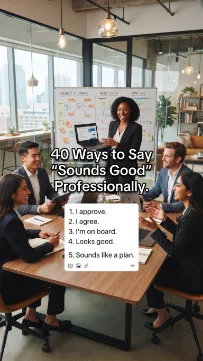
These alternatives to “sounds good” will help you sound more professional, engaged, and articulate in workplace communication. Use them according to context, audience, and the level of formality required for each situation.
When communication is clear and respectful, finding the right alternative to “sounds good” can make your responses appear more professional, confident, and polished. Whether you’re replying to a colleague, client, manager, or business partner, using varied expressions helps you communicate agreement while maintaining an appropriate tone. In professional settings, the words you choose contribute to credibility, trust, and effective workplace communication, making thoughtful alternatives valuable in emails, meetings, and everyday business conversations.
This guide explores professional ways to say “sounds good,” explains when each phrase works best, and provides practical examples for real-world situations. Drawing from established business communication practices and workplace etiquette, you’ll discover expressions that convey approval, confirmation, or agreement without sounding repetitive. By the end, you’ll have a versatile collection of professional responses suitable for formal, semi-formal, and client-facing conversations while maintaining clarity and professionalism.
Formal & Professional Alternatives
1. Phrase: That is agreeable
Meaning: I accept and approve of this proposal.
Explanation: Formal and polite, suitable for official correspondence and formal meetings.
Example Sentence: “Your proposed timeline is agreeable to our team and we can proceed.”
Best Use: Formal emails
Worst Use: Casual conversation
Tone: Formal, diplomatic
Context Variability: Professional: “The terms of the contract are agreeable to both parties.”
2. Phrase: That is acceptable
Meaning: I find this proposal satisfactory and can proceed.
Explanation: Neutral and professional, shows approval without excessive enthusiasm.
Example Sentence: “The revised budget figures are acceptable to management and will be approved.”
Best Use: Business correspondence
Worst Use: Expressing excitement
Tone: Formal, measured
Context Variability: Professional: “The delivery schedule is acceptable to our logistics team.”
3. Phrase: I consent to that
Meaning: I formally agree and give permission for this action.
Explanation: Very formal, often used in legal, contractual, or official contexts.
Example Sentence: “After reviewing the partnership proposal, I consent to the collaboration.”
Best Use: Legal/contractual contexts
Worst Use: Everyday conversation
Tone: Highly formal, official
Context Variability: Professional: “The board consents to the merger agreement.”
4. Phrase: That arrangement works
Meaning: The proposed plan is suitable, practical, and feasible.
Explanation: Professional and practical, focusing on functionality and logistics.
Example Sentence: “The shared workspace arrangement works for both departments and improves collaboration.”
Best Use: Operational discussions
Worst Use: Personal favors
Tone: Professional, practical
Context Variability: Professional: “That meeting time works for our entire team.”
5. Phrase: I find that satisfactory
Meaning: I am content with and accept this proposal.
Explanation: Formal and measured, shows approval without excessive enthusiasm.
Example Sentence: “I find the quality of your report satisfactory and well-researched.”
Best Use: Formal feedback
Worst Use: Enthusiastic agreement
Tone: Formal, restrained
Context Variability: Professional: “The client finds the deliverables satisfactory.”
6. Phrase: That is reasonable
Meaning: The proposal seems fair, logical, and well-considered.
Explanation: Diplomatic and professional, showing thoughtful agreement.
Example Sentence: “Your request for an extension is reasonable given the circumstances we discussed.”
Best Use: Negotiation contexts
Worst Use: Casual social settings
Tone: Professional, diplomatic
Context Variability: Professional: “The revised pricing seems reasonable to all stakeholders.”
7. Phrase: That’s perfectly fine
Meaning: I have no objection and am comfortable with this plan.
Explanation: Polite and professional, showing acceptance without reservation.
Example Sentence: “Your proposal for the new schedule is perfectly fine with me and my team.”
Best Use: Collaborative settings
Worst Use: Official documents
Tone: Professional, polite
Context Variability: Professional: “That approach is perfectly fine for our current needs.”
8. Phrase: I have no objection
Meaning: I do not disagree with the proposal and am willing to proceed.
Explanation: Formal and neutral, often used in meetings and official settings.
Example Sentence: “I have no objection to the revised marketing strategy you’ve outlined.”
Best Use: Formal meetings
Worst Use: Enthusiastic agreement
Tone: Formal, neutral
Context Variability: Professional: “The committee has no objection to the proposed changes.”
“Formal alternatives show respect for the situation and the people involved. Choose them for emails, reports, and meetings with senior leaders or clients.”
Collaborative & Team-Based Alternatives
9. Phrase: I’m on board
Meaning: I agree and am ready to participate fully and enthusiastically.
Explanation: Enthusiastic and professional, shows commitment and teamwork.
Example Sentence: “I’m on board with the new project direction and ready to start.”
Best Use: Team meetings
Worst Use: Formal proposals
Tone: Professional, engaged
Context Variability: Professional: “The entire team is on board with the strategic plan.”
10. Phrase: I’m aligned with that
Meaning: My thinking, goals, and perspective match this proposal.
Explanation: Modern professional language showing strategic agreement and shared vision.
Example Sentence: “I’m aligned with your vision for the campaign and its objectives.”
Best Use: Strategic discussions
Worst Use: Casual contexts
Tone: Professional, strategic
Context Variability: Professional: “Our departments are aligned on the key objectives.”
11. Phrase: That’s a solid approach
Meaning: The proposal is well-considered, robust, and likely to succeed.
Explanation: Shows confidence in and approval of the strategy or plan.
Example Sentence: “That’s a solid approach to entering the new market and gaining share.”
Best Use: Strategy discussions
Worst Use: Simple routine decisions
Tone: Professional, confident
Context Variability: Professional: “The team approved the solid approach presented.”
12. Phrase: Consider it done
Meaning: I agree and will take immediate action to implement this.
Explanation: Shows commitment, initiative, and reliability.
Example Sentence: “Consider it done—I’ll finalize the contract and send it today.”
Best Use: Task assignment responses
Worst Use: Strategic discussions
Tone: Professional, action-oriented
Context Variability: Professional: “You need this by Friday? Consider it done.”
13. Phrase: That works for me
Meaning: I agree with and can accommodate this proposal or schedule.
Explanation: Professional yet approachable, very common in workplace settings.
Example Sentence: “The 2 PM meeting slot works for me perfectly. I’ll be there.”
Best Use: Scheduling and logistics
Worst Use: Formal documents
Tone: Professional, approachable
Context Variability: Professional: “That solution works for everyone involved.”
14. Phrase: I’m comfortable with that
Meaning: I find the proposal acceptable, reassuring, and appropriate.
Explanation: Shows measured, thoughtful agreement and confidence.
Example Sentence: “I’m comfortable with the revised timeline and confident we can meet it.”
Best Use: Risk-sensitive contexts
Worst Use: Casual conversation
Tone: Professional, measured
Context Variability: Professional: “The client is comfortable with the new arrangement.”
15. Phrase: I approve of that
Meaning: I officially agree to and endorse this plan or proposal.
Explanation: Formal and authoritative, showing official endorsement.
Example Sentence: “I approve of the proposed budget allocation and recommend proceeding.”
Best Use: Managerial decisions
Worst Use: Peer conversations
Tone: Formal, authoritative
Context Variability: Professional: “The director approves of the new policy.”
16. Phrase: That seems like a good plan
Meaning: I find the proposed approach well-considered and effective.
Explanation: Professional and thoughtful, showing careful consideration.
Example Sentence: “That seems like a good plan for expanding our market reach next quarter.”
Best Use: Collaborative planning
Worst Use: Official approval
Tone: Professional, thoughtful
Context Variability: Professional: “The committee agreed it seems like a good plan.”
“Collaborative alternatives build team spirit and show active engagement. Use them to demonstrate you’re fully committed to shared success.”
Diplomatic & Polite Alternatives
17. Phrase: I’m happy with that
Meaning: I am satisfied and pleased with the proposal.
Explanation: Warm and professional, shows genuine satisfaction and positivity.
Example Sentence: “I’m happy with the way the project is progressing and the results so far.”
Best Use: Feedback conversations
Worst Use: Formal approvals
Tone: Warm, professional
Context Variability: Professional: “The client is happy with the design concept.”
18. Phrase: That’s acceptable to me
Meaning: I find this satisfactory and will proceed accordingly.
Explanation: Polite and neutral, showing conditional acceptance.
Example Sentence: “Your proposed changes are acceptable to me and meet our requirements.”
Best Use: Revision discussions
Worst Use: Enthusiastic contexts
Tone: Professional, diplomatic
Context Variability: Professional: “The terms are acceptable to both parties involved.”
19. Phrase: I’m amenable to that
Meaning: I am open to and willing to accept that proposal.
Explanation: Professional and diplomatic, showing flexibility and cooperation.
Example Sentence: “I’m amenable to extending the deadline by one week if needed.”
Best Use: Negotiation contexts
Worst Use: Personal conversations
Tone: Professional, diplomatic
Context Variability: Professional: “The team is amenable to the proposed changes.”
20. Phrase: That makes sense
Meaning: The proposal is logical, well-reasoned, and easy to understand.
Explanation: Shows intellectual agreement and clear understanding.
Example Sentence: “That makes sense given the current market conditions and customer feedback.”
Best Use: Analytical discussions
Worst Use: Routine logistics
Tone: Professional, analytical
Context Variability: Professional: “Your argument makes perfect sense to everyone.”
21. Phrase: That’s a good point
Meaning: I agree with and value the idea or perspective presented.
Explanation: Shows respect for the speaker’s contribution and thoughtful engagement.
Example Sentence: “That’s a good point about adjusting our pricing strategy to increase sales.”
Best Use: Meeting discussions
Worst Use: Task confirmation
Tone: Professional, respectful
Context Variability: Professional: “Several good points were raised in the meeting.”
22. Phrase: I appreciate that
Meaning: I value and agree with this suggestion or input.
Explanation: Shows gratitude alongside agreement, building positive relationships.
Example Sentence: “I appreciate your suggestion about streamlining the approval process.”
Best Use: Acknowledging helpful input
Worst Use: Simple scheduling
Tone: Warm, professional
Context Variability: Professional: “I appreciate the team’s thorough analysis.”
23. Phrase: I see your point
Meaning: I understand and agree with your perspective on this matter.
Explanation: Shows active listening and thoughtful agreement.
Example Sentence: “I see your point about prioritizing customer retention over new acquisitions.”
Best Use: Persuasive discussions
Worst Use: Routine approvals
Tone: Professional, engaging
Context Variability: Professional: “I see your point and support this direction.”
24. Phrase: That should do nicely
Meaning: This proposal appears well-suited for our requirements and needs.
Explanation: Professional, slightly formal, and confident in outcome.
Example Sentence: “The new software upgrade should do nicely for our team’s needs.”
Best Use: Solution evaluation
Worst Use: Casual conversation
Tone: Formal, confident
Context Variability: Professional: “The temporary solution should do nicely until we find a permanent fix.”
Casual But Professional Alternatives
25. Phrase: Sounds like a plan
Meaning: I agree with and am ready to follow this proposal.
Explanation: Friendly and professional, showing enthusiasm and commitment.
Example Sentence: “Sounds like a plan—let’s move forward with the product rollout next week.”
Best Use: Team discussions
Worst Use: Formal approvals
Tone: Friendly, approachable
Context Variability: Professional: “Sounds like a plan to me and the rest of the team.”
26. Phrase: Good call
Meaning: I agree that this is a wise, smart, and timely decision.
Explanation: Shows approval and respect for good judgment.
Example Sentence: “Good call on postponing the launch until next quarter for better results.”
Best Use: Decision confirmation
Worst Use: Formal documents
Tone: Professional, appreciative
Context Variability: Professional: “That was a good call by the leadership team.”
27. Phrase: Fair enough
Meaning: I accept this as reasonable and valid after consideration.
Explanation: Shows willingness to agree, often after some discussion.
Example Sentence: “Fair enough—let’s proceed with your suggested timeline for the project.”
Best Use: Compromise situations
Worst Use: Enthusiastic contexts
Tone: Professional, accepting
Context Variability: Professional: “Fair enough, that’s a reasonable compromise for both sides.”
28. Phrase: That’ll work
Meaning: This proposal is practical, functional, and suitable.
Explanation: Simple and professional, focusing on functionality and results.
Example Sentence: “That’ll work for the upcoming project deadline we need to meet.”
Best Use: Practical decisions
Worst Use: Formal approvals
Tone: Practical, professional
Context Variability: Professional: “That’ll work for our team’s immediate requirements.”
29. Phrase: Perfect
Meaning: This is exactly what we need at this moment.
Explanation: Brief but enthusiastic professional agreement.
Example Sentence: “Perfect—I’ll prepare the presentation for Friday’s meeting.”
Best Use: Quick confirmations
Worst Use: Formal approvals
Tone: Professional, positive
Context Variability: Professional: “Perfect timing for the product launch.”
30. Phrase: I’m game
Meaning: I am willing, enthusiastic, and ready to participate.
Explanation: Friendly professional language showing enthusiasm and flexibility.
Example Sentence: “I’m game for testing the new process next week before full implementation.”
Best Use: Team collaboration
Worst Use: Formal settings
Tone: Friendly, enthusiastic
Context Variability: Professional: “The team is game for the new challenge.”
“Casual but professional alternatives strike the right balance in most workplace conversations. They show engagement without being overly stiff or formal.”
Enthusiastic & Encouraging Alternatives
31. Phrase: Excellent idea
Meaning: This is a very good, valuable suggestion or proposal.
Explanation: Shows genuine enthusiasm and strong approval.
Example Sentence: “Excellent idea—this could significantly improve our operational efficiency.”
Best Use: Brainstorming sessions
Worst Use: Routine confirmations
Tone: Enthusiastic, supportive
Context Variability: Professional: “Excellent idea presented during the strategy session.”
32. Phrase: That’s a fantastic approach
Meaning: This proposal is exceptionally good and well-considered.
Explanation: Shows high enthusiasm and strong approval.
Example Sentence: “That’s a fantastic approach to solving the customer service issues we’ve faced.”
Best Use: Creative solutions
Worst Use: Routine decisions
Tone: Enthusiastic, encouraging
Context Variability: Professional: “The team developed a fantastic approach for the campaign.”
33. Phrase: I fully support that
Meaning: I completely agree and will back this proposal wholeheartedly.
Explanation: Shows strong commitment and endorsement.
Example Sentence: “I fully support your initiative to expand into emerging markets.”
Best Use: Strategic proposals
Worst Use: Minor decisions
Tone: Strong, committed
Context Variability: Professional: “Management fully supports the diversity initiative.”
34. Phrase: That’s a brilliant suggestion
Meaning: This is a remarkably good, insightful idea.
Explanation: Shows high appreciation and enthusiasm for the idea.
Example Sentence: “That’s a brilliant suggestion—let’s implement it immediately.”
Best Use: Exceptional ideas
Worst Use: Routine matters
Tone: Highly enthusiastic
Context Variability: Professional: “Several brilliant suggestions emerged from the workshop.”
35. Phrase: I’m excited about that
Meaning: I feel positive enthusiasm and motivation about this proposal.
Explanation: Shows personal engagement, energy, and positive anticipation.
Example Sentence: “I’m excited about the opportunity to collaborate on this important project.”
Best Use: New opportunities
Worst Use: Routine tasks
Tone: Enthusiastic, personal
Context Variability: Professional: “The team is excited about the new initiative.”
Written Communication Alternatives
36. Phrase: That is confirmed
Meaning: I officially accept and confirm this agreement or arrangement.
Explanation: Formal and definitive, suitable for written confirmation.
Example Sentence: “The meeting time is confirmed for 10 AM Thursday in Conference Room A.”
Best Use: Email confirmations
Worst Use: Spoken conversation
Tone: Formal, definitive
Context Variability: Professional: “The order is confirmed and processing for delivery.”
37. Phrase: I’m pleased to confirm
Meaning: I happily accept and formally confirm this arrangement.
Explanation: Formal and gracious, perfect for written responses and client communication.
Example Sentence: “I’m pleased to confirm our participation in the international conference.”
Best Use: Written confirmations
Worst Use: Quick spoken responses
Tone: Formal, gracious
Context Variability: Professional: “I’m pleased to confirm our agreement on the contract.”
38. Phrase: We have agreement
Meaning: All parties involved accept this proposal or decision.
Explanation: Formal and official, showing consensus among stakeholders.
Example Sentence: “We have agreement on the contract terms after the final review.”
Best Use: Official communications
Worst Use: Spontaneous conversations
Tone: Formal, official
Context Variability: Professional: “We have agreement across all departments on this issue.”
39. Phrase: This has my approval
Meaning: I officially endorse and permit this action or proposal.
Explanation: Authoritative and formal, showing official consent.
Example Sentence: “This project plan has my full approval and can proceed.”
Best Use: Official authorizations
Worst Use: Peer discussions
Tone: Formal, authoritative
Context Variability: Professional: “The proposal has senior management’s approval.”
40. Phrase: I’m in full agreement
Meaning: I completely concur with every aspect of the proposal.
Explanation: Formal and emphatic, showing complete alignment.
Example Sentence: “I’m in full agreement with the proposed strategy and its implementation plan.”
Best Use: Important decisions
Worst Use: Minor logistics
Tone: Formal, emphatic
Context Variability: Professional: “The board is in full agreement on the strategic direction.”
“Variety in professional responses shows engagement and thoughtfulness. Repeating ‘sounds good’ suggests you’re not fully present or invested in the conversation.”
Mini Quiz: Test Your Knowledge
Choose the best alternative for each scenario:
1. Your manager suggests a new project timeline during a formal review meeting. Which response sounds most professional and respectful?
- A) Sounds good
- B) I’m aligned with that timeline and confident we can deliver
- C) Cool
- D) Whatever works for you
2. A colleague proposes a creative solution in a brainstorming session. Which response shows the most enthusiasm and support?
- A) That’s acceptable
- B) That’s a fantastic approach to solving this challenge
- C) Fine
- D) I suppose so
3. You’re writing an official email confirming a business partnership agreement. Which phrase is most appropriate and professional?
- A) Sounds like a plan
- B) I’m pleased to confirm our agreement on the partnership terms
- C) Cool with me
- D) All good
4. A team member suggests a practical solution to a routine scheduling issue. Which response is balanced and professionally appropriate?
- A) That’ll work perfectly for everyone involved
- B) I’m absolutely ecstatic
- C) Whatever you think is best
- D) No opinion on this matter
5. Your manager asks if you can complete a task by Friday. What is the best professional response?
- A) Sounds good
- B) Consider it done—I’ll prioritize this and deliver by Friday
- C) Maybe
- D) I’ll try my best
(Answers: 1-B, 2-B, 3-B, 4-A, 5-B)
Comparison Table: Top 10 Alternatives
| That is agreeable | Formal | Official correspondence and formal meetings |
| I’m on board | Professional | Team collaboration and project kickoff |
| I’m aligned with that | Professional | Strategic alignment and vision discussions |
| That works for me | Professional | Scheduling, logistics, and practical decisions |
| I’m amenable to that | Diplomatic | Negotiations and compromise situations |
| Sounds like a plan | Casual Professional | Team discussions and informal meetings |
| That’s a solid approach | Professional | Strategy discussions and planning sessions |
| Consider it done | Action-oriented | Task acceptance and commitment |
| I fully support that | Supportive | Strategic proposals and major decisions |
| I’m pleased to confirm | Written Formal | Email confirmations and client communication |
FAQs
1. Is “sounds good” considered unprofessional in the workplace?
While not offensive or rude, “sounds good” is informal and can seem casual in professional settings. In formal emails, client meetings, or conversations with senior leaders, it’s better to use alternatives like “that works for me,” “I’m aligned with that,” or “that’s agreeable.” For quick internal chats with colleagues you know well, “sounds good” remains acceptable.
2. Can I use “sounds good” in work emails?
Avoid “sounds good” in formal emails or client correspondence. For quick internal messages to colleagues you know well, it’s acceptable but still limited. For professional emails, use alternatives such as “that’s acceptable,” “I’m happy with that,” or “I’m pleased to confirm” depending on the context and relationship.
3. What’s the most professional way to say “sounds good” to a manager?
Use formal or respectful alternatives like “I’m aligned with that approach,” “That works for me,” or “I’m on board with that plan.” These show respect for authority while maintaining professionalism. Avoid overly casual phrases like “cool” or “sounds good” with senior leaders.
4. How can I express enthusiastic agreement professionally without sounding over-the-top?
Use phrases like “Excellent idea,” “That’s a fantastic approach,” “I’m excited about that,” or “I fully support that.” These maintain professionalism while showing genuine enthusiasm. Avoid overly emotional phrases or excessive praise that might seem insincere.
5. What’s the difference between “That is agreeable” and “That is acceptable” in professional settings?
“That is agreeable” suggests personal satisfaction and positive acceptance of the proposal. “That is acceptable” is more neutral and suggests meeting minimum standards or requirements. Use “agreeable” for more positive, enthusiastic responses and “acceptable” for neutral or measured agreement.
6. Is “sounds good” acceptable in job interviews?
Generally, no. Job interviews require professional, articulate language. Use alternatives like “that sounds like a reasonable approach,” “I’m aligned with that perspective,” or “I appreciate that perspective” to demonstrate professionalism and communication skills.
7. What alternative should I use when I have minor concerns but still generally agree?
Use diplomatic phrases like “I’m amenable to that with a few clarifications,” “That works for me, though I’d like to discuss X,” or “I’m comfortable with that approach, but I have one question about…” These show agreement while allowing space for discussion.
8. How can I avoid overusing “sounds good” in meetings?
Prepare a list of alternatives before meetings. Practice using varied responses like “I support that,” “That’s a good point,” “I appreciate that perspective,” and “That seems reasonable.” Pay attention to how colleagues express agreement and learn from their examples.
Conclusion
Learning alternatives to “sounds good” is a powerful and practical way to enhance your professional English communication. Each alternative serves a specific purpose and tone—from formal agreement in official documents to enthusiastic support in team meetings, from diplomatic acceptance in negotiations to confident confirmation in emails.
By incorporating these 40 professional alternatives into your daily communication, you’ll sound more articulate, engaged, and confident. You’ll also demonstrate attention to detail and respect for your colleagues and clients—qualities that advance careers and build stronger professional relationships.