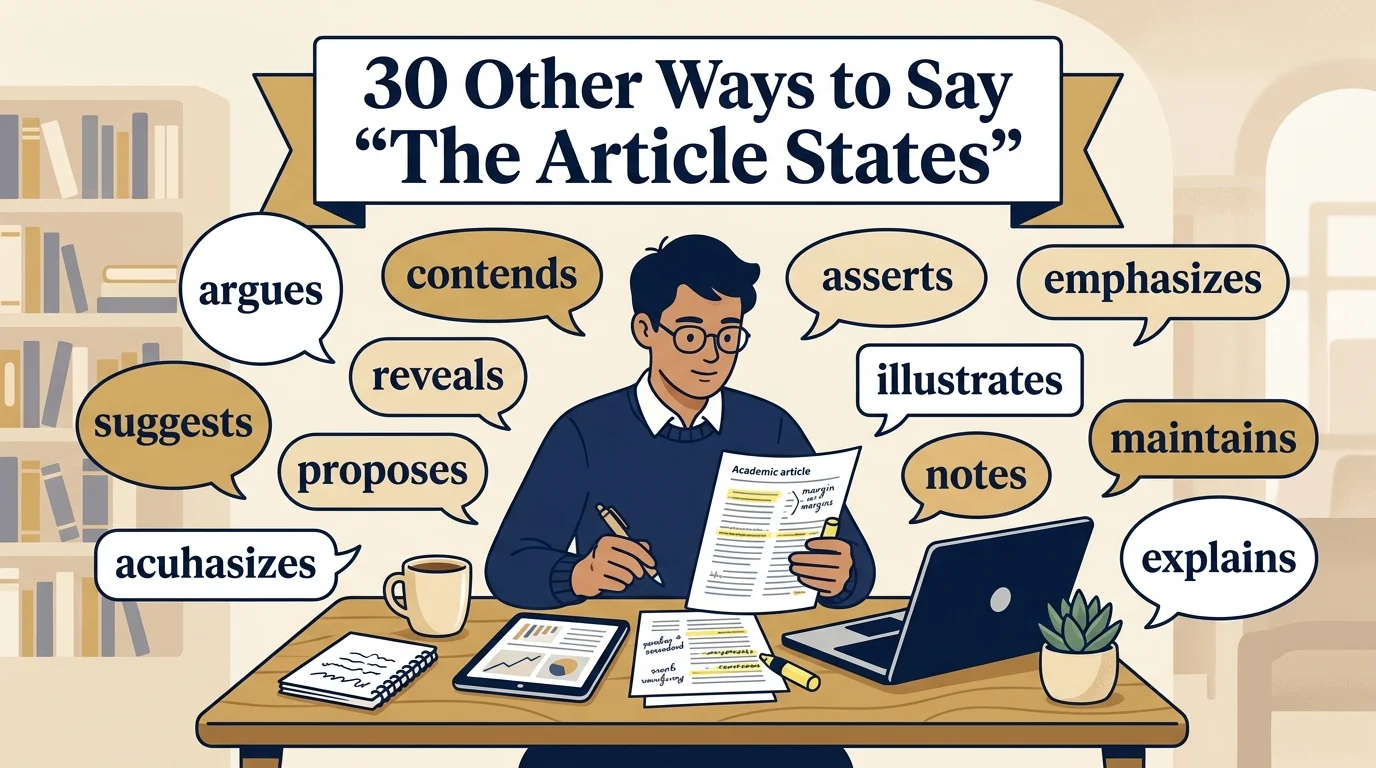
In academic writing, professional reports, and critical analysis, the phrase “the article states” appears constantly. While it’s a clear and neutral way to attribute information, overusing it makes your writing repetitive and fails to capture the nuanced arguments or perspectives an author might express. Learning alternatives to “the article states” will dramatically elevate your academic and professional writing, allowing you to describe ideas with greater precision and rhetorical sophistication.
This article provides 30 powerful alternatives to help you vary your language, demonstrate critical thinking, and communicate more effectively in essays, research papers, and business analyses. When you express excitement in English about a compelling argument, you can use varied attributive verbs to show your engagement with the source material. By expanding your vocabulary, you’ll sound more authoritative and confident in any writing context.
Quick Categories
- Formal alternatives to “the article states”
- Academic alternatives
- Casual alternatives
- Professional alternatives for reports
What Does “The Article States” Mean?
“The article states” is a phrase used to introduce information, claims, or opinions presented in a written work. It attributes a statement or viewpoint to the author or the text itself, functioning as a neutral reporting verb. However, the phrase lacks emotional or analytical depth—it simply reports without evaluating.
Example Sentence: “The article states that climate change is accelerating faster than predicted.”
Grammar Note: “States” is a transitive verb, often followed by a “that” clause. It can be used in present or past tense depending on the context (e.g., “the article states” vs. “the article stated”).
When to Use “The Article States”
- Academic essays: Citing sources in literature reviews or argumentative papers
- Research papers: Summarizing findings or background information
- Professional reports: Referencing industry publications or internal documents
- Journalism: Attributing information to sources or reports
- Critical reviews: Describing the content of a book, article, or study
Spoken vs Written: This phrase is primarily written, though you might hear it in academic presentations or formal discussions. It is rarely used in casual conversation.
Formal vs Informal: It is neutral and fits most formal writing, but overuse signals limited vocabulary. In informal contexts, simpler alternatives like “says” or “mentions” are more natural.
Is It Professional or Polite to Say “The Article States”?
Polite? ✔️ Yes
Professional? ✔️ Yes (but it lacks nuance)
While “the article states” is perfectly acceptable in academic and professional writing, it is overused and can make your writing feel monotonous. Skilled writers deploy a range of professional reaction phrases to show their critical engagement with sources, such as “the author asserts,” “the text claims,” or “the paper demonstrates.”
Business Example: “The article states that our industry will grow by 20% next year.”
Better Alternative: “The article projects that our industry will grow by 20% next year.”
Pros and Cons of Using “The Article States”
Pros
- Clear and neutral – No bias or interpretation
- Easy to understand – Accessible to all readers
- Commonly accepted – Standard in academic writing
- Straightforward – Gets the point across quickly
Cons
- Overused – Becomes invisible and boring
- Lacks analytical depth – Doesn’t show critical thinking
- Impersonal – Fails to connect with the author’s intent
- Not suitable for persuasive writing – Too passive for strong arguments
“The verbs you choose to attribute ideas reveal how you engage with a text. Choose them deliberately.”
30 Powerful Alternatives to “The Article States” (With Examples)
These alternatives will help you write more dynamically and precisely, whether you’re crafting an academic essay, a business report, or a critical review. Each alternative carries a distinct connotation—choose the one that best matches the author’s tone and your analytical stance.
Formal & Academic Alternatives
1. Phrase: The article argues
Meaning: The article presents a reasoned case for a specific position
Explanation: Implies the author is trying to persuade through logic and evidence
Example Sentence: “The article argues that remote work increases productivity, citing multiple studies.”
Best Use: Persuasive essays
Worst Use: Neutral summaries
Tone: Analytical, assertive
Context Variability: Academic: “The author argues for a paradigm shift in educational policy.”
2. Phrase: The author contends
Meaning: The author asserts a viewpoint with conviction, often against counterarguments
Explanation: Suggests a strong, defended position
Example Sentence: “The author contends that traditional teaching methods are obsolete.”
Best Use: Debates
Worst Use: Objective reporting
Tone: Strong, confident
Context Variability: Academic: “Smith contends that the data supports his hypothesis.”
3. Phrase: The text suggests
Meaning: The article implies or hints at an idea without stating it explicitly
Explanation: Indicates inference or indirect presentation
Example Sentence: “The text suggests a correlation between diet and mental health outcomes.”
Best Use: Interpreting subtext
Worst Use: Clear-cut facts
Tone: Tentative, interpretive
Context Variability: Professional: “The report suggests that market conditions may shift.”
4. Phrase: The paper proposes
Meaning: The article puts forward an idea or plan for consideration
Explanation: Often used for recommendations or hypotheses
Example Sentence: “The paper proposes a new framework for sustainable urban development.”
Best Use: Research proposals
Worst Use: Historical descriptions
Tone: Innovative, forward-looking
Context Variability: Academic: “This study proposes an alternative to current models.”
5. Phrase: The author asserts
Meaning: The author declares something confidently and forcefully
Explanation: Stronger than “states”; implies unwavering conviction
Example Sentence: “The author asserts that freedom of speech is non-negotiable.”
Best Use: Strong opinions
Worst Use: Neutral facts
Tone: Forceful, definitive
Context Variability: Academic: “The researcher asserts the primacy of qualitative data.”
6. Phrase: The article maintains
Meaning: The article continues to uphold a particular position or belief
Explanation: Suggests sustained argumentation
Example Sentence: “The article maintains that economic growth must prioritize environmental sustainability.”
Best Use: Persistent arguments
Worst Use: One-off claims
Tone: Steadfast, consistent
Context Variability: Professional: “The white paper maintains its stance despite criticism.”
7. Phrase: The study reveals
Meaning: The article discloses previously unknown information or findings
Explanation: Implies discovery or uncovering
Example Sentence: “The study reveals a startling connection between sleep and memory retention.”
Best Use: Research findings
Worst Use: Opinion pieces
Tone: Revelatory, factual
Context Variability: Academic: “The experiment reveals significant differences between groups.”
8. Phrase: The investigation demonstrates
Meaning: The article shows clearly through evidence or examples
Explanation: Stronger than “suggests”; implies proof
Example Sentence: “The investigation demonstrates that early intervention yields better outcomes.”
Best Use: Empirical studies
Worst Use: Theoretical discussions
Tone: Evidence-based, conclusive
Context Variability: Professional: “The audit demonstrates compliance with regulations.”
9. Phrase: The analysis indicates
Meaning: The article points toward a conclusion based on data or reasoning
Explanation: More tentative than “demonstrates”
Example Sentence: “The analysis indicates that consumer preferences have shifted dramatically.”
Best Use: Data-driven writing
Worst Use: Philosophical arguments
Tone: Objective, cautious
Context Variability: Professional: “The data indicates a need for strategic realignment.”
10. Phrase: The author posits
Meaning: The author puts forward a theory or assumption as a basis for reasoning
Explanation: Often used for foundational claims in theoretical work
Example Sentence: “The author posits that human behavior is driven by subconscious desires.”
Best Use: Theoretical frameworks
Worst Use: Practical recommendations
Tone: Theoretical, speculative
Context Variability: Academic: “The philosopher posits the existence of innate knowledge.”
11. Phrase: The article claims
Meaning: The article asserts something that may be disputed or unproven
Explanation: Often implies a degree of doubt or requires verification
Example Sentence: “The article claims that artificial intelligence will replace most jobs within a decade.”
Best Use: Controversial statements
Worst Use: Established facts
Tone: Assertive, potentially questionable
Context Variability: Academic: “The journalist claims the government withheld evidence.”
12. Phrase: The writing conveys
Meaning: The article communicates a specific idea, feeling, or message
Explanation: Emphasizes the act of transmission rather than the content itself
Example Sentence: “The writing conveys a sense of urgency about climate action.”
Best Use: Tone and emotion
Worst Use: Specific data points
Tone: Communicative, expressive
Context Variability: Professional: “The memo conveys the CEO’s vision for the company.”
13. Phrase: The text articulates
Meaning: The article expresses an idea clearly and coherently
Explanation: Implies clarity and eloquence
Example Sentence: “The text articulates the complexities of intersectional feminism with precision.”
Best Use: Complex ideas
Worst Use: Simple statements
Tone: Clear, eloquent
Context Variability: Academic: “The author articulates the central thesis in the introduction.”
14. Phrase: The essay expounds
Meaning: The article explains or elaborates on an idea in detail
Explanation: Suggests thorough treatment of a subject
Example Sentence: “The essay expounds on the historical roots of modern inequality.”
Best Use: Extensive analyses
Worst Use: Brief mentions
Tone: Detailed, elaborate
Context Variability: Academic: “The chapter expounds upon the theoretical model.”
15. Phrase: The manuscript delineates
Meaning: The article describes, outlines, or defines something precisely
Explanation: Implies clear boundaries or specifications
Example Sentence: “The manuscript delineates the phases of the clinical trial.”
Best Use: Processes or stages
Worst Use: Abstract concepts
Tone: Precise, technical
Context Variability: Professional: “The policy paper delineates the steps for implementation.”
“Varied reporting verbs show your reader that you are actively interpreting the source, not just copying it.”
Professional & Business Alternatives
16. Phrase: The report highlights
Meaning: The article draws special attention to key information
Explanation: Emphasizes importance or significance
Example Sentence: “The report highlights emerging risks in the supply chain.”
Best Use: Summarizing key points
Worst Use: Background information
Tone: Emphatic, focused
Context Variability: Professional: “The earnings report highlights record profits.”
17. Phrase: The brief notes
Meaning: The article mentions something briefly but importantly
Explanation: Less prominent than “states”
Example Sentence: “The brief notes that staffing shortages may affect production.”
Best Use: Minor but relevant points
Worst Use: Main arguments
Tone: Brief, supplementary
Context Variability: Professional: “The memo notes the change in reporting structure.”
18. Phrase: The publication outlines
Meaning: The article provides a structured overview of a topic
Explanation: Implies organization and clarity
Example Sentence: “The publication outlines the steps necessary for regulatory compliance.”
Best Use: Guides and frameworks
Worst Use: Argumentative pieces
Tone: Structured, instructional
Context Variability: Professional: “The white paper outlines our strategic priorities.”
19. Phrase: The document specifies
Meaning: The article provides detailed and precise information
Explanation: Often used in technical or legal contexts
Example Sentence: “The document specifies the exact dimensions required for the equipment.”
Best Use: Technical details
Worst Use: Broad overviews
Tone: Precise, exact
Context Variability: Professional: “The contract specifies delivery timelines.”
20. Phrase: The memo clarifies
Meaning: The article removes ambiguity or confusion
Explanation: Implies that the information was previously unclear
Example Sentence: “The memo clarifies the new remote work policy for all employees.”
Best Use: Clarifications
Worst Use: Original claims
Tone: Clear, helpful
Context Variability: Professional: “The email clarifies the meeting agenda.”
21. Phrase: The analysis suggests
Meaning: The article proposes a possibility based on evaluation
Explanation: More tentative than “indicates”
Example Sentence: “The analysis suggests that quarterly targets may need adjustment.”
Best Use: Forward-looking insights
Worst Use: Confirmed facts
Tone: Cautious, interpretive
Context Variability: Professional: “The market analysis suggests a downturn.”
22. Phrase: The briefing emphasizes
Meaning: The article gives special importance to a particular point
Explanation: Stronger than “notes”
Example Sentence: “The briefing emphasizes the need for cybersecurity training.”
Best Use: Priorities
Worst Use: Trivial points
Tone: Urgent, important
Context Variability: Professional: “The directive emphasizes compliance.”
23. Phrase: The overview enumerates
Meaning: The article lists items one by one
Explanation: Implies a systematic listing
Example Sentence: “The overview enumerates the key stakeholders involved.”
Best Use: Lists and categories
Worst Use: Continuous prose
Tone: Systematic, clear
Context Variability: Professional: “The annual report enumerates our achievements.”
“In business writing, choose verbs that convey action and purpose—’emphasizes,’ ‘outlines,’ and ‘highlights’ are powerful choices.”
Casual & Conversational Alternatives
24. Phrase: The article says
Meaning: Simple, direct, and neutral attribution
Explanation: Everyday language, appropriate for informal contexts
Example Sentence: “The article says that eating breakfast improves concentration.”
Best Use: Casual reading
Worst Use: Formal essays
Tone: Simple, straightforward
Context Variability: Casual: “I read an article that says coffee is good for you.”
25. Phrase: The author mentions
Meaning: The author refers to something briefly without elaboration
Explanation: Less emphasis than “states”
Example Sentence: “The author mentions the role of genetics but doesn’t explore it deeply.”
Best Use: Minor points
Worst Use: Central arguments
Tone: Incidental, brief
Context Variability: Casual: “She mentions the study in passing.”
26. Phrase: The piece points out
Meaning: The article draws attention to a noteworthy fact
Explanation: Often used to highlight something the reader might miss
Example Sentence: “The piece points out that many people overlook the environmental impact.”
Best Use: Observational points
Worst Use: Theoretical arguments
Tone: Attentive, instructive
Context Variability: Casual: “This blog points out an interesting trend.”
27. Phrase: The article tells us
Meaning: The article informs the reader in a direct, conversational way
Explanation: Friendly and engaging
Example Sentence: “The article tells us that we should take more breaks during the day.”
Best Use: Lifestyle or advice pieces
Worst Use: Research papers
Tone: Friendly, engaging
Context Variability: Casual: “This magazine tells us how to save money.”
28. Phrase: The writer reports
Meaning: The author conveys information, often from a journalistic perspective
Explanation: Implies objective news delivery
Example Sentence: “The writer reports that the city has approved the new budget.”
Best Use: News articles
Worst Use: Opinion columns
Tone: Journalistic, factual
Context Variability: Casual: “The reporter reports from the scene.”
29. Phrase: The blog post shares
Meaning: The article conveys personal experiences or insights
Explanation: Common in lifestyle and personal writing
Example Sentence: “The blog post shares five tips for sustainable living.”
Best Use: Online content
Worst Use: Academic citations
Tone: Personal, accessible
Context Variability: Casual: “The post shares her journey as an entrepreneur.”
30. Phrase: The article explains
Meaning: The article makes something clear through reasoning or description
Explanation: Implies pedagogical intent
Example Sentence: “The article explains how vaccines work at a cellular level.”
Best Use: Instructional content
Worst Use: Argumentative essays
Tone: Educational, helpful
Context Variability: Casual: “This guide explains the process step-by-step.”
Common Mistakes Using “The Article States”
1. Mistake: Overusing “states” when a more precise verb would show critical engagement.
Example: ❌ “The article states that the policy is effective. The article also states that…”
Fix: “The article argues that the policy is effective. It further maintains that…”
2. Mistake: Using “states” for indirect or implied ideas.
Example: ❌ “The article states that the author is concerned about inequality.”
Fix: “The article suggests that the author is concerned about inequality.”
3. Mistake: Using “states” in persuasive writing when you need stronger verbs.
Example: ❌ “The article states that we should change our approach.”
Fix: “The article urges that we change our approach.”
4. Mistake: Failing to vary attribution verbs across a paragraph.
Example: ❌ “The article states X. The article states Y. The article states Z.”
Fix: Use a mix: “The article argues X. The author contends Y. The analysis reveals Z.”
5. Mistake: Using “states” for claims that are not clearly confirmed.
Example: ❌ “The article states that extraterrestrial life exists.”
Fix: “The article claims that extraterrestrial life exists.” (if unproven)
Comparison Table: Top Alternatives
| Phrase | Tone | Best Use |
|---|---|---|
| argues | Analytical, assertive | Persuasive or debatable points |
| contends | Strong, confident | Staking a defensible position |
| suggests | Tentative, interpretive | Implications or inferences |
| proposes | Innovative, forward-looking | Hypotheses or plans |
| asserts | Forceful, definitive | Strong personal opinions |
| demonstrates | Evidence-based, conclusive | Empirical findings |
| indicates | Objective, cautious | Data-driven conclusions |
| posits | Theoretical, speculative | Foundational assumptions |
| emphasizes | Emphatic, focused | Key priorities |
| outlines | Structured, instructional | Overviews and frameworks |
Mini Quiz / Self-Check
1. You’re writing a research paper and want to show that the author is firmly defending a controversial opinion. Which verb is best?
- A) mentions
- B) contends
- C) suggests
- D) outlines
Answer: B) contends
2. You’re summarizing a business report that highlights main takeaways. Which verb conveys this best?
- A) articulates
- B) emphasizes
- C) posits
- D) explains
Answer: B) emphasizes
3. You’re describing a study that found new evidence. Which verb shows discovery?
- A) claims
- B) reveals
- C) says
- D) tells
Answer: B) reveals
4. In a casual blog, you want to share a helpful point. Which verb is most natural?
- A) expounds
- B) delineates
- C) points out
- D) contends
Answer: C)
FAQs
Q1: What is the best alternative to “the article states” for academic writing?
The best choice depends on context. For persuasive arguments, use “argues” or “contends.” For data-driven claims, use “demonstrates” or “indicates.” For theoretical propositions, use “posits” or “proposes.” Vary your verbs to show critical engagement.
Q2: Can I use “says” in formal academic writing?
“Says” is generally too informal for academic papers. Instead, use “states,” “argues,” “asserts,” or “claims.” However, in direct quotations or casual asides, “says” might be acceptable.
Q3: What is the difference between “suggests” and “implies”?
“Suggests” is often used when the author presents evidence that points to a conclusion. “Implies” means the author hints without stating directly, often through tone or word choice. Both are useful for interpretive writing.
Q4: How many alternatives should I use in a single paragraph?
Aim for 2–3 different reporting verbs in a paragraph to maintain variety without overloading. Repetition of the same verb within a paragraph becomes monotonous.
Q5: Is “the article states” grammatically correct in past tense?
Yes, you can write “the article stated” if you are summarizing a past publication. However, in academic writing, the present tense (“states”) is preferred for established texts because they exist in the present.
Conclusion
Mastering alternatives to “the article states” is a hallmark of sophisticated writing. By varying your attribution verbs, you not only avoid repetition but also demonstrate your analytical skills—showing whether you agree, interpret, or question the source. This nuanced approach to reporting makes your essays, reports, and professional documents more engaging and persuasive.