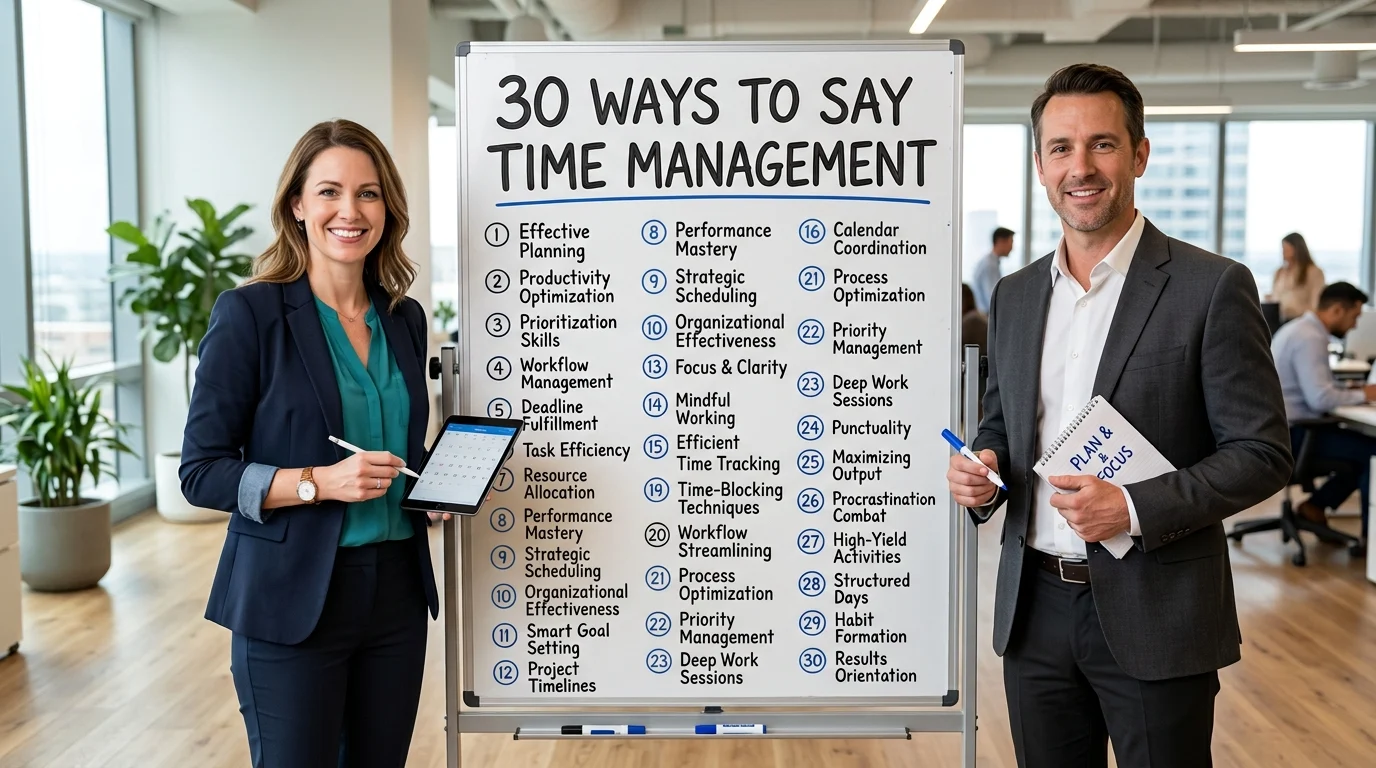
Time management is one of the most discussed skills in professional and personal development contexts. People use this term constantly to describe how they organize, prioritize, and allocate their time across various tasks and responsibilities. While “time management” is clear and widely understood, using it repeatedly can make your language feel mechanical and limited.
Learning alternatives to time management will elevate your professional communication and help you express organization skills in English with greater precision. Whether you’re writing a resume, conducting a performance review, or discussing productivity strategies, having a rich vocabulary of professional organizational phrases allows you to articulate your approach with sophistication and clarity. These strategies for managing time will help you sound more competent and thoughtful in any setting.
Quick Categories
Formal Alternatives
- Strategic time allocation
- Temporal resource optimization
- Efficient scheduling practices
- Systematic prioritization
Professional Alternatives
- Effective planning
- Task prioritization
- Workload optimization
- Productivity management
Casual Alternatives
- Getting organized
- Smart scheduling
- Time savvy
- Making the most of your day
Action-Oriented Phrases
- Maximizing productivity
- Streamlining workflows
- Optimizing daily routines
- Prioritizing effectively
Common Mistakes Section
1. Using “time management” when you mean “prioritization”
“I need better time management” when you actually need to prioritize tasks. Better: “I need to prioritize my tasks more effectively.”
2. Treating time management as a single skill
Time management encompasses planning, prioritization, delegation, and focus. Be specific about which aspect you’re addressing.
3. Using formal alternatives in casual settings
“I’m implementing temporal resource optimization” sounds pretentious. Better: “I’m getting better at planning my day.”
4. Confusing time management with productivity
Productivity is about output; time management is about organizing time. They’re related but distinct concepts.
5. Overusing buzzwords without substance
Using professional alternatives to time management without actually demonstrating the skill undermines your credibility.
What Does “Time Management” Mean?
Time management refers to the practice of planning, organizing, and controlling how you spend your time to increase effectiveness, efficiency, and productivity. It involves setting priorities, allocating time to specific activities, and minimizing time wasted on non-essential tasks.
Grammar: As a compound noun, “time management” functions as a singular concept. It’s often used as a subject or object in sentences.
Example Sentence: “Good time management allows professionals to accomplish more in less time while maintaining work-life balance.”
When to Use “Time Management”
- Job interviews and resumes
- Performance reviews and professional development discussions
- Personal productivity planning
- Team meetings and project management
- Self-improvement and goal-setting contexts
Spoken: Common in both professional and casual conversations
Written: Frequently appears in business documents, emails, and self-help content
Formal: Acceptable but can be enhanced with more specific terminology
Informal: Perfectly natural and widely understood
Is It Professional or Polite to Say “Time Management”?
Polite? ✔️ Yes – It’s a neutral, professional term
Professional? ✔️ Yes – It’s standard in business and educational contexts
Business Example: “Effective time management is essential for meeting project deadlines and maintaining quality standards.”
Pros and Cons of Using “Time Management”
Pros
- Widely understood across all industries
- Clear and straightforward meaning
- Industry-standard terminology
- Recognized as a crucial professional skill
Cons
- Overused and can sound generic
- Doesn’t convey specific methods or approaches
- Can seem like a buzzword without context
- Fails to distinguish between different aspects of organization
Other Ways to Say “Time Management” (With Examples)
These alternatives to time management will help you sound more sophisticated, specific, and professional in various contexts. Use them according to your audience, situation, and the particular aspect of time organization you wish to emphasize.
Formal Alternatives to “Time Management”
1. Phrase: Strategic time allocation
Meaning: The deliberate distribution of time to high-priority activities
Explanation: Emphasizes thoughtful, purpose-driven scheduling
Example Sentence: “Our department’s success depends on strategic time allocation across all project phases.”
Best Use: Executive presentations
Worst Use: Casual conversation
Tone: Professional, analytical
Context Variability: Perfect for board meetings and strategic planning sessions
2. Phrase: Temporal resource optimization
Meaning: Maximizing the value derived from available time
Explanation: Frames time as a valuable resource requiring careful management
Example Sentence: “Temporal resource optimization has increased our team’s output by 30%.”
Best Use: Formal reports
Worst Use: Everyday discussions
Tone: Technical, sophisticated
Context Variability: Suitable for academic and high-level business contexts
3. Phrase: Efficient scheduling practices
Meaning: Methods for arranging activities to maximize productivity
Explanation: Focuses on the practical implementation of time organization
Example Sentence: “The company has implemented efficient scheduling practices to reduce downtime.”
Best Use: Operational meetings
Worst Use: Social media posts
Tone: Professional, procedural
Context Variability: Great for operational discussions and process improvement
4. Phrase: Systematic prioritization
Meaning: A structured approach to ordering tasks by importance
Explanation: Emphasizes the methodical nature of choosing what to do first
Example Sentence: “Systematic prioritization ensures critical projects receive adequate attention.”
Best Use: Project management
Worst Use: Personal conversations
Tone: Methodical, organized
Context Variability: Essential for project planning and team leadership
5. Phrase: Time utilization strategy
Meaning: A planned approach to making the most of available time
Explanation: Emphasizes purposeful and efficient use of time
Example Sentence: “Our time utilization strategy has improved both efficiency and employee satisfaction.”
Best Use: Corporate communications
Worst Use: Text messages
Tone: Strategic, professional
Context Variability: Works well in strategic planning and annual reviews
6. Phrase: Optimal time distribution
Meaning: Allocating time in the most beneficial way
Explanation: Focuses on achieving the best results through wise allocation
Example Sentence: “Optimal time distribution across departments has streamlined our operations.”
Best Use: Organizational planning
Worst Use: Casual chats
Tone: Analytical, deliberate
Context Variability: Suitable for resource allocation discussions
7. Phrase: Productivity optimization
Meaning: Maximizing output relative to time invested
Explanation: Emphasizes the efficiency aspect of time management
Example Sentence: “Productivity optimization has become a key focus area for our team.”
Best Use: Business strategy
Worst Use: Social conversations
Tone: Professional, results-focused
Context Variability: Excellent for performance improvement initiatives
8. Phrase: Workflow organization
Meaning: Structuring work processes for maximum efficiency
Explanation: Focuses on how tasks are arranged and executed
Example Sentence: “Better workflow organization has reduced project completion times significantly.”
Best Use: Process improvement
Worst Use: Personal reflection
Tone: Practical, efficient
Context Variability: Great for operational and logistics discussions
9. Phrase: Task sequencing
Meaning: Arranging tasks in a logical order for efficiency
Explanation: Emphasizes the order and timing of activities
Example Sentence: “Proper task sequencing prevents bottlenecks and reduces wasted time.”
Best Use: Project planning
Worst Use: General conversation
Tone: Logical, systematic
Context Variability: Essential for complex project management
10. Phrase: Time economy
Meaning: The efficient use of time as a valuable resource
Explanation: Treats time with the same care as financial resources
Example Sentence: “Time economy is essential for maintaining competitive advantage in our industry.”
Best Use: Economic discussions
Worst Use: Personal chats
Tone: Professional, resource-focused
Context Variability: Suitable for business and economic contexts
Professional Alternatives
11. Phrase: Effective planning
Meaning: Organizing activities in a productive manner
Explanation: Emphasizes the planning aspect of time organization
Example Sentence: “Effective planning allows our team to anticipate challenges and meet deadlines.”
Best Use: Team meetings
Worst Use: Informal settings
Tone: Professional, practical
Context Variability: Versatile across workplace settings
12. Phrase: Task prioritization
Meaning: Determining the order in which tasks should be completed
Explanation: Focuses specifically on deciding what matters most
Example Sentence: “Task prioritization helps us focus on high-impact activities first.”
Best Use: Daily stand-ups
Worst Use: Social media
Tone: Action-oriented, focused
Context Variability: Perfect for agile and dynamic work environments
13. Phrase: Workload optimization
Meaning: Balancing and organizing work for maximum efficiency
Explanation: Considers capacity and resources alongside time
Example Sentence: “Workload optimization has prevented burnout while maintaining productivity.”
Best Use: Management discussions
Worst Use: Casual conversation
Tone: Strategic, balanced
Context Variability: Great for team management and HR discussions
14. Phrase: Productivity management
Meaning: Overseeing and improving output efficiency
Explanation: Combines time organization with results focus
Example Sentence: “Productivity management is a core competency we develop in all managers.”
Best Use: Leadership training
Worst Use: Personal reflection
Tone: Professional, results-driven
Context Variability: Suitable for professional development contexts
15. Phrase: Schedule optimization
Meaning: Arranging timetables for peak efficiency
Explanation: Focuses on perfecting the schedule itself
Example Sentence: “Schedule optimization has reduced meeting conflicts and improved focus time.”
Best Use: Logistics planning
Worst Use: Social settings
Tone: Practical, efficient
Context Variability: Excellent for operational roles
16. Phrase: Resource scheduling
Meaning: Allocating personnel and time to specific activities
Explanation: Broader view that includes both human and time resources
Example Sentence: “Resource scheduling ensures we have the right people at the right times.”
Best Use: Staff planning
Worst Use: Personal organization
Tone: Professional, logistical
Context Variability: Great for HR and project management
17. Phrase: Time stewardship
Meaning: Responsible and careful management of time
Explanation: Emphasizes accountability and mindfulness
Example Sentence: “Time stewardship reflects our commitment to respecting both our time and others’.”
Best Use: Leadership discussions
Worst Use: Quick conversations
Tone: Responsible, thoughtful
Context Variability: Suitable for leadership and values-based discussions
18. Phrase: Efficiency planning
Meaning: Organizing activities to minimize waste
Explanation: Focuses on eliminating non-productive elements
Example Sentence: “Efficiency planning has streamlined our approval processes significantly.”
Best Use: Process improvement
Worst Use: Personal reflection
Tone: Professional, improvement-focused
Context Variability: Perfect for operational excellence initiatives
19. Phrase: Work organization
Meaning: Structuring tasks and activities for productivity
Explanation: General professional term for getting work done effectively
Example Sentence: “Good work organization reduces stress and improves outcomes.”
Best Use: General workplace discussions
Worst Use: Formal documents
Tone: Professional, accessible
Context Variability: Versatile across most work contexts
20. Phrase: Operational planning
Meaning: Organizing day-to-day activities for smooth functioning
Explanation: Emphasizes the practical, daily aspect of organization
Example Sentence: “Operational planning ensures our daily activities align with strategic goals.”
Best Use: Team leadership
Worst Use: Personal conversations
Tone: Professional, practical
Context Variability: Great for management and operations roles
Casual/Informal Alternatives
21. Phrase: Getting organized
Meaning: Structuring tasks and time in a coherent way
Explanation: Simple, accessible term for time organization
Example Sentence: “I’m getting organized so I can handle this busy season better.”
Best Use: Personal conversations
Worst Use: Professional documents
Tone: Relaxed, approachable
Context Variability: Perfect for everyday discussions
22. Phrase: Smart scheduling
Meaning: Making intelligent decisions about when to do tasks
Explanation: Emphasizes thoughtful, strategic choices
Example Sentence: “Smart scheduling has really improved my work-life balance.”
Best Use: Casual professional chat
Worst Use: Formal reports
Tone: Practical, savvy
Context Variability: Works in both personal and informal professional settings
23. Phrase: Making the most of your day
Meaning: Maximizing the value of available time
Explanation: Positive, encouraging perspective on time use
Example Sentence: “I’ve been making the most of my day by planning my tasks the night before.”
Best Use: Motivational conversations
Worst Use: Corporate documents
Tone: Uplifting, practical
Context Variability: Great for coaching and personal development
24. Phrase: Time savvy
Meaning: Knowledgeable and smart about using time
Explanation: Casual term for someone who manages time well
Example Sentence: “She’s really time savvy – she always gets everything done efficiently.”
Best Use: Complimentary descriptions
Worst Use: Professional writing
Tone: Casual, complimentary
Context Variability: Suitable for informal conversations
25. Phrase: Juggling responsibilities
Meaning: Managing multiple tasks simultaneously
Explanation: Acknowledges the challenge of handling many demands
Example Sentence: “I’m juggling responsibilities at work and home right now.”
Best Use: Personal updates
Worst Use: Professional presentations
Tone: Casual, relatable
Context Variability: Perfect for personal conversations about busy periods
26. Phrase: On top of things
Meaning: Well-organized and in control
Explanation: Indicates confident management of responsibilities
Example Sentence: “After reorganizing my schedule, I finally feel on top of things.”
Best Use: Updates to colleagues
Worst Use: Formal writing
Tone: Confident, capable
Context Variability: Great for casual professional updates
27. Phrase: Keeping things together
Meaning: Managing various responsibilities effectively
Explanation: Emphasizes stability and control
Example Sentence: “Despite the busy season, I’m keeping things together with a good schedule.”
Best Use: Personal conversations
Worst Use: Professional reports
Tone: Resilient, grounded
Context Variability: Works in personal and casual professional settings
28. Phrase: Staying on schedule
Meaning: Maintaining progress according to plan
Explanation: Focuses on meeting planned deadlines
Example Sentence: “Using a task manager helps me stay on schedule.”
Best Use: Project updates
Worst Use: Academic writing
Tone: Practical, disciplined
Context Variability: Common in both personal and professional contexts
29. Phrase: Time optimization
Meaning: Making time work better for you
Explanation: Modern, slightly tech-inspired term
Example Sentence: “Time optimization tools have changed how I work.”
Best Use: Technology discussions
Worst Use: Formal documents
Tone: Modern, efficient
Context Variability: Popular in startup and tech environments
30. Phrase: Prioritization skills
Meaning: Ability to determine what’s most important
Explanation: Focuses specifically on the core skill of prioritizing
Example Sentence: “Developing prioritization skills has transformed my productivity.”
Best Use: Personal development
Worst Use: Formal presentations
Tone: Growth-oriented, reflective
Context Variability: Great for skill-building discussions
“The most effective time managers don’t just manage time—they prioritize, optimize, and align their actions with their goals.” 🎯
Mini Quiz / Self-Check
1. Which phrase is most appropriate for a formal business proposal?
- A) Getting organized
- B) Strategic time allocation
- C) Juggling responsibilities
- D) Time savvy
Answer: B – “Strategic time allocation” is formal and appropriate for business proposals.
2. You’re describing your personal workflow to a colleague. Which is best?
- A) Temporal resource optimization
- B) Effective planning
- C) Time economy
- D) Systematic prioritization
Answer: B – “Effective planning” strikes the right balance between professional and accessible.
3. Your friend asks how you’re handling a busy period. Which response is most natural?
- A) I’m practicing temporal resource optimization
- B) I’m focusing on efficient scheduling practices
- C) I’m on top of things with good planning
- D) I’m implementing systematic prioritization
Answer: C – “On top of things” is natural, friendly, and appropriate for personal conversations.
4. Which phrase would be inappropriate in an academic paper?
- A) Time allocation strategies
- B) Productivity optimization
- C) Making the most of your day
- D) Workflow organization
Answer: C – “Making the most of your day” is too casual for academic writing.
Comparison Table: Top 10 Alternatives
| Phrase | Tone | Best Use |
|---|---|---|
| Strategic time allocation | Formal | Executive presentations |
| Effective planning | Professional | Workplace discussions |
| Task prioritization | Professional | Daily operations |
| Schedule optimization | Professional | Logistics planning |
| Getting organized | Casual | Personal conversations |
| Workload optimization | Professional | Management planning |
| Time stewardship | Professional | Leadership contexts |
| On top of things | Casual | Project updates |
| Productivity management | Professional | Performance discussions |
| Smart scheduling | Professional-casual | Team coordination |
FAQs
What is the best alternative to “time management” for a resume?
“Effective planning,” “task prioritization,” and “workload optimization” are excellent for resumes. They demonstrate specific skills while sounding professional.
How can I describe time management skills without using the term?
Focus on specific aspects like prioritization, organization, efficiency, or planning. For example: “I excel at prioritizing tasks to meet tight deadlines while maintaining quality.”
Is “time management” still acceptable in professional contexts?
Yes, “time management” remains a standard and accepted term in professional environments. However, using a variety of alternatives demonstrates greater language sophistication.
What’s the difference between “time management” and “productivity”?
Time management is the organization of time, while productivity is the output achieved within that time. They’re related but distinct concepts.
How can I improve my time management vocabulary?
Practice using specific alternatives based on your context. Pay attention to how experienced professionals phrase their time organization skills in meetings and written communications.
Conclusion
Mastering alternatives to time management is essential for professional growth and effective communication. Whether you’re crafting a resume, leading a team, or simply discussing your workflow, having a diverse vocabulary of strategies for managing time helps you articulate your approach with precision and credibility.
Start incorporating these phrases into your professional vocabulary today. Match your language to your audience and context, and soon you’ll communicate your organizational skills with confidence and sophistication. Remember, the goal isn’t just to avoid repetitiont’s to convey your competence and strategic thinking effectively in every professional interaction.