“Work ethic” is a cornerstone of professional communication it describes your approach to work, your commitment to quality, and your reliability as an employee or colleague. Whether you’re writing a resume, giving a performance review, or describing your professional philosophy, this term appears frequently in workplace discussions.
However, relying solely on “work ethic” can make your communication sound repetitive and one-dimensional. Learning alternatives to work ethic will help you articulate professional strengths with greater precision and impact. When you express professional commitment in English using diverse vocabulary, you demonstrate linguistic sophistication and emotional intelligence in the workplace.
Quick Categories
- Formal alternatives to “work ethic”
- Professional alternatives
- Informal expressions
- Casual alternatives
What Does “Work Ethic” Mean?
“Work ethic” refers to a set of values based on hard work, diligence, and the belief that effort leads to reward. It encompasses reliability, dedication, responsibility, and the personal commitment to perform tasks with integrity and quality.
Example Sentence: “Her strong work ethic earned her a promotion within six months of joining the company.”
Grammar Note: “Work ethic” is a singular, uncountable noun (when referring to the general concept) but can be used with adjectives to describe different types (e.g., “a strong work ethic,” “an exceptional work ethic”).
When to Use “Work Ethic”
- Resumes and cover letters: Describing professional values
- Performance reviews: Evaluating employee dedication
- Job interviews: Explaining your approach to work
- Professional recommendations: Endorsing a colleague’s reliability
- Personal development: Reflecting on your own work habits
Spoken vs Written: “Work ethic” is commonly used in both spoken and written professional communication. However, in written documents, alternatives to work ethic often create more nuanced and impressive descriptions.
Formal vs Informal: The term is neutral and works across most professional contexts, but overuse in written materials reduces impact.
Is It Professional or Polite to Say “Work Ethic”?
Polite? ✔️ Yes
Professional? ✔️ Yes (but limited in expressiveness)
While “work ethic” is completely acceptable in professional contexts, sophisticated communicators use varied language to paint a fuller picture of their professional character.
Business Example: “John’s work ethic is exceptional.”
Better Alternative: “John demonstrates exceptional dedication and reliability in every project he undertakes.”
Pros and Cons of Using “Work Ethic”
Pros
- Clear and direct – Instantly understood in any workplace
- Universally recognized – Used across industries and cultures
- Positive connotation – Implies desirable professional traits
- Easy to use – Fits naturally in most sentences
Cons
- Overused – Lacks impact when used repeatedly
- Vague – Fails to specify which aspects of work ethic (reliability, quality, speed, etc.)
- Generic – Doesn’t distinguish you from other candidates
- Limited emotional range – Cannot convey passion, enthusiasm, or specific strengths
“Precise language transforms a generic statement into a compelling professional narrative.”
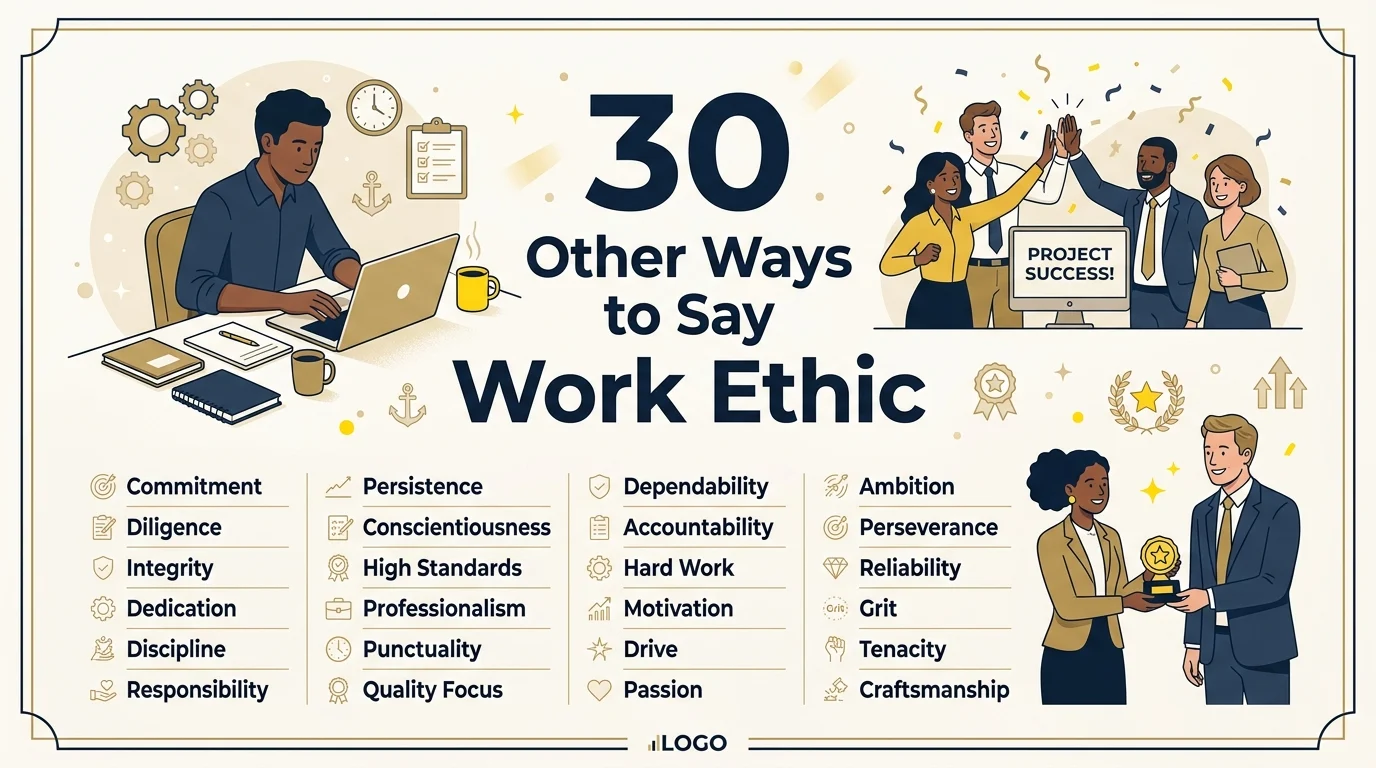
30 Powerful Alternatives to “Work Ethic” (With Examples)
These alternatives will help you sound more professional, articulate, and confident in any work-related context. Use them according to tone, audience, and the specific aspect of work ethic you wish to emphasize.
Formal Alternatives to “Work Ethic”
1. Phrase: Diligence
Meaning: Careful, persistent, and dedicated effort in work
Explanation: Emphasizes thoroughness and attention to detail
Example Sentence: “Her diligence in reviewing every contract clause saved the company from potential legal issues.”
Best Use: Quality-focused roles
Worst Use: Casual conversation
Tone: Formal, respectful
Context Variability: Professional: “The success of the project reflects the team’s diligence.”
2. Phrase: Dedication
Meaning: Complete commitment to a task, role, or purpose
Explanation: Suggests loyalty and sustained effort over time
Example Sentence: “His dedication to mentoring junior staff has created a supportive team culture.”
Best Use: Long-term commitment
Worst Use: One-time tasks
Tone: Committed, sincere
Context Variability: Professional: “We appreciate your dedication to this demanding project.”
3. Phrase: Professionalism
Meaning: The combination of skill, competence, and ethical behavior
Explanation: Encompasses both technical ability and workplace conduct
Example Sentence: “Her professionalism during the crisis inspired confidence in the entire team.”
Best Use: Overall workplace conduct
Worst Use: Task-specific contexts
Tone: Formal, respected
Context Variability: Professional: “The department’s professionalism has enhanced our reputation.”
4. Phrase: Conscientiousness
Meaning: The quality of being thorough, careful, and driven by a sense of duty
Explanation: Psychological term for organized, responsible behavior
Example Sentence: “His conscientiousness in meeting deadlines has made him invaluable to the team.”
Best Use: Personality assessments
Worst Use: Casual chat
Tone: Academic, psychological
Context Variability: Professional: “Conscientiousness is a key predictor of job performance.”
5. Phrase: Tenacity
Meaning: Persistent determination and refusal to give up
Explanation: Focuses on perseverance through challenges
Example Sentence: “Her tenacity in turning around failing accounts impressed senior management.”
Best Use: Overcoming obstacles
Worst Use: Routine tasks
Tone: Determined, resilient
Context Variability: Professional: “His tenacity has been crucial to our market expansion.”
6. Phrase: Assiduity
Meaning: Constant, diligent application to a task
Explanation: Formal term for unwavering commitment and care
Example Sentence: “The assiduity of the research team ensured the study’s validity.”
Best Use: Academic or legal contexts
Worst Use: Everyday business
Tone: Highly formal
Context Variability: Professional: “We value the assiduity of our quality control staff.”
7. Phrase: Industriousness
Meaning: Hard-working and productive character
Explanation: Emphasizes sustained effort and output
Example Sentence: “The team’s industriousness led to completing the project three weeks early.”
Best Use: Production-focused roles
Worst Use: Service industries
Tone: Formal, historical
Context Variability: Professional: “Her industriousness has doubled departmental output.”
8. Phrase: Perseverance
Meaning: Continued effort despite difficulties or delays
Explanation: Focuses on endurance and resilience
Example Sentence: “His perseverance through multiple failed prototypes resulted in the breakthrough.”
Best Use: Long-term projects
Worst Use: Quick tasks
Tone: Inspirational, respectful
Context Variability: Professional: “Perseverance has been key to our R&D success.”
9. Phrase: Reliability
Meaning: Consistently dependable and trustworthy performance
Explanation: Focuses on trust and accountability
Example Sentence: “Her reliability means I can assign critical tasks without hesitation.”
Best Use: Trust-based roles
Worst Use: Creative positions
Tone: Trustworthy, solid
Context Variability: Professional: “We depend on your reliability in client-facing situations.”
10. Phrase: Accountability
Meaning: Taking ownership of tasks, outcomes, and responsibilities
Explanation: Emphasizes personal responsibility and follow-through
Example Sentence: “The team’s accountability for their decisions improved project outcomes significantly.”
Best Use: Leadership contexts
Worst Use: Entry-level positions
Tone: Responsible, mature
Context Variability: Professional: “Accountability is central to our organizational culture.”
“The words you choose shape how others perceive your professional identity. Be intentional.”
Professional Alternatives to “Work Ethic”
11. Phrase: Commitment
Meaning: Dedication to a cause, role, or organization
Explanation: Suggests loyalty and long-term investment
Example Sentence: “The team’s commitment to excellence has been recognized by our clients.”
Best Use: Mission-driven contexts
Worst Use: Short-term projects
Tone: Passionate, engaged
Context Variability: Professional: “We value your commitment to our shared goals.”
12. Phrase: Discipline
Meaning: Self-control and consistent adherence to standards
Explanation: Focuses on structure, routine, and personal accountability
Example Sentence: “His discipline in following processes ensures consistent quality.”
Best Use: Procedure-based roles
Worst Use: Creative positions
Tone: Structured, controlled
Context Variability: Professional: “Discipline is essential for maintaining our standards.”
13. Phrase: Drive
Meaning: Inner motivation and ambition to achieve goals
Explanation: Highlights initiative and forward momentum
Example Sentence: “Her drive to succeed inspires everyone around her.”
Best Use: Sales or growth roles
Worst Use: Administrative tasks
Tone: Energetic, ambitious
Context Variability: Professional: “The team’s drive pushed us past our targets.”
14. Phrase: Initiative
Meaning: The ability to act proactively without needing direction
Explanation: Focuses on independent action and problem-solving
Example Sentence: “His initiative in identifying market gaps created new revenue streams.”
Best Use: Innovation contexts
Worst Use: Compliance roles
Tone: Proactive, creative
Context Variability: Professional: “We reward employees who show initiative.”
15. Phrase: Determination
Meaning: Firm commitment to achieving a goal regardless of obstacles
Explanation: Similar to tenacity but broader in application
Example Sentence: “The team’s determination resulted in a successful product launch.”
Best Use: Challenging projects
Worst Use: Daily routine work
Tone: Strong, purposeful
Context Variability: Professional: “Determination has been our greatest asset.”
16. Phrase: Punctuality
Meaning: Being consistently on time and meeting deadlines
Explanation: A specific aspect of work ethic focused on timeliness
Example Sentence: “Her punctuality and reliability make her a valuable team member.”
Best Use: Time-sensitive roles
Worst Use: Remote/flexible settings
Tone: Practical, dependable
Context Variability: Professional: “Punctuality reflects respect for everyone’s time.”
17. Phrase: Efficiency
Meaning: Achieving maximum productivity with minimum wasted effort
Explanation: Focuses on smart work and resource optimization
Example Sentence: “Her efficiency in streamlining processes saved the department thousands.”
Best Use: Operations roles
Worst Use: Creative fields
Tone: Smart, practical
Context Variability: Professional: “Efficiency is valued across all departments.”
18. Phrase: Resourcefulness
Meaning: Finding creative solutions with limited resources
Explanation: Highlights problem-solving and adaptability
Example Sentence: “Her resourcefulness kept the project moving despite budget cuts.”
Best Use: Startups or constrained environments
Worst Use: Luxury/abundant contexts
Tone: Creative, adaptable
Context Variability: Professional: “Resourcefulness often trumps experience.”
19. Phrase: Integrity
Meaning: Adherence to moral and ethical principles
Explanation: Connects work ethic to honesty and character
Example Sentence: “His integrity in financial reporting has built trust with stakeholders.”
Best Use: Ethics-critical roles
Worst Use: Manual labor contexts
Tone: Principled, trustworthy
Context Variability: Professional: “We operate with integrity in all dealings.”
20. Phrase: Grit
Meaning: Courage, resolve, and strength of character
Explanation: Popular modern term for resilience and determination
Example Sentence: “Her grit in facing challenges has made her a role model.”
Best Use: Inspirational contexts
Worst Use: Formal documents
Tone: Tough, admirable
Context Variability: Professional: “Grit distinguishes good employees from great ones.”
“Professional language isn’t about sounding fancy—it’s about being understood with precision.”
Informal Expressions for “Work Ethic”
21. Phrase: Go-getter
Meaning: An ambitious, energetic person who pursues goals
Explanation: Describes someone who takes initiative
Example Sentence: “We need more go-getters who aren’t afraid to challenge the status quo.”
Best Use: Team motivation
Worst Use: Formal references
Tone: Energetic, enthusiastic
Context Variability: Casual: “She’s a real go-getter—always pushing for improvement.”
22. Phrase: Grind
Meaning: Hard, consistent work often done diligently
Explanation: Modern term for sustained effort
Example Sentence: “The team respected his grind—he never stopped until the work was done.”
Best Use: Startups or modern workplaces
Worst Use: Corporate formal contexts
Tone: Modern, relatable
Context Variability: Casual: “Everyone appreciates her grind and commitment.”
23. Phrase: Hustle
Meaning: Energetic, determined effort
Explanation: Often associated with entrepreneurship
Example Sentence: “Her hustle has taken the company to new heights.”
Best Use: Sales or entrepreneurial contexts
Worst Use: Formal environments
Tone: Energetic, modern
Context Variability: Casual: “The hustle in this team is incredible.”
24. Phrase: Strong work game
Meaning: Excellent work habits and performance
Explanation: Informal way to praise someone’s work ethic
Example Sentence: “Her strong work game has earned her a lot of respect.”
Best Use: Casual praise
Worst Use: Professional documentation
Tone: Friendly, modern
Context Variability: Casual: “You’ve got a strong work game—keep it up!”
25. Phrase: Nose to the grindstone
Meaning: Working continuously and diligently
Explanation: An idiom describing sustained effort
Example Sentence: “He’s had his nose to the grindstone all week to meet the deadline.”
Best Use: Creative contexts
Worst Use: Formal meetings
Tone: Idiomatic, expressive
Context Variability: Casual: “She keeps her nose to the grindstone.”
26. Phrase: Workhorse
Meaning: A person who works extremely hard
Explanation: Describes someone who carries heavy workloads
Example Sentence: “She’s the workhorse of the department—completely dependable.”
Best Use: Praising dedication
Worst Use: Formal settings
Tone: Practical, appreciative
Context Variability: Casual: “He’s a workhorse; you can always count on him.”
27. Phrase: Unsung hero
Meaning: Someone whose hard work goes unrecognized
Explanation: Describes diligent but overlooked team members
Example Sentence: “Our logistics team are the unsung heroes of every major launch.”
Best Use: Team recognition
Worst Use: Individual contexts
Tone: Grateful, acknowledging
Context Variability: Casual: “The unsung heroes deserve more recognition.”
Casual Alternatives to “Work Ethic”
28. Phrase: “On it” mentality
Meaning: The attitude of immediately tackling tasks
Explanation: Describes proactive, responsive behavior
Example Sentence: “Her ‘on it’ mentality means nothing falls through the cracks.”
Best Use: Fast-paced environments
Worst Use: Strategic roles
Tone: Alert, responsive
Context Variability: Casual: “We love the ‘on it’ mentality in this team.”
29. Phrase: Self-starter
Meaning: Someone who works independently without supervision
Explanation: Emphasizes independence and initiative
Example Sentence: “We’re looking for self-starters who can own their projects.”
Best Use: Remote work
Worst Use: Highly collaborative roles
Tone: Independent, capable
Context Variability: Casual: “She’s a self-starter—she needs minimal supervision.”
30. Phrase: Can-do attitude
Meaning: Willingness to tackle challenges with optimism
Explanation: Describes positive, solution-focused behavior
Example Sentence: “His can-do attitude has been infectious in the team.”
Best Use: Team culture
Worst Use: Technical documentation
Tone: Positive, encouraging
Context Variability: Casual: “We need more can-do attitudes in the office.”
Common Mistakes Using “Work Ethic”
1. Mistake: Using “work ethic” to describe skill rather than effort
Example: ❌ “Her work ethic in coding is excellent.”
Fix: Use “technical skills”—“Her coding skills are excellent.”
2. Mistake: Describing “good work ethic” without specific examples
Example: ❌ “He has a good work ethic.”
Fix: Specify behaviors—“He consistently meets deadlines and delivers high-quality work.”
3. Mistake: Overusing “work ethic” in resumes
Example: ❌ “Strong work ethic. Excellent work ethic. Proven work ethic.”
Fix: Vary vocabulary—“Diligent, reliable, and highly motivated professional…”
4. Mistake: Confusing “work ethic” with “work-life balance”
Example: ❌ “A good work ethic means working 60 hours a week.”
Fix: Distinguish—“Work ethic is about quality, not just quantity of hours.”
5. Mistake: Using “work ethic” interchangeably with “productivity”
Example: ❌ “Improving work ethic will increase output.”
Fix: Be specific—“Improving processes will increase productivity.”
Comparison Table: Top Alternatives
| Phrase | Tone | Best Use |
|---|---|---|
| Diligence | Formal, respectful | Quality-focused roles |
| Dedication | Committed, sincere | Long-term commitment |
| Professionalism | Formal, respected | Overall workplace conduct |
| Reliability | Trustworthy, solid | Trust-based roles |
| Tenacity | Determined, resilient | Overcoming obstacles |
| Conscientiousness | Academic, psychological | Personality assessments |
| Discipline | Structured, controlled | Procedure-based roles |
| Drive | Energetic, ambitious | Sales or growth roles |
| Initiative | Proactive, creative | Innovation contexts |
| Grit | Tough, admirable | Inspirational contexts |
Mini Quiz / Self-Check
1. You’re writing a formal job reference for a colleague. Which word is MOST appropriate?
- A) Hustle
- B) Diligence
- C) Grind
- D) On it mentality
Answer: B) Diligence
2. You’re describing someone who works well independently. Which phrase fits BEST?
- A) Workhorse
- B) Go-getter
- C) Self-starter
- D) Nose to the grindstone
Answer: C) Self-starter
3. You’re in a performance review praising a team member’s ability to overcome challenges. Which word is MOST suitable?
- A) Punctuality
- B) Tenacity
- C) Efficiency
- D) Conscientiousness
Answer: B) Tenacity
4. A startup founder says, “We need more hustle in the team.” In what context is this LEAST appropriate?
- A) Creative brainstorming session
- B) Formal board meeting
- C) Team pep talk
- D) New hire orientation
Answer: B) Formal board meeting
“Mastering professional vocabulary isn’t about impressing people—it’s about communicating your true value.”
FAQs
Q1: What are the best formal alternatives to “work ethic”?
The most effective formal alternatives include “diligence,” “dedication,” “professionalism,” “conscientiousness,” and “tenacity.” These terms convey structured, thoughtful commitment appropriate for resumes, references, and performance reviews.
Q2: How can I describe strong work ethic without using those exact words?
Use specific descriptors like “reliable,” “dedicated,” “self-motivated,” “detail-oriented,” and “consistent.” For example: “She consistently delivers high-quality work ahead of deadlines.”
Q3: What’s the difference between “work ethic” and “professionalism”?
“Work ethic” specifically focuses on effort, dedication, and task completion, while “professionalism” encompasses a broader range of workplace behaviors including communication, appearance, ethics, and relationships.
Q4: Can I use “grit” in a professional context?
Yes, but use it carefully. “Grit” is appropriate in motivational contexts, team discussions, and informal professional settings. Avoid it in highly formal documents like cover letters for conservative industries.
Q5: How many alternatives to “work ethic” should I know?
Mastering 10-15 alternatives across formal, professional, and casual tones will significantly improve your workplace communication. This article provides 30 options to help you articulate professional strengths with precision.
Conclusion
Expanding your vocabulary to include alternatives to work ethic will transform your professional communication. Whether you’re writing a resume, giving feedback, or describing your strengths in an interview, choosing the right word demonstrates linguistic sophistication and emotional intelligence.
Start incorporating these 30 alternatives into your daily professional language. Pay attention to the subtle differences between terms and select words that accurately reflect your specific strengths. Remember, great communication isn’t about using fancy words it’s about expressing your professional identity with clarity, precision, and authenticity.