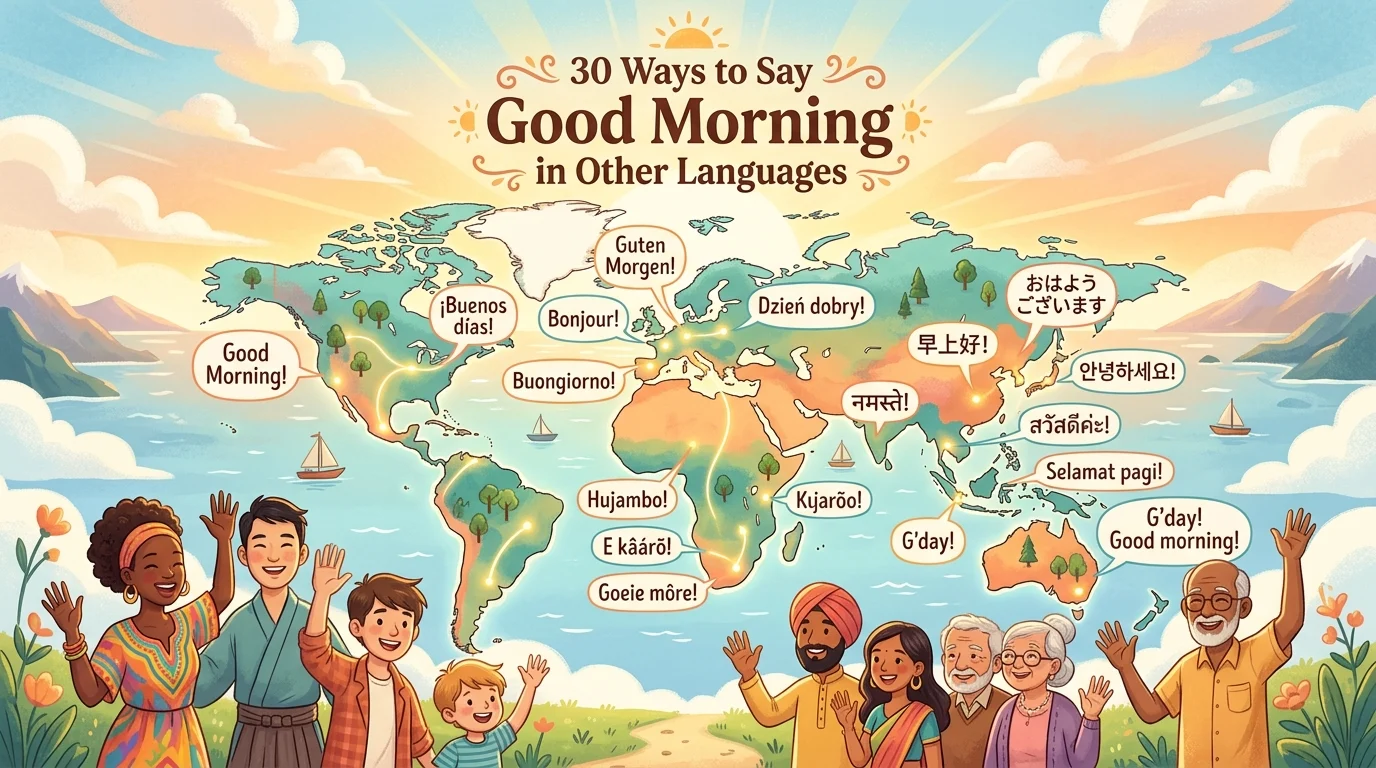
Saying “good morning” is one of the first social exchanges we make each day. In English, it’s simple and universal. But when you travel, work internationally, or connect with people from different cultures, knowing how to greet someone in their native language instantly builds rapport and shows respect.
Learning alternatives to good morning in other languages will transform your communication skills, opening doors to deeper connections and cultural appreciation. Just as you express excitement in English with varied vocabulary, using local greetings demonstrates emotional intelligence and global awareness. This article provides 30 morning greetings from around the world, complete with pronunciation tips, cultural context, and usage guidance.
Quick Categories
- Formal greetings (honorific, business settings)
- Casual greetings (friends, family, peers)
- Regional variations (dialects and local flavours)
- Professional greetings (workplace, customer service)
What Does “Good Morning” Mean?
“Good morning” is a polite salutation used to greet someone during the early part of the day, typically from sunrise until noon. It conveys goodwill, positivity, and a wish for the other person to have a pleasant day ahead.
Example Sentence (English): “Good morning, everyone—let’s make today productive.”
Grammar Note: In English, “good morning” is an interjection, often capitalised when starting a letter or email. In many languages, the phrase may be a fixed expression, a compound word, or a sentence with verb forms.
When to Use “Good Morning”
- Morning encounters: From waking until midday (approx. 12:00 PM)
- Professional settings: Starting meetings, emails, or phone calls
- Social situations: Greeting neighbours, shopkeepers, or friends
- Travel contexts: Interacting with locals in hotels, restaurants, or taxis
- Written communication: Opening emails or letters in the morning
Spoken vs Written: Spoken morning greetings are often accompanied by a smile and eye contact. Written forms (e.g., emails) are more formal and often include the recipient’s name.
Formal vs Informal: In English, “good morning” is neutral—appropriate for both formal and informal use. However, in many languages, the choice between formal and casual versions is critical (e.g., Japanese, Korean, French).
Is It Professional or Polite to Say “Good Morning”?
Polite? ✔️ Yes
Professional? ✔️ Yes (always appropriate)
“Good morning” is universally polite and professional. However, in international contexts, using the local equivalent elevates your professionalism exponentially. It signals cultural competence and genuine respect.
Business Example: “Good morning, Mr. Tanaka. Thank you for your time.”
Better (in Japanese): “Ohayou gozaimasu, Tanaka-san.”
Pros and Cons of Using “Good Morning” (in English)
Pros
- Universally understood – Safe in any English-speaking context
- Polite and friendly – Creates a positive tone
- Simple and straightforward – No risk of misunderstanding
- Time-specific – Clearly indicates the time of day
Cons
- Overly generic – Lacks cultural or personal touch
- Insufficient in global settings – May alienate non-native speakers
- Missed opportunity – Fails to demonstrate cultural awareness
- Rote repetition – Can feel automatic and unenthusiastic
“Learning to say ‘good morning’ in someone’s native language is like offering a handshake to their culture.”
30 Ways to Say “Good Morning” in Other Languages (With Examples)
These alternatives will help you sound more fluent, confident, and culturally aware. Use them according to context, region, and formality.
Formal & Professional Greetings
1. Phrase: Buenos días (Spanish)
Meaning: “Good days” – used throughout the morning
Explanation: The standard morning greeting across Spain and Latin America
Example Sentence: “Buenos días, señor. ¿Cómo está usted?” (Good morning, sir. How are you?)
Best Use: All Spanish-speaking countries
Worst Use: After noon (use “buenas tardes”)
Tone: Warm, respectful
Context Variability: Professional: “Buenos días, equipo” (Good morning, team).
2. Phrase: Bonjour (French)
Meaning: “Good day” – used from morning until early evening
Explanation: The essential French greeting; always use it before “au revoir”
Example Sentence: “Bonjour, madame. Je voudrais un café.” (Good morning, madam. I’d like a coffee.)
Best Use: Formal and informal alike
Worst Use: After 6 PM (use “bonsoir”)
Tone: Polite, elegant
Context Variability: Professional: “Bonjour à tous” (Good morning everyone).
3. Phrase: Guten Morgen (German)
Meaning: “Good morning” – literal translation
Explanation: Used until about 10–11 AM; after that, “Guten Tag” (good day)
Example Sentence: “Guten Morgen, Frau Schmidt. Wie geht es Ihnen?” (Good morning, Mrs. Schmidt. How are you?)
Best Use: Morning business meetings
Worst Use: Late morning (switch to “Guten Tag”)
Tone: Direct, efficient
Context Variability: Professional: “Guten Morgen, Kollegen” (Good morning, colleagues).
4. Phrase: Ohayou gozaimasu (Japanese)
Meaning: “Good morning” – formal/polite version
Explanation: Used until about 10 AM; the casual “ohayou” is for friends
Example Sentence: “Ohayou gozaimasu, Tanaka-san. Kaigi wa juu-ji desu.” (Good morning, Mr. Tanaka. The meeting is at 10.)
Best Use: Workplaces, elders, strangers
Worst Use: Close friends (use “ohayou”)
Tone: Respectful, polite
Context Variability: Professional: Always use the full form in business.
5. Phrase: Buongiorno (Italian)
Meaning: “Good day” – covers morning and early afternoon
Explanation: The standard Italian greeting until about 2 PM
Example Sentence: “Buongiorno, signore. Che cosa desidera?” (Good morning, sir. What would you like?)
Best Use: All formal and informal contexts
Worst Use: After 2 PM (use “buon pomeriggio”)
Tone: Melodic, friendly
Context Variability: Professional: “Buongiorno a tutti” (Good morning everyone).
6. Phrase: Dobré ráno (Czech)
Meaning: “Good morning” – direct translation
Explanation: Used until about 9 AM; after that, “dobrý den” (good day)
Example Sentence: “Dobré ráno, pane Nováku. Máte kávu?” (Good morning, Mr. Novák. Do you have coffee?)
Best Use: Morning encounters in Czechia
Worst Use: After 9 AM
Tone: Formal, clear
Context Variability: Professional: Use with formal address.
7. Phrase: God morgen (Danish/Norwegian)
Meaning: “Good morning” – identical in both languages
Explanation: Used until about 10 AM; casual enough for any setting
Example Sentence: “God morgen, alle sammen. Hvordan har I det?” (Good morning, everyone. How are you?)
Best Use: Scandinavia
Worst Use: Late morning
Tone: Warm, informal
Context Variability: Professional: Works in offices.
8. Phrase: Goedemorgen (Dutch)
Meaning: “Good morning” – one word in Dutch
Explanation: Used until noon; after that “goedemiddag”
Example Sentence: “Goedemorgen, meneer. Wat kan ik voor u doen?” (Good morning, sir. What can I do for you?)
Best Use: Netherlands, Belgium
Worst Use: After noon
Tone: Polite, neutral
Context Variability: Professional: Standard in business.
9. Phrase: Dzień dobry (Polish)
Meaning: “Good day” – used all day until evening
Explanation: The universal Polish greeting; morning-specific is “dzień dobry” anyway
Example Sentence: “Dzień dobry, pani Mario. Jak się pani ma?” (Good morning, Ms. Maria. How are you?)
Best Use: All day (but works for morning)
Worst Use: Evening (use “dobry wieczór”)
Tone: Formal, respectful
Context Variability: Professional: Always use with “pan/pani”.
10. Phrase: Bom dia (Portuguese)
Meaning: “Good day” – morning greeting in Portugal and Brazil
Explanation: Used until noon; after that “boa tarde”
Example Sentence: “Bom dia, como você está?” (Good morning, how are you?)
Best Use: All Lusophone countries
Worst Use: After noon
Tone: Friendly, musical
Context Variability: Professional: Common in offices.
“A simple morning greeting in the local language can turn a stranger into a friend within seconds.”
Casual & Informal Greetings
11. Phrase: Ohayou (Japanese)
Meaning: Casual “good morning”
Explanation: Used with friends, family, and close colleagues
Example Sentence: “Ohayou! Kyō wa ii tenki da ne.” (Morning! The weather is nice today, isn’t it?)
Best Use: Social settings
Worst Use: Formal or business contexts
Tone: Relaxed, friendly
Context Variability: Casual: Never use with superiors.
12. Phrase: Salut (French)
Meaning: “Hi” – but can be used as a casual morning greeting
Explanation: Not strictly “good morning,” but common among friends in the morning
Example Sentence: “Salut, ça va ?” (Morning, how’s it going?)
Best Use: Friends and peers
Worst Use: Professional or with strangers
Tone: Very casual
Context Variability: Casual: Only with known acquaintances.
13. Phrase: Ciao (Italian)
Meaning: “Hi/Bye” – can be used in the morning casually
Explanation: Common among friends, but less formal than “buongiorno”
Example Sentence: “Ciao, come stai?” (Morning, how are you?)
Best Use: Informal morning greetings
Worst Use: Professional or with elders
Tone: Informal, friendly
Context Variability: Casual: Not appropriate in business.
14. Phrase: Morgen! (German)
Meaning: Shortened “Guten Morgen” – very casual
Explanation: Used among friends and family; omits “guten”
Example Sentence: “Morgen! Alles klar?” (Morning! All good?)
Best Use: Casual conversations
Worst Use: Formal or with unknown people
Tone: Laid-back
Context Variability: Casual: Never in written business communication.
15. Phrase: ‘Morning! (English slang)
Meaning: Shortened “good morning”
Explanation: Common in informal spoken English
Example Sentence: “‘Morning, mate. Coffee?”
Best Use: Friends, colleagues (informal)
Worst Use: Formal letters, emails
Tone: Casual, familiar
Context Variability: Casual: Fine in most spoken contexts.
16. Phrase: Guten Morgen, ihr Lieben! (German)
Meaning: “Good morning, my dears!” – affectionate casual
Explanation: Used among close friends or family members
Example Sentence: “Guten Morgen, ihr Lieben! Frühstück ist fertig.” (Morning, darlings! Breakfast is ready.)
Best Use: Intimate groups
Worst Use: Professional
Tone: Warm, affectionate
Context Variability: Personal: Only with close circle.
Regional & Cultural Variations
17. Phrase: Sabah al-khayr (Arabic)
Meaning: “Morning of goodness”
Explanation: Standard morning greeting across the Arab world
Example Sentence: “Sabah al-khayr, ya ustaz. Kayfa haluka?” (Good morning, teacher. How are you?)
Best Use: All Arabic-speaking countries
Worst Use: After noon (use “masa’ al-khayr”)
Tone: Warm, respectful
Context Variability: Professional: Very common in business.
18. Phrase: Shubh prabhat (Hindi)
Meaning: “Auspicious morning”
Explanation: Formal morning greeting in Hindi
Example Sentence: “Shubh prabhat, ji. Aap kaise hain?” (Good morning, sir. How are you?)
Best Use: Formal and respectful
Worst Use: Casual friends (use “namaste” or “good morning”)
Tone: Formal, traditional
Context Variability: Professional: Used in formal settings.
19. Phrase: In’anga nziza (Kinyarwanda)
Meaning: “Beautiful morning” – Rwandan greeting
Explanation: Used to wish a pleasant morning
Example Sentence: “In’anga nziza, mwaramutse?” (Good morning, did you wake well?)
Best Use: Rwanda, Burundi
Worst Use: Outside East Africa
Tone: Kind, cultural
Context Variability: Professional: Appropriate in local offices.
20. Phrase: Selamat pagi (Indonesian/Malay)
Meaning: “Safe morning” – peace and safety wish
Explanation: Used from sunrise until about 10–11 AM
Example Sentence: “Selamat pagi, pak. Ada yang bisa saya bantu?” (Good morning, sir. Can I help you?)
Best Use: Indonesia, Malaysia, Singapore
Worst Use: After noon (use “selamat siang”)
Tone: Polite, friendly
Context Variability: Professional: Essential in business.
21. Phrase: Míngtiān zǎo (Chinese – 明天早) – Actually, that’s “tomorrow morning”. The correct is “Zǎo’ān” (早安) or “Zǎoshang hǎo” (早上好).
Let’s correct: Phrase: Zǎo’ān (早安 – Mandarin)
Meaning: “Morning peace” – less common; more standard is “Zǎoshang hǎo”
Explanation: “Zǎoshang hǎo” literally means “morning good”
Example Sentence: “Zǎoshang hǎo, dàjiā. Jīntiān tiānqì hěn hǎo.” (Good morning, everyone. The weather is nice today.)
Best Use: All Mandarin-speaking regions
Worst Use: In Taiwan, “zǎo” (早) is more casual
Tone: Neutral, polite
Context Variability: Professional: Standard in offices.
22. Phrase: Annyeonghaseyo (Korean – 안녕하세요)
Meaning: “Are you at peace?” – but used as a general greeting at any time
Explanation: While not morning-specific, it’s the standard polite greeting used in the morning
Example Sentence: “Annyeonghaseyo, gajang-nim. Eodi gaseyo?” (Good morning, boss. Where are you going?)
Best Use: Any time of day (but fine for morning)
Worst Use: Casual friends (use “annyeong”)
Tone: Respectful, formal
Context Variability: Professional: Used throughout the workday.
23. Phrase: Hyvää huomenta (Finnish)
Meaning: “Good morning” – direct translation
Explanation: Used until about 10 AM; after that “hyvää päivää”
Example Sentence: “Hyvää huomenta, mitä kuuluu?” (Good morning, how are you?)
Best Use: Finland
Worst Use: Late morning
Tone: Polite, straightforward
Context Variability: Professional: Common in workplaces.
24. Phrase: Boker tov (Hebrew – בוקר טוב)
Meaning: “Morning good” – literally
Explanation: Used from sunrise until midday
Example Sentence: “Boker tov, maspik? Yalla, nitkadem.” (Good morning, ready? Let’s get going.)
Best Use: Israel, Jewish communities
Worst Use: Afternoon
Tone: Cheerful, direct
Context Variability: Professional: Standard in Israeli business.
25. Phrase: Mirem ves (Kurdish)
Meaning: “Good morning” in Kurmanji Kurdish
Explanation: Used in Kurdish regions of Turkey, Syria, Iraq, Iran
Example Sentence: “Mirem ves, heval. Tu çawa yî?” (Good morning, friend. How are you?)
Best Use: Kurdish-speaking areas
Worst Use: Outside those regions
Tone: Friendly, cultural
Context Variability: Personal: Used in daily life.
26. Phrase: Saba’a el-khair (Egyptian Arabic)
Meaning: “Morning of goodness” – similar to standard but with Egyptian pronunciation
Explanation: The Egyptian dialect version; also “saba’a el-noor” as a response
Example Sentence: “Saba’a el-khair, ya basha. izzayyak?” (Good morning, boss. How are you?)
Best Use: Egypt
Worst Use: Other Arab countries (use standard instead)
Tone: Warm, colloquial
Context Variability: Professional: Fine in Egyptian offices.
27. Phrase: Ug’u (Bantu – Swahili) – Actually, Swahili is “Habari za asubuhi”
Let’s correct: Phrase: Habari za asubuhi (Swahili)
Meaning: “News of the morning?” – a typical Swahili greeting
Explanation: It’s a question, but functions as “good morning”
Example Sentence: “Habari za asubuhi? Mambo?” (Good morning? How are things?)
Best Use: East Africa
Worst Use: Formal business (use “shikamoo” for elders)
Tone: Friendly, cultural
Context Variability: Casual: More common among friends.
28. Phrase: Morek (Kazakh)
Meaning: “Morning” – short for “qayrly tań” (good morning)
Explanation: Informal way to greet in the morning in Kazakhstan
Example Sentence: “Morek, dostar! Qalaysıñdar?” (Morning, friends! How are you?)
Best Use: Informal settings
Worst Use: Formal or with elders
Tone: Casual, modern
Context Variability: Casual: Used among youth.
29. Phrase: Kalimera (Greek – καλημέρα)
Meaning: “Good day” – covers morning and early afternoon
Explanation: Used from sunrise until about 2 PM
Example Sentence: “Kalimera, kyrie. Ti kanete?” (Good morning, sir. How are you?)
Best Use: Greece and Cyprus
Worst Use: After 2 PM (use “kalispera”)
Tone: Warm, melodic
Context Variability: Professional: Very common.
30. Phrase: Günaydın (Turkish)
Meaning: “Day is bright” – poetic morning greeting
Explanation: Used from morning until noon; after that “iyi günler”
Example Sentence: “Günaydın, arkadaşlar. Haydi işe başlayalım.” (Good morning, friends. Let’s start work.)
Best Use: Turkey, Azerbaijan
Worst Use: Afternoon
Tone: Bright, positive
Context Variability: Professional: Standard in offices.
Common Mistakes When Saying “Good Morning” in Other Languages
1. Mistake: Using informal forms with strangers or superiors (e.g., “Ohayou” with a boss)
Example: ❌ “Ohayou, Tanaka-sama” – should be “Ohayou gozaimasu”
Fix: Learn the politeness levels before using any greeting.
2. Mistake: Using morning greetings after noon
Example: ❌ Saying “Buenos días” at 3 PM
Fix: Know the time cutoff (e.g., “buenas tardes” after noon in Spanish).
3. Mistake: Mispronouncing tones (especially in Mandarin)
Example: ❌ Saying “zǎo” with wrong tone (can sound like another word)
Fix: Listen to native audio; tones change meaning.
4. Mistake: Forgetting the appropriate response
Example: ❌ In Arabic, if someone says “Sabah al-khayr,” you must reply “Sabah al-noor” – not just “hello”
Fix: Learn the paired response for each culture.
5. Mistake: Using a greeting from a different dialect in the wrong region
Example: ❌ Using Egyptian “Saba’a el-khair” in Saudi Arabia (still understood but sounds odd)
Fix: Use standard Arabic (Fusha) or the local dialect you know.
Comparison Table: Top 10 Morning Greetings
| Phrase (Language) | Tone | Best Use |
|---|---|---|
| Buenos días (Spanish) | Warm, respectful | All Spanish-speaking countries |
| Bonjour (French) | Elegant, polite | France, Canada, Belgium, Switzerland |
| Guten Morgen (German) | Direct, efficient | Germany, Austria, Switzerland |
| Ohayou gozaimasu (Japanese) | Formal, respectful | Business, strangers, elders |
| Buongiorno (Italian) | Melodic, friendly | Italy, Switzerland |
| Sabah al-khayr (Arabic) | Warm, traditional | Arab world |
| Zǎoshang hǎo (Mandarin) | Neutral, clear | China, Taiwan, Singapore |
| Annyeonghaseyo (Korean) | Polite, versatile | Korea (any time of day) |
| Bom dia (Portuguese) | Friendly, musical | Brazil, Portugal, Angola |
| Goedemorgen (Dutch) | Neutral, polite | Netherlands, Belgium |
Mini Quiz / Self-Check
1. You are meeting a Japanese client at 9 AM. Which greeting should you use?
- A) Ohayou
- B) Ohayou gozaimasu
- C) Konnichiwa
- D) Ciao
Answer: B) Ohayou gozaimasu (formal morning greeting)
2. You are in France at 10 AM and want to greet a shopkeeper. What do you say?
- A) Bonsoir
- B) Salut
- C) Bonjour
- D) Au revoir
Answer: C) Bonjour (standard morning greeting)
3. You are in Spain at 2:30 PM. What greeting should you use?
- A) Buenos días
- B) Buenas tardes
- C) Buenas noches
- D) Hola
Answer: B) Buenas tardes (good afternoon)
4. You are greeting close friends in Germany in the morning. Which is most appropriate?
- A) Guten Morgen
- B) Morgen!
- C) Guten Tag
- D) Hallo
Answer: B) Morgen! (casual shortened form)
“A mispronounced greeting is better than no greeting at all. Effort always earns goodwill.”
FAQs
Q1: What is the most widely understood way to say “good morning” in other languages?
English “good morning” is globally understood, but “bonjour” (French) and “buenos días” (Spanish) are also widely recognised due to colonial history and tourism. For maximum impact, use the local language.
Q2: Should I use formal or informal morning greetings when travelling?
Always default to formal when unsure. In Japan, Korea, and Arabic countries, formal is safer. In Western Europe, formal is fine but casual may be accepted with peers.
Q3: Are there languages where “good morning” is not used?
Some languages lack a specific morning greeting. For example, in Hawaiian, “Aloha” serves for any time. In Korean, “Annyeonghaseyo” works all day. Always check cultural norms.
Q4: How do I respond when someone greets me in their language?
Learn the standard response. For example, in Arabic, reply “Sabah al-noor” (morning of light). In Spanish, you can reply “Buenos días” back or “Igualmente” (likewise).
Q5: What are the trickiest morning greetings to pronounce?
Mandarin Chinese tones, Japanese pitch accent, and Arabic guttural sounds can be challenging. Practice with audio guides and ask natives for feedback—they appreciate your effort.
Conclusion
Learning alternatives to good morning in other languages is one of the simplest yet most impactful ways to build bridges across cultures. Each greeting carries the history, values, and warmth of its people. By mastering these 30 greetings, you’re not just learning words—you’re demonstrating respect, curiosity, and a genuine desire to connect.
Start with one or two languages relevant to your life or travels. Practice pronunciation daily, and don’t be afraid to make mistakes. Native speakers will always appreciate your effort, and each correct greeting will open doors you never expected. Remember, the world is a mosaic of voices and every “good morning” in a new language adds a beautiful tile to that picture.