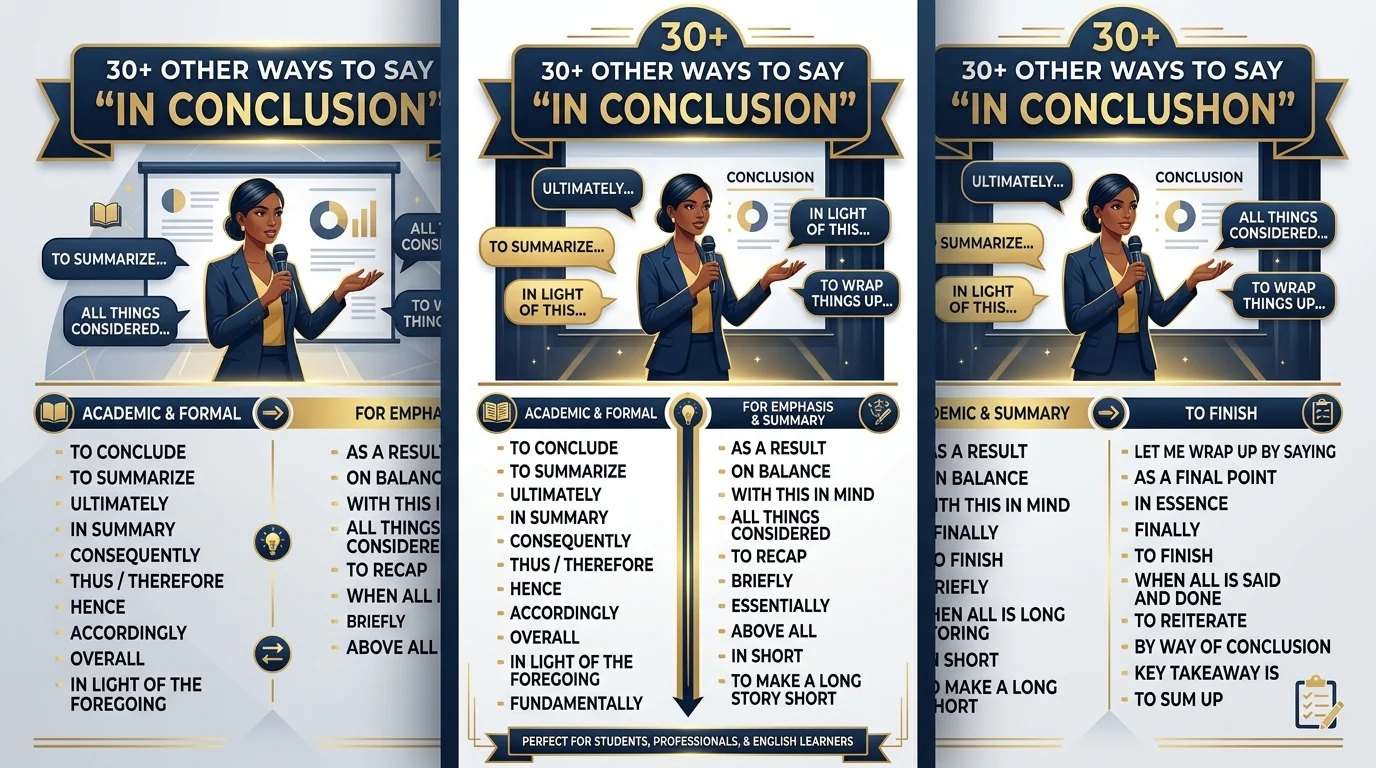
Looking for other ways to say “in conclusion”? Here are 5 top alternatives: to summarize, in summary, ultimately, to conclude, and all things considered. Each fits different contexts and tones.
“In conclusion” is one of the most overused transition phrases in English. While it serves a clear purpose signaling the end of a presentation, essay, or speech relying on it exclusively makes your writing sound repetitive and formulaic. Knowing alternatives to “in conclusion” will elevate your communication and keep your audience engaged.
Learning other ways to say “in conclusion” helps you express ideas in English more naturally while adapting your tone to different audiences. Whether you’re writing an academic paper, delivering a business presentation, or crafting a persuasive essay, this guide will give you 30+ powerful alternatives with real-world examples.
Quick Categories Section
Formal Alternatives to “In Conclusion”
- In summary
- To summarize
- To conclude
- In closing
- Ultimately
Academic Alternatives
- As demonstrated
- In light of this
- Taking everything into account
- Given these points
- All factors considered
Professional Alternatives
- To wrap up
- In the final analysis
- All things considered
- On the whole
- To bring it all together
Casual/Conversational Alternatives
- In a nutshell
- To cut a long story short
- The bottom line is
- At the end of the day
- All in all
Persuasive/Impactful Alternatives
- As a result
- Consequently
- Therefore
- Thus
- Hence
Pro Tips Box 💡
Pro Tip: When choosing from these alternatives to “in conclusion”, consider your medium. Written essays benefit from formal academic phrases, while spoken presentations allow for more conversational closings.
Common Mistakes Section
- Using multiple concluding phrases in one closing paragraph
- ❌ “In summary, to conclude, ultimately, we must act now.”
- ✅ “In summary, we must act now.”
- Using overly casual phrases in academic writing
- ❌ “In a nutshell, the research proves this theory.”
- ✅ “In summary, the research proves this theory.”
- Using “in conclusion” as a filler rather than a signal
- ❌ “In conclusion, I’d like to mention one more thing…”
- ✅ “In conclusion, these findings demonstrate our success.”
- Starting a new point after “in conclusion”
- ❌ “In conclusion, the project succeeded. Additionally, we learned many lessons.”
- ✅ “In conclusion, the project succeeded by teaching us many lessons.”
- Forgetting to actually conclude after the phrase
- ❌ “To summarize, let’s consider various options.”
- ✅ “To summarize, we recommend option A.”
What Does “In Conclusion” Mean?
In conclusion is a transitional phrase used to introduce the final statements in a speech, essay, or presentation. It signals that the speaker or writer is about to summarize key points and provide a final perspective. In grammar, it functions as a prepositional phrase and typically appears at the beginning of a concluding paragraph.
Example: “In conclusion, the evidence clearly supports our hypothesis.”
When to Use “In Conclusion”
- Academic essays: Standard but overused
- Business presentations: Common but can seem robotic
- Formal speeches: Appropriate for structured closings
- Research papers: Acceptable but better alternatives exist
- Spoken vs Written: More acceptable in spoken contexts
- Formal vs Informal: Used primarily in formal settings
Is It Professional or Polite to Say “In Conclusion”?
“In conclusion” is both professional and polite, but it can sound robotic and formulaic. Professional closing phrases like “to summarize” or “in the final analysis” often feel more natural.
Example: “In conclusion, our quarterly performance exceeded expectations.” (Acceptable)
Better: “To summarize, our quarterly performance exceeded expectations.”
Polite? ✔️ Yes
Professional? ✔️ Yes (but overused)
Pros and Cons of Using “In Conclusion”
Pros
- Universally understood
- Clear signal of ending
- Appropriate for all formal contexts
- Simple and straightforward
Cons
- Overused and clichéd
- Can sound robotic
- Lacks creativity
- May bore your audience
Other Ways to Say “In Conclusion” (With Examples)
These alternatives to “in conclusion” will help you sound more fluent, confident, and natural in different situations. Use them according to tone, context, and audience.
1. Phrase: To Summarize
Meaning: To provide a brief overview of the main points.
Explanation: This is a professional and direct way to introduce a conclusion.
Example Sentence: “To summarize, our findings indicate a significant increase in customer satisfaction.”
Best Use: Business presentations
Worst Use: Casual conversations
Tone: Professional, direct
Context Variability: Professional/Academic
2. Phrase: In Summary
Meaning: A concise way to present the key takeaways.
Explanation: Slightly more formal than “to summarize” but equally clear.
Example Sentence: “In summary, the project was a success on all metrics.”
Best Use: Reports and essays
Worst Use: Speeches
Tone: Professional, clear
Context Variability: Academic/Professional
3. Phrase: To Conclude
Meaning: To bring something to an end with final thoughts.
Explanation: A formal alternative that maintains professionalism.
Example Sentence: “To conclude, I’d like to thank everyone for their contributions.”
Best Use: Formal speeches
Worst Use: Social media posts
Tone: Formal, respectful
Context Variability: Formal only
4. Phrase: Ultimately
Meaning: In the end; after everything is considered.
Explanation: Creates a sense of finality while sounding sophisticated.
Example Sentence: “Ultimately, our decision will impact the entire organization.”
Best Use: Persuasive writing
Worst Use: Academic essays
Tone: Sophisticated, impactful
Context Variability: Professional/Formal
5. Phrase: All Things Considered
Meaning: Taking every factor into account.
Explanation: A balanced way to present a conclusion.
Example Sentence: “All things considered, we believe this is the best course of action.”
Best Use: Professional discussions
Worst Use: Academic papers
Tone: Measured, thoughtful
Context Variability: Professional/Casual
6. Phrase: In Closing
Meaning: A polite way to signal the end of a speech.
Explanation: Often used in spoken contexts like presentations.
Example Sentence: “In closing, I want to leave you with one final thought.”
Best Use: Speeches
Worst Use: Written essays
Tone: Warm, engaging
Context Variability: Formal/Spoken
7. Phrase: To Wrap Up
Meaning: To finish or conclude something.
Explanation: More conversational but acceptable in professional settings.
Example Sentence: “To wrap up, let’s review our key takeaways.”
Best Use: Meetings
Worst Use: Academic writing
Tone: Professional, accessible
Context Variability: Professional/Casual
8. Phrase: In the Final Analysis
Meaning: After examining all evidence and perspectives.
Explanation: A sophisticated way to present a conclusion.
Example Sentence: “In the final analysis, the benefits far outweigh the costs.”
Best Use: Business reports
Worst Use: Casual settings
Tone: Analytical, formal
Context Variability: Professional/Academic
9. Phrase: To Bring It All Together
Meaning: To synthesize various points into a coherent conclusion.
Explanation: Emphasizes the connection between ideas.
Example Sentence: “To bring it all together, our strategy addresses all key challenges.”
Best Use: Presentations
Worst Use: Academic papers
Tone: Engaging, clear
Context Variability: Professional
10. Phrase: In a Nutshell
Meaning: A concise summary of the main points.
Explanation: Informal but widely understood and used.
Example Sentence: “In a nutshell, we need to improve our customer service.”
Best Use: Casual meetings
Worst Use: Formal reports
Tone: Informative, casual
Context Variability: Casual only
11. Phrase: To Cut a Long Story Short
Meaning: To provide a brief summary of a longer situation.
Explanation: A conversational way to conclude a narrative.
Example Sentence: “To cut a long story short, we decided to change our approach.”
Best Use: Storytelling
Worst Use: Professional writing
Tone: Informal, narrative
Context Variability: Casual only
12. Phrase: The Bottom Line Is
Meaning: The most important or fundamental point.
Explanation: Emphasizes the central conclusion.
Example Sentence: “The bottom line is that we must increase our sales.”
Best Use: Business discussions
Worst Use: Academic essays
Tone: Direct, impactful
Context Variability: Professional/Casual
13. Phrase: At the End of the Day
Meaning: After everything has been considered.
Explanation: A casual but widely accepted concluding phrase.
Example Sentence: “At the end of the day, what matters most is customer satisfaction.”
Best Use: Casual conversations
Worst Use: Formal writing
Tone: Conversational, warm
Context Variability: Casual/Professional
14. Phrase: On the Whole
Meaning: Generally; considering everything.
Explanation: A balanced way to present an overall conclusion.
Example Sentence: “On the whole, the initiative achieved its primary objectives.”
Best Use: Professional reports
Worst Use: Personal messages
Tone: Measured, formal
Context Variability: Professional/Academic
15. Phrase: All in All
Meaning: Everything considered.
Explanation: A simple, versatile concluding phrase.
Example Sentence: “All in all, it was a productive and successful quarter.”
Best Use: Business reviews
Worst Use: Academic papers
Tone: Warm, positive
Context Variability: Casual/Professional
16. Phrase: As a Result
Meaning: Consequently; because of what was discussed.
Explanation: Shows cause and effect in the conclusion.
Example Sentence: “As a result, we have decided to expand our operations.”
Best Use: Persuasive writing
Worst Use: Introductory conclusions
Tone: Logical, direct
Context Variability: All contexts
17. Phrase: Consequently
Meaning: As a result; therefore.
Explanation: A formal way to show logical consequence.
Example Sentence: “Consequently, our market share has increased significantly.”
Best Use: Academic writing
Worst Use: Casual conversations
Tone: Formal, logical
Context Variability: Academic/Professional
18. Phrase: Therefore
Meaning: For that reason; as a result.
Explanation: A classic logical connector for conclusions.
Example Sentence: “Therefore, we recommend implementing the new system.”
Best Use: Formal writing
Worst Use: Casual texts
Tone: Formal, persuasive
Context Variability: All contexts
19. Phrase: Thus
Meaning: Consequently; as a result.
Explanation: A concise, formal concluding connector.
Example Sentence: “Thus, the evidence supports our original hypothesis.”
Best Use: Academic papers
Worst Use: Everyday conversations
Tone: Formal, academic
Context Variability: Academic only
20. Phrase: Hence
Meaning: For this reason; as a consequence.
Explanation: Similar to “therefore” but more literary.
Example Sentence: “Hence, we must reconsider our approach.”
Best Use: Formal writing
Worst Use: Casual settings
Tone: Classical, formal
Context Variability: Formal/Academic
21. Phrase: To Recap
Meaning: To review the main points briefly.
Explanation: Emphasizes the review aspect of the conclusion.
Example Sentence: “To recap, we’ve covered three main strategies.”
Best Use: Presentations
Worst Use: Academic papers
Tone: Professional, clear
Context Variability: Professional
22. Phrase: Given These Points
Meaning: Taking into account the points discussed.
Explanation: Directly references previous arguments.
Example Sentence: “Given these points, we believe the project should proceed.”
Best Use: Persuasive essays
Worst Use: Brief presentations
Tone: Logical, formal
Context Variability: Academic/Professional
23. Phrase: Taking Everything into Account
Meaning: Considering all factors and perspectives.
Explanation: A thorough and measured concluding phrase.
Example Sentence: “Taking everything into account, the team performed admirably.”
Best Use: Reviews and reports
Worst Use: Short presentations
Tone: Measured, thoughtful
Context Variability: Professional
24. Phrase: As Demonstrated
Meaning: Based on evidence that has been shown.
Explanation: Connects conclusion directly to proof.
Example Sentence: “As demonstrated, this approach yields the best results.”
Best Use: Research papers
Worst Use: Casual conversations
Tone: Academic, evidence-based
Context Variability: Academic only
25. Phrase: In Light of This
Meaning: Considering this information.
Explanation: Shows how new understanding affects the conclusion.
Example Sentence: “In light of this, we recommend updating our policy.”
Best Use: Professional reports
Worst Use: Casual settings
Tone: Analytical, formal
Context Variability: Professional/Academic
26. Phrase: All Factors Considered
Meaning: Taking every relevant factor into account.
Explanation: A thorough and professional concluding phrase.
Example Sentence: “All factors considered, the investment appears sound.”
Best Use: Business analysis
Worst Use: Casual writing
Tone: Analytical, professional
Context Variability: Professional
27. Phrase: The Final Point Is
Meaning: Introducing the last and most important point.
Explanation: Emphasizes the significance of the conclusion.
Example Sentence: “The final point is that we must act before it’s too late.”
Best Use: Persuasive speeches
Worst Use: Academic papers
Tone: Emphatic, persuasive
Context Variability: Professional/Formal
28. Phrase: In Essence
Meaning: The fundamental nature of something.
Explanation: Strips away details to reveal the core message.
Example Sentence: “In essence, this policy protects both employees and the company.”
Best Use: Formal summaries
Worst Use: Casual conversations
Tone: Refined, sophisticated
Context Variability: Formal/Professional
29. Phrase: In Brief
Meaning: A concise summary.
Explanation: Direct and economical way to conclude.
Example Sentence: “In brief, our results exceeded all expectations.”
Best Use: Professional emails
Worst Use: Long presentations
Tone: Concise, professional
Context Variability: Professional
30. Phrase: To Put It Simply
Meaning: A straightforward way to summarize complex information.
Explanation: Makes a complex conclusion accessible.
Example Sentence: “To put it simply, we need to work smarter, not harder.”
Best Use: Presentations
Worst Use: Academic papers
Tone: Clear, accessible
Context Variability: All contexts
Scroll-Stopping Pull Quotes
“The right conclusion transforms a good speech into an unforgettable one.”
“Using alternatives to ‘in conclusion’ shows sophistication and rhetorical skill.”
“Your conclusion is your final impression—make it count with the right words.”
“The best communicators know that how you finish matters as much as how you start.”
Mini Quiz / Self-Check
1. Which phrase would you use in a formal academic paper?
A. In a nutshell
B. At the end of the day
C. In summary
D. The bottom line is
Answer: C – “In summary” is appropriate for academic writing.
2. You’re concluding a business presentation. Which option sounds most professional?
A. To cut a long story short
B. To summarize
C. All in all
D. In a nutshell
Answer: B – “To summarize” is professional and clear.
3. Which phrase is NOT appropriate for professional writing?
A. Therefore
B. Ultimately
C. To wrap up
D. Hence
Answer: C – “To wrap up” is more conversational than professional.
4. You’re writing a persuasive essay. Which alternative is most powerful?
A. As demonstrated
B. Consequently
C. Therefore
D. All of the above
Answer: D – All three provide strong logical connections.
Comparison Table: Top Alternatives
| Phrase | Tone | Best Use |
|---|---|---|
| To Summarize | Professional | Presentations/Reports |
| In Summary | Academic | Essays/Papers |
| Ultimately | Sophisticated | Persuasive writing |
| To Conclude | Formal | Speeches |
| All Things Considered | Measured | Professional discussions |
| In a Nutshell | Casual | Conversational settings |
| The Bottom Line Is | Direct | Business contexts |
| Therefore | Logical | Formal writing |
| As Demonstrated | Academic | Research papers |
| To Wrap Up | Professional/Accessible | Meetings |
FAQs
1. What are other ways to say “in conclusion” in an essay?
Use formal alternatives to “in conclusion” like “to summarize,” “in summary,” “to conclude,” “ultimately,” or “in the final analysis” to maintain academic tone.
2. How do I choose between alternatives to “in conclusion” for presentations?
Consider your audience: use conversational phrases like “to wrap up” for informal presentations and formal phrases like “to conclude” for executive audiences.
3. Can I use casual alternatives to “in conclusion” in professional writing?
Avoid casual phrases like “in a nutshell” or “at the end of the day” in formal professional writing. Opt for professional closing phrases like “in summary” or “all things considered.”
4. What are some powerful ways to say “in conclusion” in persuasive writing?
Use logical connectors like “therefore,” “consequently,” “thus,” or “hence” to create strong, persuasive conclusions that emphasize cause and effect.
5. Why should I learn other ways to say “in conclusion” for my English speaking?
Learning alternatives makes your speaking more engaging and less robotic. Varying your language demonstrates fluency and keeps your audience interested until the very end.
Conclusion
Mastering other ways to say “in conclusion” is essential for becoming a more engaging and effective communicator. Whether you’re writing an academic paper, delivering a business presentation, or having a conversation, the right concluding phrase can leave a lasting impression on your audience.
Practice using these alternatives to “in conclusion” in your daily communications. Start with one or two new phrases each week, and soon you’ll naturally choose the perfect closing for every situation. Remember, the best communicators don’t just say goodbye they leave their audience with something to remember.