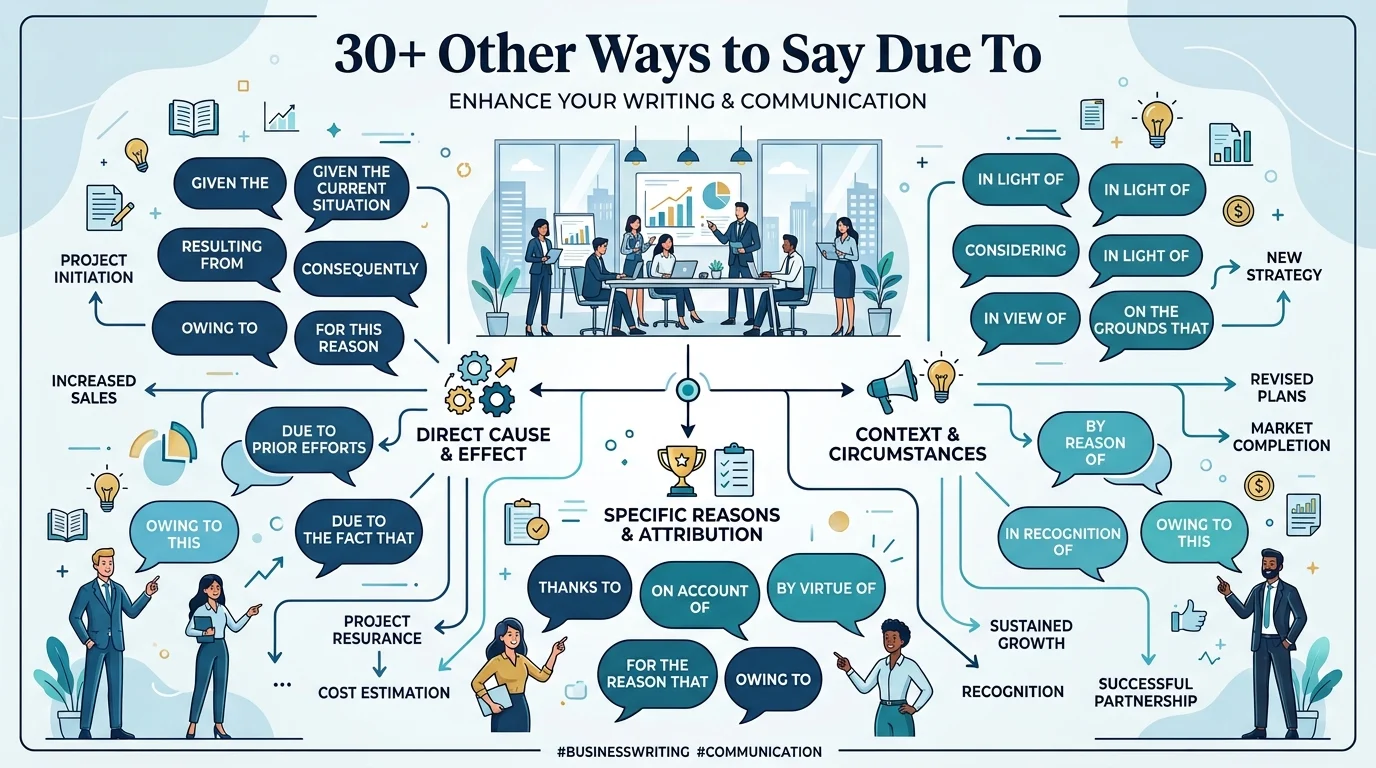
Replace repetitive “due to” phrases with alternatives like “owing to,” “as a result of,” “because of,” “on account of,” and “thanks to” to express causation more precisely and professionally in your English communication.
The phrase “due to” is one of the most common ways to express cause and effect in English, but overusing it can make your writing sound monotonous and uninspired. Whether you’re writing a business report, an academic paper, or a casual email, knowing alternatives to “due to” helps you communicate cause and effect relationships with greater nuance and sophistication.
Learning other ways to say “due to” not only improves your vocabulary but also helps you express excitement in English when explaining positive outcomes and convey complex relationships with precision. This guide provides 30 powerful alternatives categorized by formality and context, so you can choose the perfect phrase every time.
Quick Categories
Formal Alternatives to “Due To”
- Owing to
- As a consequence of
- By reason of
- In consequence of
- As a result of
Professional Alternatives to “Due To”
- Because of
- On account of
- Thanks to
- In light of
- Given that
Casual Alternatives to “Due To”
- Because
- Since
- Seeing as
- What with
- Now that
Academic Alternatives
- Attributable to
- Resulting from
- Arising from
- Stemming from
- Deriving from
Common Mistakes Using “Due To”
- Confusing “due to” with “because of” grammatically
- ❌ “The game was cancelled due to rain.” (Should modify a noun)
- ✅ “The cancellation was due to rain.” (Modifies “cancellation”)
- Note: In modern usage, this distinction is fading, but it’s good to know.
- Using “due to” when you mean “owing to”
- ❌ “Due to the fact that it was raining, we stayed inside.”
- ✅ “Owing to the rain, we stayed inside.” (More concise)
- Overusing “due to the fact that”
- ❌ “Due to the fact that the market is volatile, we’re cautious.”
- ✅ “Given the market volatility, we’re cautious.”
- Using “due to” to express purpose instead of cause
- ❌ “I called due to to confirm the appointment.”
- ✅ “I called to confirm the appointment.”
- Using “due to” with verbs instead of nouns
- ❌ “We arrived late due to it rained.”
- ✅ “We arrived late due to the rain.”
What Does “Due To” Mean?
“Due to” is a prepositional phrase meaning “because of” or “as a result of.” It indicates a causal relationship between two things, where one event or situation is the reason for another.
Example Sentence: “The flight was delayed due to technical difficulties.”
Grammar Note: Traditionally, “due to” should modify a noun (act as an adjective), while “because of” modifies verbs (acts as an adverb). However, modern English often uses them interchangeably.
When to Use “Due To”
- Explaining cause and effect in any context
- Business reports to explain outcomes
- Academic writing to present research findings
- Professional emails to justify decisions
- Presentations to connect ideas logically
- Casual conversation when explaining reasons
Spoken vs Written: Used in both, but written English demands more varied phrasing to avoid repetition.
Formal vs Informal: Acceptable in both, but formal contexts benefit from more sophisticated alternatives.
Is It Professional or Polite to Say “Due To”?
“Due to” is professionally acceptable but can sound repetitive when overused. Using varied alternatives demonstrates linguistic sophistication.
Politeness: ✔️ Yes “Due to” is considered polite and neutral.
Professionalism: ✔️ Yes but use sparingly and vary your language.
Business Example: Instead of “The project was delayed due to budget constraints,” try “Budget constraints delayed the project.”
Pros and Cons of Using “Due To”
Pros
- Clear and direct Instantly communicates cause and effect
- Universally understood Recognized in all English dialects
- Grammatically simple Easy to use correctly
- Versatile Works in almost any context
Cons
- Overused Can become repetitive and boring
- Too formal in some contexts May sound stiff in casual conversation
- Limited precision Doesn’t convey nuance or degree of causation
- Often wordy Especially with phrases like “due to the fact that”
Other Ways to Say “Due To” (With Examples)
These alternatives will help you sound more fluent, confident, and natural in different situations. Use them according to tone, context, and audience to express causation with precision and variety.
Formal & Professional Alternatives
1. Phrase: Owing to
- Meaning: As a result of; because of
- Explanation: More formal than “due to,” often used in legal and financial contexts
- Example Sentence: “Owing to the economic downturn, the company has restructured its operations.”
- Best Use: Formal writing
- Worst Use: Casual conversation
- Tone: Formal, sophisticated
- Context Variability: Professional/Written common in business reports
2. Phrase: As a result of
- Meaning: Something that happens because of something else
- Explanation: Clear cause and effect language for formal contexts
- Example Sentence: “As a result of our marketing campaign, sales increased by 40%.”
- Best Use: Reports and analyses
- Worst Use: Casual chats
- Tone: Professional, analytical
- Context Variability: Professional excellent for business communication
3. Phrase: On account of
- Meaning: Because of; due to
- Explanation: More formal and elegant alternative
- Example Sentence: “The event was postponed on account of the weather forecast.”
- Best Use: Formal announcements
- Worst Use: Everyday speech
- Tone: Formal, respectful
- Context Variability: Professional/Written common in official documents
4. Phrase: In light of
- Meaning: Considering; in view of
- Explanation: Suggests that new information has led to a decision
- Example Sentence: “In light of recent developments, we’ve revised our strategy.”
- Best Use: Decision explanations
- Worst Use: Simple causal relationships
- Tone: Thoughtful, strategic
- Context Variability: Professional perfect for business communications
5. Phrase: By reason of
- Meaning: Because of (formal/legal)
- Explanation: Very formal, often used in legal documents
- Example Sentence: “The contract was terminated by reason of breach of terms.”
- Best Use: Legal documents
- Worst Use: Everyday conversation
- Tone: Legalistic, formal
- Context Variability: Professional/Legal common in contracts
6. Phrase: In consequence of
- Meaning: As a result of
- Explanation: Very formal, often used in official reports
- Example Sentence: “In consequence of the merger, several departments will be restructured.”
- Best Use: Official announcements
- Worst Use: Casual discussions
- Tone: Formal, official
- Context Variability: Professional/Written common in corporate communications
7. Phrase: Thanks to
- Meaning: Because of (often positive)
- Explanation: Expresses gratitude or recognizes a positive cause
- Example Sentence: “Thanks to our dedicated team, we exceeded our targets.”
- Best Use: Positive outcomes
- Worst Use: Negative situations
- Tone: Appreciative, positive
- Context Variability: Professional/Casual great for team communications
8. Phrase: Given that
- Meaning: Taking into account; considering
- Explanation: Introduces a condition or consideration
- Example Sentence: “Given that we have limited resources, we need to prioritize our projects.”
- Best Use: Strategic decisions
- Worst Use: Simple cause effect
- Tone: Diplomatic, analytical
- Context Variability: Professional excellent for meetings and reports
9. Phrase: Attributable to
- Meaning: Can be credited to; caused by
- Explanation: Academic and analytical language
- Example Sentence: “The company’s success is largely attributable to innovative product design.”
- Best Use: Academic and analytical writing
- Worst Use: Casual conversation
- Tone: Academic, precise
- Context Variability: Academic/Professional common in research
10. Phrase: Resulting from
- Meaning: Happening as a consequence of
- Explanation: Emphasizes the cause and effect relationship
- Example Sentence: “The delays resulting from supply chain issues have affected production.”
- Best Use: Technical reports
- Worst Use: Simple statements
- Tone: Analytical, professional
- Context Variability: Professional ideal for reports
“Mastering causal language transforms your English from basic to brilliant.”
Academic & Analytical Alternatives
11. Phrase: Arising from
- Meaning: Originating or developing from
- Explanation: Academic language for causal relationships
- Example Sentence: “The challenges arising from globalization are numerous.”
- Best Use: Academic essays
- Worst Use: Everyday speech
- Tone: Academic, intellectual
- Context Variability: Academic/Written common in scholarly work
12. Phrase: Stemming from
- Meaning: Originating from
- Explanation: Suggests a root cause
- Example Sentence: “The current crisis is stemming from years of mismanagement.”
- Best Use: Root cause analysis
- Worst Use: Simple explanations
- Tone: Analytical, insightful
- Context Variability: Academic/Professional great for analysis
13. Phrase: Deriving from
- Meaning: Obtaining or coming from
- Explanation: Academic language for origins
- Example Sentence: “These benefits are deriving from our new investment strategy.”
- Best Use: Academic writing
- Worst Use: Casual conversation
- Tone: Formal, academic
- Context Variability: Academic common in research papers
14. Phrase: Due to the fact that
- Meaning: Because of the reason that
- Explanation: Wordy but useful for formal contexts
- Example Sentence: “Due to the fact that demand has increased, we’re expanding production.”
- Best Use: Formal explanations
- Worst Use: Concise writing
- Tone: Formal, explanatory
- Context Variability: Professional/Written use sparingly
15. Phrase: In view of
- Meaning: Considering; taking into account
- Explanation: Formal alternative for decision making contexts
- Example Sentence: “In view of the feedback, we’ve made some adjustments.”
- Best Use: Formal communications
- Worst Use: Casual chats
- Tone: Diplomatic, professional
- Context Variability: Professional excellent for business
16. Phrase: Taking into account
- Meaning: Considering all factors
- Explanation: Acknowledges multiple factors in causation
- Example Sentence: “Taking into account the budget, we’ve chosen the most cost effective option.”
- Best Use: Decision explanations
- Worst Use: Simple cause effect
- Tone: Thoughtful, strategic
- Context Variability: Professional common in management
17. Phrase: By virtue of
- Meaning: Because of (formal/legal)
- Explanation: Suggests authority or inherent quality
- Example Sentence: “By virtue of his position, the manager approved the budget.”
- Best Use: Legal/formal contexts
- Worst Use: Casual situations
- Tone: Legalistic, formal
- Context Variability: Professional/Legal common in formal documents
18. Phrase: Based on
- Meaning: Using as a foundation
- Explanation: Indicates information driven causation
- Example Sentence: “Based on customer feedback, we redesigned the product.”
- Best Use: Data driven decisions
- Worst Use: Personal reasons
- Tone: Analytical, evidence based
- Context Variability: Professional great for business reports
19. Phrase: Out of
- Meaning: Because of (motivation)
- Explanation: Often used for emotional or voluntary actions
- Example Sentence: “She helped us out of kindness.”
- Best Use: Emotional/motivational causes
- Worst Use: Formal writing
- Tone: Personal, explanatory
- Context Variability: Casual/Professional common
20. Phrase: Following
- Meaning: As a consequence of
- Explanation: Emphasizes sequence of events
- Example Sentence: “Following the announcement, shares rose dramatically.”
- Best Use: Timelines and sequences
- Worst Use: Simple relationships
- Tone: Sequential, formal
- Context Variability: Professional great for reports
“The right causal phrase adds precision and sophistication to your communication.”
Casual & Conversational Alternatives
21. Phrase: Because
- Meaning: For the reason that
- Explanation: The simplest and most common alternative
- Example Sentence: “We canceled the trip because the weather was terrible.”
- Best Use: Everyday conversation
- Worst Use: Formal writing
- Tone: Neutral, casual
- Context Variability: Casual/Spoken universally understood
22. Phrase: Since
- Meaning: Because; as
- Explanation: More formal than “because” but still conversational
- Example Sentence: “Since you asked, I’ll share my opinion.”
- Best Use: Giving explanations
- Worst Use: Formal documents
- Tone: Friendly, explanatory
- Context Variability: Casual/Professional versatile
23. Phrase: Seeing as
- Meaning: Considering that; because
- Explanation: Very casual and conversational
- Example Sentence: “Seeing as it’s getting late, we should probably leave.”
- Best Use: Casual speech
- Worst Use: Professional settings
- Tone: Casual, friendly
- Context Variability: Casual common in everyday conversation
24. Phrase: Seeing that
- Meaning: Given that; because
- Explanation: Similar to “seeing as” but slightly more formal
- Example Sentence: “Seeing that you’re interested, I’ll send you more details.”
- Best Use: Informal conversations
- Worst Use: Formal writing
- Tone: Casual, explanatory
- Context Variability: Casual/Spoken common
25. Phrase: Now that
- Meaning: Because something has happened
- Explanation: Emphasizes a new situation
- Example Sentence: “Now that we have the budget, we can start the project.”
- Best Use: Cause and effect over time
- Worst Use: Simple relationships
- Tone: Causal, conversational
- Context Variability: Casual/Professional adaptable
26. Phrase: Considering that
- Meaning: Taking into account; because
- Explanation: Indicates a thoughtful cause
- Example Sentence: “Considering that you’re new, we’ll give you extra support.”
- Best Use: Acknowledging circumstances
- Worst Use: Formal writing
- Tone: Understanding, diplomatic
- Context Variability: Casual/Professional versatile
27. Phrase: As
- Meaning: Because; since
- Explanation: Short and simple
- Example Sentence: “As it was raining, we stayed indoors.”
- Best Use: Simple explanations
- Worst Use: Formal writing
- Tone: Neutral, casual
- Context Variability: Casual/Spoken common
28. Phrase: What with
- Meaning: Because of (often multiple reasons)
- Explanation: Very casual, used in spoken English
- Example Sentence: “What with the traffic and the rain, we were really late.”
- Best Use: Casual complaints
- Worst Use: Professional contexts
- Tone: Casual, conversational
- Context Variability: Casual common in speech
29. Phrase: As long as
- Meaning: Because of the condition that
- Explanation: Expresses a condition that creates an outcome
- Example Sentence: “We can succeed as long as everyone cooperates.”
- Best Use: Conditional statements
- Worst Use: Simple cause effect
- Tone: Conditional, hopeful
- Context Variability: Casual/Professional common
30. Phrase: For
- Meaning: Because (literary/formal)
- Explanation: More common in written English
- Example Sentence: “We must act now, for the situation is critical.”
- Best Use: Literary or formal writing
- Worst Use: Casual conversation
- Tone: Literary, formal
- Context Variability: Written common in literature
“Expanding your causal vocabulary makes your English more dynamic and engaging.”
Mini Quiz / Self Check
Question 1: You’re writing a formal business report. Which phrase is most appropriate?
- A) Seeing as
- B) Owing to
- C) What with
Answer: B “Owing to” is the most appropriate for formal business writing.
Question 2: You’re in a casual conversation with a colleague. Which alternative sounds natural?
- A) By reason of
- B) Seeing that
- C) In consequence of
Answer: B “Seeing that” is appropriate for casual conversation.
Question 3: Which of these is NOT a professional way to replace “due to”?
- A) As a result of
- B) What with
- C) In light of
Answer: B “What with” is very casual and not suitable for professional contexts.
Question 4: You want to express a positive outcome caused by a specific factor. Which phrase works best?
- A) Thanks to
- B) Due to
- C) As a consequence of
Answer: A “Thanks to” specifically suggests a positive cause and effect relationship.
Comparison Table: Top 10 Alternatives
| Phrase | Tone | Best Use |
| Owing to | Formal, sophisticated | Business and financial reports |
| As a result of | Professional, analytical | Reports and analyses |
| In light of | Strategic, diplomatic | Decision making communications |
| Attributable to | Academic, precise | Research and academic writing |
| Thanks to | Appreciative, positive | Acknowledging positive causes |
| Because | Neutral, casual | Everyday conversation |
| Since | Friendly, explanatory | General explanations |
| Seeing as | Casual, friendly | Spoken English |
| Based on | Analytical, evidence based | Data driven decisions |
| Given that | Diplomatic, analytical | Strategic planning |
FAQs
1. What’s the difference between “due to” and “because of”?
Traditionally, “due to” modifies nouns (e.g., “The cancellation was due to rain”), while “because of” modifies verbs (e.g., “We canceled because of rain”). However, modern English often uses them interchangeably, and both are widely accepted.
2. Is “due to” too formal for casual conversation?
Not at all! “Due to” is perfectly acceptable in casual conversation. However, using varied alternatives like “because,” “since,” and “seeing as” can make your speech more natural and less repetitive.
3. Can I use “thanks to” for negative outcomes?
Typically no. “Thanks to” implies gratitude or positive causation. For negative outcomes, use alternatives like “due to,” “because of,” or “owing to.”
4. What’s the most professional alternative to “due to”?
“In light of,” “as a result of,” and “owing to” are among the most professional alternatives. They demonstrate sophisticated language skills and are widely used in business and academic contexts.
5. Are these alternatives interchangeable with “due to”?
Most are, but each has slightly different nuances. For example, “thanks to” suggests positive causation, while “stemming from” suggests root causes. Always consider the specific meaning and context you need.
Conclusion
Learning different ways to say “due to” is essential for effective and varied English communication. Whether you’re writing a formal business report, having a casual conversation, or explaining complex academic concepts, having a rich vocabulary of causal phrases allows you to express yourself with precision and sophistication.
Start incorporating these 30 alternatives into your daily communication. Begin with a few that feel comfortable and gradually expand your range. Remember, the goal is not to eliminate “due to” entirely but to use it strategically alongside other expressions. With consistent practice, you’ll find yourself communicating more naturally and professionally in any context.