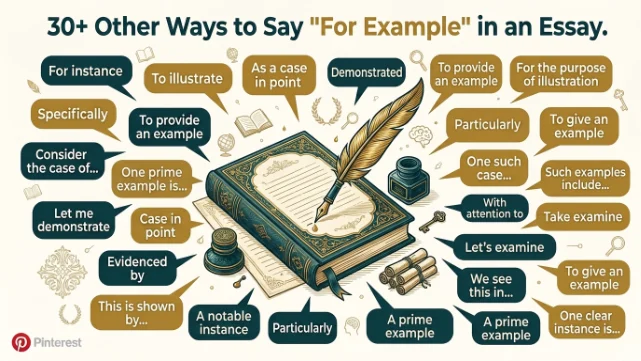
Replace repetitive “for example” phrases with “for instance,” “such as,” “to illustrate,” “as an example,” and “namely” to make your academic writing more varied, professional, and engaging.
The phrase “for example” is a staple of academic writing, used to introduce evidence, clarify points, and support arguments. However, relying on it too heavily can make your essay sound monotonous and unpolished. Knowing alternatives to “for example” is essential for any student or researcher aiming to produce high-quality, fluent academic prose.
Learning other ways to say “for example” in an essay not only improves your vocabulary but also helps you express excitement in English (when presenting compelling evidence) and maintain reader interest. This guide provides 30 powerful alternatives categorized by formality and usage, so you can choose the perfect phrase for every academic context.
Quick Categories
Formal Academic Alternatives
- For instance
- To illustrate
- As an example
- In particular
- Namely
Transitional Phrases for Essays
- As a case in point
- By way of illustration
- To demonstrate
- Consider
- Take, for example
Specific Illustration Phrases
- Such as
- Including
- Among them
- Specifically
- Especially
Less Common & Sophisticated Alternatives
- To cite an instance
- As proof
- Let’s say
- Suppose
- As seen in
Common Mistakes Using “For Example”
- Using “for example” too frequently in a single paragraph
- ❌ “Many animals are endangered. For example, tigers are at risk. For example, elephants also face threats.”
- ✅ “Many animals are endangered. Tigers, for instance, are at risk, and elephants also face similar threats.”
- Forgetting the comma after “for example”
- ❌ “There are many options for example we could choose the first one.”
- ✅ “There are many options; for example, we could choose the first one.”
- Using “for example” when “such as” is more appropriate
- ❌ “I enjoy fruits, for example, apples and oranges.”
- ✅ “I enjoy fruits, such as apples and oranges.” (when listing items within a sentence)
- Starting every new example with “for example”
- ❌ “For example, the first study showed positive results. For example, the second study confirmed these findings.”
- ✅ “The first study showed positive results. Similarly, the second study confirmed these findings.” (using a different transition)
- Using “for example” with an incomplete sentence
- ❌ “The benefits are clear. For example, increased productivity.”
- ✅ “The benefits are clear. For example, productivity increased by 20% after the change.” (provide a full clause)
What Does “For Example” Mean?
“For example” is a transitional phrase used to introduce a specific instance or case that illustrates a general statement or claim. It signals to the reader that you are about to provide evidence or a concrete illustration to support your argument.
Example Sentence: “Many renewable energy sources are becoming more affordable; for example, solar power costs have dropped by 80% in the last decade.”
Grammar Note: “For example” is typically followed by a comma and introduces a full clause or a noun phrase. In formal writing, it is often used after a semicolon or as the start of a new sentence.
When to Use “For Example”
- Introducing evidence to support a claim
- Clarifying abstract concepts with concrete instances
- Providing case studies or real-world applications
- Making arguments more persuasive and relatable
- Academic essays, research papers, and reports
- Presentations and speeches to illustrate points
Spoken vs Written: More formal in written English; in spoken English, you can use more casual alternatives.
Formal vs Informal: Acceptable in both, but essays demand variety and sophistication beyond this single phrase.
Is It Professional or Polite to Say “For Example”?
“For example” is perfectly professional and acceptable in all academic and business contexts. However, overusing it can make your writing feel repetitive and unrefined.
Professionalism: ✔️ Yes – It is a standard academic phrase.
Polite: ✔️ Yes – It is neutral and courteous.
Business Example: “Our marketing strategy has proven effective; for example, we saw a 25% increase in engagement last quarter.” (acceptable but could be improved with alternatives like “for instance” or “as demonstrated by”).
Pros and Cons of Using “For Example”
Pros
- Clear and familiar – Instantly understood by all readers
- Straightforward – Leaves no ambiguity about your intent
- Versatile – Works in both spoken and written English
- Standard academic usage – Accepted in all educational levels
Cons
- Overused – Becomes repetitive and dull
- Lacks sophistication – Not impressive in high-level writing
- Can break flow – If used too often, it disrupts paragraph cohesion
- Limited nuance – Does not convey the relationship between examples and arguments
Other Ways to Say “For Example” in an Essay (With Examples)
These alternatives will help you sound more fluent, confident, and academically sophisticated in your essays. Use them according to tone, context, and the type of illustration you need.
Formal Academic Alternatives
1. Phrase: For instance
- Meaning: To introduce a specific example
- Explanation: The closest and most common formal alternative to “for example”
- Example Sentence: “Several European countries have adopted renewable energy targets; for instance, Germany aims to be carbon-neutral by 2045.”
- Best Use: Academic essays
- Worst Use: Casual speech (though acceptable)
- Tone: Formal, neutral
- Context Variability: Professional/Academic – widely used in all formal writing
2. Phrase: To illustrate
- Meaning: To provide a clarifying example
- Explanation: Emphasizes the act of making something clearer
- Example Sentence: “To illustrate the effectiveness of this method, consider the case of a small business that increased sales by 50%.”
- Best Use: Persuasive arguments
- Worst Use: Listing simple items
- Tone: Demonstrative, explanatory
- Context Variability: Academic – excellent for detailed explanations
3. Phrase: As an example
- Meaning: Introducing a case that represents the whole
- Explanation: Simpler but effective alternative
- Example Sentence: “As an example, the Renaissance period saw an explosion of artistic innovation.”
- Best Use: Introductions of broader points
- Worst Use: Inside sentences (better as a clause)
- Tone: Formal, direct
- Context Variability: Academic/Written – very common
4. Phrase: In particular
- Meaning: Focusing on a specific case among many
- Explanation: Often used to highlight the most relevant example
- Example Sentence: “The study revealed significant improvement in test scores; in particular, students in the intervention group showed a 15% increase.”
- Best Use: Emphasizing key evidence
- Worst Use: Introducing random examples
- Tone: Focused, selective
- Context Variability: Professional/Academic – ideal for data-driven essays
5. Phrase: Namely
- Meaning: Specifying exactly what you mean
- Explanation: Used to list specific items or examples precisely
- Example Sentence: “The program offers several advantages, namely cost-effectiveness, scalability, and ease of use.”
- Best Use: Listing specific elements
- Worst Use: Lengthy examples
- Tone: Precise, formal
- Context Variability: Academic/Written – great for definitions and enumerations
6. Phrase: By way of illustration
- Meaning: Using a concrete case to explain
- Explanation: A more formal and verbose alternative
- Example Sentence: “By way of illustration, the company’s turnaround strategy can be observed in its 2023 quarterly reports.”
- Best Use: Formal academic papers
- Worst Use: Everyday writing
- Tone: Scholarly, detailed
- Context Variability: Academic – appropriate for theses and dissertations
7. Phrase: To demonstrate
- Meaning: Showing proof or evidence
- Explanation: Implies a more rigorous, evidence-based approach
- Example Sentence: “To demonstrate the efficacy of the drug, the researchers conducted a double-blind trial.”
- Best Use: Scientific or research-oriented essays
- Worst Use: Casual examples
- Tone: Evidential, persuasive
- Context Variability: Academic/Scientific – perfect for lab reports and research papers
8. Phrase: As a case in point
- Meaning: A specific instance that confirms your argument
- Explanation: A slightly more formal idiom
- Example Sentence: “Many cities have struggled with traffic congestion; as a case in point, London’s congestion charge has had mixed results.”
- Best Use: Strong evidence in argumentative essays
- Worst Use: Simple lists
- Tone: Persuasive, intellectual
- Context Variability: Academic/Written – effective in opinion pieces
9. Phrase: Consider
- Meaning: Directing the reader to think about an example
- Explanation: A more engaging imperative that draws the reader in
- Example Sentence: “Consider the impact of social media on youth: studies show increased anxiety rates.”
- Best Use: Introductory examples
- Worst Use: After already listing examples
- Tone: Engaging, directive
- Context Variability: Academic/Spoken – works well in presentations
10. Phrase: Take, for example
- Meaning: Introducing a specific instance
- Explanation: A slightly conversational but acceptable formal phrase
- Example Sentence: “Take, for example, the automotive industry’s shift to electric vehicles.”
- Best Use: When you want a more direct address
- Worst Use: Very formal academic writing (use “consider” instead)
- Tone: Direct, slightly informal
- Context Variability: Professional/Spoken – good for lectures
“The best academic writers know that varying transition phrases keeps readers engaged and arguments compelling.”
Transitional & Illustrative Alternatives
11. Phrase: Such as
- Meaning: Introducing examples within a sentence
- Explanation: Used to list specific items without a full clause
- Example Sentence: “The curriculum covers core subjects, such as mathematics, science, and literature.”
- Best Use: Listing items within a sentence
- Worst Use: Introducing a full sentence example
- Tone: Neutral, concise
- Context Variability: Academic/Written – extremely common
12. Phrase: Including
- Meaning: Examples that are part of a larger group
- Explanation: Implies the examples are not exhaustive
- Example Sentence: “The museum features works by many famous artists, including Picasso, Monet, and Van Gogh.”
- Best Use: Incomplete lists
- Worst Use: Introducing a single example
- Tone: Inclusive, neutral
- Context Variability: Academic – perfect for listing components
13. Phrase: Among them
- Meaning: Examples selected from a group
- Explanation: Focuses on specific cases within a larger set
- Example Sentence: “Several startups have disrupted the industry; among them, Uber and Airbnb are the most notable.”
- Best Use: Highlighting standout examples
- Worst Use: Listing more than three items
- Tone: Selective, emphatic
- Context Variability: Academic/Written – good for case studies
14. Phrase: Specifically
- Meaning: Narrowing down to a precise example
- Explanation: Emphasizes the exactness of the example
- Example Sentence: “The policy targets vulnerable populations; specifically, low-income families will receive direct benefits.”
- Best Use: Clarifying a subset
- Worst Use: Broad examples
- Tone: Precise, focused
- Context Variability: Professional/Academic – excellent for policy or legal writing
15. Phrase: Especially
- Meaning: Highlighting an outstanding example
- Explanation: Conveys that this example is particularly relevant
- Example Sentence: “Many countries face water scarcity, especially those in arid regions like the Middle East.”
- Best Use: Emphasizing significance
- Worst Use: Neutral listing
- Tone: Emphatic, relevant
- Context Variability: Academic/Written – works in persuasive essays
16. Phrase: To cite an instance
- Meaning: Introducing a formal reference or example
- Explanation: Very formal, often used when referencing research
- Example Sentence: “To cite an instance, Smith’s (2019) study found a direct correlation between exercise and mental health.”
- Best Use: Citing specific studies
- Worst Use: Everyday examples
- Tone: Scholarly, reference-heavy
- Context Variability: Academic – ideal for research papers
17. Phrase: As proof
- Meaning: Offering something as evidence
- Explanation: Strongly asserts that the example validates your claim
- Example Sentence: “The company has thrived; as proof, its annual revenue doubled in just three years.”
- Best Use: Strong arguments
- Worst Use: Mild or unclear claims
- Tone: Confident, persuasive
- Context Variability: Academic/Argumentative – powerful in debates
18. Phrase: Let’s say
- Meaning: Hypothetical or invented example
- Explanation: More conversational but can be used in explanatory essays
- Example Sentence: “Let’s say a country invests heavily in education; the long-term benefits are evident.”
- Best Use: Hypothetical scenarios
- Worst Use: Formal research papers
- Tone: Friendly, illustrative
- Context Variability: Casual/Spoken – better for lectures than formal writing
19. Phrase: Suppose
- Meaning: Introducing a hypothetical example
- Explanation: Similar to “let’s say” but slightly more formal
- Example Sentence: “Suppose the government implements a carbon tax; emissions would likely decrease.”
- Best Use: Theoretical arguments
- Worst Use: Factual evidence
- Tone: Hypothetical, instructive
- Context Variability: Academic/Written – common in philosophy and economics
20. Phrase: As seen in
- Meaning: Pointing to observable examples
- Explanation: Connects your statement to real-world instances
- Example Sentence: “The trend toward remote work is accelerating, as seen in the rise of co-working spaces globally.”
- Best Use: Empirical evidence
- Worst Use: Abstract examples
- Tone: Observational, factual
- Context Variability: Academic/Professional – suitable for case analyses
“Replacing ‘for example’ with varied expressions signals to your examiner that you have a strong command of academic English.”
Sophisticated & Lesser-Known Alternatives
21. Phrase: To give a concrete example
- Meaning: To provide a tangible illustration
- Explanation: Emphasizes that the example is specific and real
- Example Sentence: “To give a concrete example, the city of Copenhagen reduced emissions by 40% through cycling infrastructure.”
- Best Use: Making abstract points tangible
- Worst Use: Short lists
- Tone: Practical, grounded
- Context Variability: Academic/Professional – good for case studies
22. Phrase: By way of example
- Meaning: Similar to “by way of illustration”
- Explanation: A more formal alternative, often used in legal or philosophical writing
- Example Sentence: “By way of example, consider the ethical implications of artificial intelligence.”
- Best Use: Formal philosophical or ethical essays
- Worst Use: Casual or short essays
- Tone: Scholarly, reflective
- Context Variability: Academic – high-level writing
23. Phrase: In the case of
- Meaning: Focusing on a particular example
- Explanation: Useful when discussing specific scenarios
- Example Sentence: “In the case of Japan, the aging population has led to labor shortages.”
- Best Use: Country or group-specific examples
- Worst Use: Generic examples
- Tone: Specific, analytical
- Context Variability: Academic – common in social sciences
24. Phrase: As demonstrated by
- Meaning: Introducing evidence that proves your point
- Explanation: Strongly ties the example to your argument
- Example Sentence: “The strategy is effective, as demonstrated by the company’s record sales.”
- Best Use: Evidence-heavy writing
- Worst Use: Weak claims
- Tone: Evidentiary, confident
- Context Variability: Professional/Academic – perfect for business reports
25. Phrase: To name a few
- Meaning: Offering a few examples among many
- Explanation: Useful when you don’t want to list everything
- Example Sentence: “The festival offers various activities: workshops, concerts, and art exhibitions, to name a few.”
- Best Use: Incomplete lists
- Worst Use: Single examples
- Tone: Informal but acceptable
- Context Variability: Casual/Written – better for blog posts than strict essays
26. Phrase: Including but not limited to
- Meaning: Providing examples that are not exhaustive
- Explanation: Very formal and precise, often used in legal or policy writing
- Example Sentence: “The policy applies to all employees, including but not limited to full-time, part-time, and contract workers.”
- Best Use: Legal or official documents
- Worst Use: Short essays
- Tone: Precise, legalistic
- Context Variability: Professional – common in contracts and policies
27. Phrase: To illustrate this point
- Meaning: Specifically to clarify your argument
- Explanation: Directly links the example to your thesis
- Example Sentence: “To illustrate this point, we can examine the economic growth of South Korea post-1960.”
- Best Use: Argumentative essays
- Worst Use: Simple listing
- Tone: Argumentative, clear
- Context Variability: Academic/Written – excellent for thesis development
28. Phrase: As an illustration
- Meaning: Using something to clarify
- Explanation: Slightly more formal than “to illustrate”
- Example Sentence: “As an illustration, the author uses the metaphor of a journey to represent personal growth.”
- Best Use: Literary or artistic analysis
- Worst Use: Scientific data
- Tone: Descriptive, explanatory
- Context Variability: Academic – common in humanities
29. Phrase: Take the example of
- Meaning: Directing attention to a specific case
- Explanation: Similar to “take, for example” but more formal
- Example Sentence: “Take the example of Finland’s education system, which consistently ranks among the best.”
- Best Use: Introductions of detailed case studies
- Worst Use: Quick examples
- Tone: Direct, engaging
- Context Variability: Academic/Spoken – great for presentations
30. Phrase: This is evident in
- Meaning: Showing that your point is clearly reflected in an example
- Explanation: Connects the example to observable evidence
- Example Sentence: “The importance of teamwork is evident in the success of major tech companies like Google.”
- Best Use: Demonstrating a principle
- Worst Use: When the example is not clearly tied to the point
- Tone: Assertive, clear
- Context Variability: Academic/Written – effective for conclusions
“A rich vocabulary of transition phrases is a hallmark of an advanced academic writer.”
Mini Quiz / Self-Check
Question 1: You are writing a scientific paper and want to introduce a specific study as evidence. Which phrase is most appropriate?
- A) Let’s say
- B) To cite an instance
- C) For instance
Answer: B – “To cite an instance” is more formal and reference-oriented for scientific papers.
Question 2: You want to list a few items within a sentence without starting a new clause. Which is best?
- A) For example
- B) Such as
- C) To illustrate
Answer: B – “Such as” is used for in-sentence listings.
Question 3: Which of the following is NOT a correct usage of “for example”?
- A) “Many birds migrate south. For example, swallows fly to Africa.”
- B) “For example, the cost of living has risen.” (standing alone)
- C) “I enjoy outdoor activities, for example, hiking and swimming.”
Answer: C – “For example” should not be used to list items within a sentence; use “such as” instead.
Question 4: You are writing a persuasive essay and want to make a strong evidence-based claim. Which phrase adds the most authority?
- A) As proof
- B) As an example
- C) Let’s say
Answer: A – “As proof” directly asserts that the example validates your argument.
Comparison Table: Top 10 Alternatives
| Phrase | Tone | Best Use |
|---|---|---|
| For instance | Formal, neutral | General academic examples |
| To illustrate | Demonstrative, clear | Clarifying complex points |
| Such as | Concise, neutral | In-sentence listings |
| In particular | Focused, selective | Highlighting key examples |
| Namely | Precise, formal | Specifying exact items |
| As a case in point | Persuasive, intellectual | Strong argument support |
| Consider | Engaging, directive | Drawing reader in |
| To cite an instance | Scholarly, reference-heavy | Research citations |
| As demonstrated by | Evidentiary, confident | Empirical evidence |
| By way of illustration | Scholarly, formal | High-level academic writing |
FAQs
1. Can I use “for example” at the start of a sentence in an essay?
Yes, you can start a sentence with “For example,” followed by a comma. It is perfectly acceptable in academic writing. However, vary your usage with alternatives to avoid repetition.
2. What is the difference between “for example” and “such as”?
“For example” introduces a full example (often a clause), while “such as” introduces examples within a sentence (list of items). Use “for example” when you need a separate statement, and “such as” when you are listing items directly.
3. How many times can I use “for example” in an essay?
There is no strict limit, but overusing it can make your writing monotonous. A good rule of thumb is to use it no more than once per paragraph and to rely on alternatives for variety.
4. Are these alternatives suitable for all types of essays?
Most alternatives are suitable for academic essays. However, some like “let’s say” and “suppose” are better for hypothetical or philosophical essays. Always match the formality to your assignment type and audience.
5. Can I use “e.g.” as a substitute in formal writing?
Yes, “e.g.” (exempli gratia) is a standard abbreviation meaning “for example” and is widely used in academic writing, especially in parentheses or footnotes. However, in the main text, it’s often better to use a full phrase for readability.
Conclusion
Mastering alternatives to “for example” is a simple yet impactful way to elevate your academic writing. By varying your transition phrases, you demonstrate linguistic flexibility, keep your reader engaged, and make your arguments more compelling. Each alternative carries a subtle nuance, so choose the one that best fits the context and the strength of your evidence.
Start by incorporating three to four new phrases into your next essay. With consistent practice, these alternatives will become second nature, and your writing will gain the fluency and sophistication expected at higher academic levels. Remember, the goal is not to avoid “for example” entirely but to use it strategically among a rich repertoire of expressions.