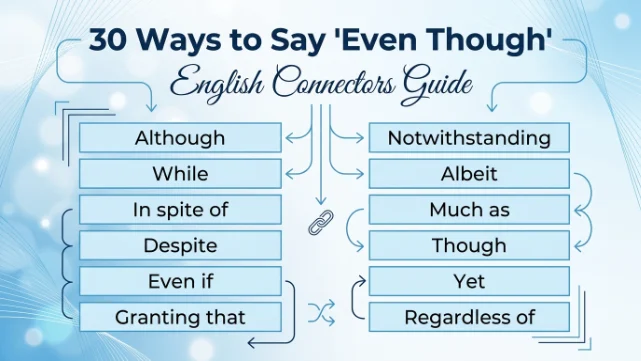
Stop overusing “even though” and try these powerful connectors instead: “although,” “despite the fact that,” “notwithstanding,” “nevertheless,” “whereas,” and “in spite of.” These alternatives add variety and sophistication to your English expression.
“Even though” is one of the most common linking phrases in English. It introduces a contrast or concession, helping you express complex ideas by showing that something happened despite obstacles, differences, or unexpected conditions. Used in spoken and written English, this phrase is essential for creating nuanced, thoughtful communication.
However, repetition of “even though” can make your writing sound repetitive and basic. Learning alternatives to “even though” improves your sentence variety and helps you express contrast in English with greater precision. Whether you’re writing an academic essay, a professional email, or a casual conversation, knowing multiple options enhances your fluency and confidence.
Quick Categories
Formal Alternatives
- “Although”
- “Notwithstanding”
- “Whereas”
- “Despite the fact that”
- “In spite of the fact that”
Professional Alternatives
- “Despite”
- “In spite of”
- “Regardless of the fact that”
- “Even so”
- “Be that as it may”
Casual Alternatives
- “Though”
- “While”
- “Still”
- “But still”
Academic Alternatives
- “Albeit”
- “Granted that”
- “Admittedly”
- “For all that”
Formal Alternatives to “Even Though”
1. Phrase: Although
Meaning: In spite of the fact that; introduces a contrast.
Explanation: The most direct and widely used formal alternative to “even though.”
Example Sentence: “Although the project faced numerous setbacks, the team delivered exceptional results.”
Best Use: Formal writing
Worst Use: Casual speech
Tone: Formal, neutral, academic
2. Phrase: Notwithstanding
Meaning: In spite of something; without being prevented by.
Explanation: A very formal connector often used in legal, business, and academic contexts.
Example Sentence: “Notwithstanding the challenges we encountered, the initiative proved successful.”
Best Use: Legal documents
Worst Use: Everyday conversation
Tone: Highly formal, legal, academic
3. Phrase: Whereas
Meaning: In contrast or comparison with the fact that.
Explanation: Often used to show a direct contrast between two statements or clauses.
Example Sentence: “Whereas our competitors struggled with innovation, our team excelled in creative solutions.”
Best Use: Comparative analysis
Worst Use: Personal contexts
Tone: Formal, analytical, comparative
4. Phrase: Despite the Fact That
Meaning: Even though; regardless of the reality that.
Explanation: Adds weight to the concession by explicitly acknowledging the obstacle.
Example Sentence: “Despite the fact that resources were limited, the department achieved its annual targets.”
Best Use: Reports
Worst Use: Quick conversation
Tone: Formal, emphatic, professional
5. Phrase: In Spite of the Fact That
Meaning: Regardless of the reality that.
Explanation: Very similar to “despite the fact that” but slightly more formal.
Example Sentence: “In spite of the fact that the market was volatile, investments remained stable.”
Best Use: Academic writing
Worst Use: Daily speech
Tone: Formal, measured, academic
6. Phrase: Albeit
Meaning: Although; even though (often used to introduce a concession).
Explanation: Compact and sophisticated; often appears between commas.
Example Sentence: “The proposal was accepted, albeit with several conditions attached.”
Best Use: Refined writing
Worst Use: Casual conversation
Tone: Formal, elegant, concise
💡 Pro Tip: “Albeit” is excellent for sophisticated writing but can sound pretentious in everyday conversation. Reserve it for academic papers, formal proposals, and professional articles.
Professional Alternatives to “Even Though”
7. Phrase: Despite
Meaning: Without being affected by; in spite of.
Explanation: A clean, professional preposition that works well in business contexts.
Example Sentence: “Despite budget constraints, we managed to implement all key features.”
Best Use: Business communication
Worst Use: Emotional contexts
Tone: Professional, concise, direct
8. Phrase: In Spite Of
Meaning: Regardless of; without being prevented by.
Explanation: Similar to “despite,” though slightly more conversational.
Example Sentence: “In spite of initial doubts, the new strategy proved highly effective.”
Best Use: Professional settings
Worst Use: Legal documents
Tone: Professional, clear, balanced
9. Phrase: Regardless of the Fact That
Meaning: Without considering the reality that.
Explanation: Emphasizes that the obstacle is irrelevant to the outcome.
Example Sentence: “Regardless of the fact that we faced supply chain issues, production remained on schedule.”
Best Use: Overcoming challenges
Worst Use: Simple statements
Tone: Professional, determined, emphatic
10. Phrase: Even So
Meaning: Despite that; nevertheless.
Explanation: Used to concede a point while maintaining your position.
Example Sentence: “The data was incomplete; even so, we drew meaningful conclusions.”
Best Use: Counterarguments
Worst Use: Emails
Tone: Professional, balanced, rhetorical
11. Phrase: Be That as It May
Meaning: Regardless of the previous point; nevertheless.
Explanation: Acknowledges the validity of a preceding point before moving forward.
Example Sentence: “Be that as it may, we must still address the underlying issue.”
Best Use: Decision making
Worst Use: Casual chats
Tone: Professional, firm, measured
12. Phrase: All the Same
Meaning: Nevertheless; despite what has been said.
Explanation: Concedes a point while maintaining your own perspective.
Example Sentence: “The competitor’s product is cheaper; all the same, our solution offers superior value.”
Best Use: Sales discussions
Worst Use: Formal reports
Tone: Professional, persuasive, confident
💡 Pro Tip: In professional writing, use “despite” and “in spite of” when you want a concise, direct alternative. They’re versatile and always appropriate in business contexts.
Casual Alternatives to “Even Though”
13. Phrase: Though
Meaning: Although; even though (informal).
Explanation: A shortened, casual version of “although” often placed at the end of a sentence.
Example Sentence: “I didn’t get much sleep last night. I feel great, though.”
Best Use: Everyday speech
Worst Use: Academic writing
Tone: Casual, conversational, friendly
14. Phrase: While
Meaning: Although; despite the fact that.
Explanation: A versatile word that can introduce contrast in both formal and informal contexts.
Example Sentence: “While I understand your concerns, I believe we should proceed.”
Best Use: Balanced opinions
Worst Use: Quick remarks
Tone: Neutral, accessible, clear
15. Phrase: Still
Meaning: Nevertheless; despite that.
Explanation: Simple and direct, often used in both speech and informal writing.
Example Sentence: “The traffic was terrible; still, we arrived on time.”
Best Use: Short statements
Worst Use: Complex sentences
Tone: Casual, direct, plain
16. Phrase: But Still
Meaning: However; despite that.
Explanation: A conversational way to acknowledge a contrast while maintaining your position.
Example Sentence: “It was a risky move. But still, it paid off in the end.”
Best Use: Casual stories
Worst Use: Formal writing
Tone: Conversational, engaging, friendly
17. Phrase: Yet
Meaning: Nevertheless; despite that.
Explanation: Brief and powerful; often used in creative and casual writing.
Example Sentence: “She was tired after the long journey, yet she insisted on working late.”
Best Use: Narrative contexts
Worst Use: Simple statements
Tone: Literary, casual, rhythmic
18. Phrase: Even If
Meaning: Whether or not; regardless of whether.
Explanation: Similar to “even though” but introduces hypothetical contrast rather than factual.
Example Sentence: “Even if I don’t win the competition, I’ll be happy I participated.”
Best Use: Hypotheticals
Worst Use: Facts
Tone: Casual, conditional, open
💡 Pro Tip: In casual speech, “though” at the end of a sentence is a natural alternative. In writing, place “though” at the beginning or middle for clarity.
Academic and Sophisticated Alternatives
19. Phrase: Granted That
Meaning: Assuming that; even if we accept that.
Explanation: Acknowledges a premise before presenting a counterpoint.
Example Sentence: “Granted that the methodology was unconventional, the results were nonetheless valid.”
Best Use: Research
Worst Use: Daily speech
Tone: Academic, analytical, formal
20. Phrase: Admittedly
Meaning: It must be admitted; even though we acknowledge.
Explanation: Shows honesty about limitations while still arguing your point.
Example Sentence: “Admittedly, the sample size was small; however, the findings are compelling.”
Best Use: Critical analysis
Worst Use: Personal remarks
Tone: Academic, honest, balanced
21. Phrase: For All That
Meaning: Despite everything; nevertheless.
Explanation: An older, formal expression meaning “in spite of all that.”
Example Sentence: “For all that has been said, the project remains on track.”
Best Use: Formal discussions
Worst Use: Casual talk
Tone: Formal, literary, dignified
22. Phrase: Much As
Meaning: Although; even though (often used with “may”).
Explanation: Expresses concession while emphasizing the strength of the alternative.
Example Sentence: “Much as I respect your opinion, I must disagree with your conclusion.”
Best Use: Polite disagreements
Worst Use: Quick replies
Tone: Formal, polite, respectful
23. Phrase: While It Is True That
Meaning: Even though we acknowledge that.
Explanation: Uses a longer construction to show concession before making a point.
Example Sentence: “While it is true that costs have increased, our profit margins remain healthy.”
Best Use: Presentations
Worst Use: Everyday talk
Tone: Academic, careful, diplomatic
24. Phrase: In Defiance Of
Meaning: Despite; openly ignoring.
Explanation: Suggests active resistance to an obstacle or expectation.
Example Sentence: “In defiance of conventional wisdom, they launched the product without prior testing.”
Best Use: Bold statements
Worst Use: Casual comments
Tone: Dramatic, formal, emphatic
💡 Pro Tip: In academic writing, “granted that” and “admittedly” show intellectual honesty while still supporting your argument. They make your writing more persuasive.
Common Mistakes When Using “Even Though”
Mistake 1: Confusing “Even Though” with “Even If”
Explanation: “Even though” refers to real situations; “even if” refers to hypothetical situations.
Example: ❌ “Even though it rains, we will go.” (The rain is hypothetical.)
✓ “Even if it rains, we will go.” (Hypothetical condition)
✓ “Even though it was raining, we went.” (Real, past situation)
Mistake 2: Forgetting the Comma After an Introductory Clause
Explanation: When a concessive clause comes first, use a comma before the main clause.
Example: ❌ “Although I was tired I finished the work.”
✓ “Although I was tired, I finished the work.”
Mistake 3: Using “Despite” Instead of “Despite the Fact That”
Explanation: “Despite” must be followed by a noun or noun phrase, not a full clause.
Example: ❌ “Despite the project was delayed, we delivered.”
✓ “Despite the project delay, we delivered.”
✓ “Despite the fact that the project was delayed, we delivered.”
Mistake 4: Replacing “Even Though” with “Though” Incorrectly
Explanation: “Though” can appear at the end of a sentence, but “even though” cannot.
Example: ❌ “The weather was cold, even though I enjoyed the walk.”
✓ “The weather was cold. I enjoyed the walk, though.”
✓ “Even though the weather was cold, I enjoyed the walk.”
Mistake 5: Overusing “Even Though” in Every Sentence
Explanation: Repeated use of any connector weakens your writing. Vary your alternatives.
Example: ❌ “Even though I worked hard, I failed. Even though I failed, I learned. Even though I learned, I still needed help.”
✓ “Although I worked hard, I failed. Despite that failure, I learned valuable lessons. Nevertheless, I still needed help.”
What Does “Even Though” Mean?
“Even though” is a subordinating conjunction that introduces a concessive clause. It means “despite the fact that” or “in spite of the fact that.” It shows that something happened or is true despite an obstacle or unexpected condition.
Grammar Note: “Even though” is followed by a subject and a verb (a full clause). It is often confused with “even if,” which introduces hypothetical conditions rather than real ones.
Example Sentence: “Even though she was nervous, she delivered a flawless presentation.”
When to Use “Even Though”
Common Contexts:
- Contrasting ideas: Presenting opposing viewpoints
- Overcoming obstacles: Showing success despite difficulties
- Acknowledging limitations: Demonstrating awareness of weaknesses
- Academic writing: Presenting balanced arguments
- Professional communication: Showing realistic assessment of situations
Spoken vs Written:
- Spoken: Used frequently in everyday conversation
- Written: Common in all forms of writing, from casual to academic
Formal vs Informal:
- Formal: Appropriate in academic papers, business reports, professional emails
- Informal: Widely used in casual conversation and friendly messages
Is It Professional or Polite to Say “Even Though”?
“Yes” to both! “Even though” is a standard connector that is both professional and polite in virtually all contexts.
- Polite? ✔️ Yes – Shows careful, balanced consideration
- Professional? ✔️ Yes – Used in formal reports, meetings, and communications
Business Example: “Even though revenue projections are modest, we remain confident in our strategy.”
Unlike some phrases that risk being too casual or personal, “even though” is universally acceptable and always sounds competent.
Pros and Cons of Using “Even Though”
Pros:
- Clear meaning – Everyone understands it immediately
- Widely accepted – Works in all contexts
- Grammatically correct – No concerns about appropriateness
- Perfect for contrast – Precisely communicates concession
Cons:
- Overused – Can become repetitive if used too often
- Lacks nuance – Doesn’t convey the strength of contrast
- Can sound basic – May not impress in advanced writing
- Often misused – Easily confused with “even if”
💡 “Varying your connectors transforms basic English into sophisticated expression.”
Other Ways to Say “Even Though” (With Examples)
These alternatives to “even though” will help you sound more fluent, confident, and natural in different situations.
Use them according to tone, context, and audience to express contrast in English with precision.
25. Phrase: At the Same Time
Meaning: Nevertheless; despite that.
Explanation: Presents a contrasting point that coexists with the previous statement.
Example Sentence: “The strategy is ambitious; at the same time, it’s entirely achievable.”
Best Use: Balanced views
Worst Use: Quick contrasts
Tone: Balanced, thoughtful, conversational
26. Phrase: That Said
Meaning: Nevertheless; even though that’s true.
Explanation: Acknowledges a point before moving to an opposing one.
Example Sentence: “The budget is tight. That said, we shouldn’t sacrifice quality.”
Best Use: Team meetings
Worst Use: Formal reports
Tone: Balanced, collaborative, natural
27. Phrase: In Any Case
Meaning: Regardless; despite everything.
Explanation: Suggests the main point remains true regardless of circumstances.
Example Sentence: “In any case, the decision has already been made.”
Best Use: Closing remarks
Worst Use: Complex arguments
Tone: Final, firm, clear
28. Phrase: With That in Mind
Meaning: Considering that; despite that.
Explanation: Acknowledges a consideration while presenting an alternative.
Example Sentence: “With that in mind, we should approach the problem differently.”
Best Use: Problem solving
Worst Use: Quick replies
Tone: Thoughtful, strategic, professional
29. Phrase: As Much As
Meaning: Although; even though.
Explanation: Emphasizes the strength of the concession.
Example Sentence: “As much as I enjoy traveling, I appreciate coming home.”
Best Use: Personal expression
Worst Use: Technical writing
Tone: Warm, personal, expressive
30. Phrase: For Acknowledging
Meaning: While recognizing that.
Explanation: Shows awareness of the obstacle or condition.
Example Sentence: “For acknowledging the challenges, we remain optimistic about the outcome.”
Best Use: Diplomatic statements
Worst Use: Casual conversation
Tone: Formal, diplomatic, measured
31. Phrase: It Is True That
Meaning: We admit that.
Explanation: Concedes a point before presenting a counterpoint.
Example Sentence: “It is true that interest rates are rising; however, our investment strategy remains sound.”
Best Use: Financial contexts
Worst Use: Everyday talk
Tone: Formal, analytical, considered
32. Phrase: Up to a Point
Meaning: To some extent but not completely.
Explanation: Shows partial agreement before expressing reservations.
Example Sentence: “I agree with your assessment up to a point, but I have some reservations.”
Best Use: Balanced feedback
Worst Use: Simple answers
Tone: Cautious, balanced, professional
Quiz: Test Your Knowledge
1. Which phrase is most appropriate in an academic research paper?
A) Though
B) But still
C) Notwithstanding
D) Even if
Answer: C – “Notwithstanding” is highly formal and appropriate for academic writing.
2. You want to express a hypothetical contrast. Which phrase should you use?
A) Even though
B) Even if
C) Despite
D) Albeit
Answer: B – “Even if” introduces hypothetical conditions, while “even though” refers to real situations.
3. Your colleague acknowledges a difficulty but remains committed. Which phrase fits best?
A) That said
B) While it is true that
C) Nevertheless
D) But still
Answer: C – “Nevertheless” professionally acknowledges a challenge while reinforcing commitment.
4. Which phrase CANNOT be followed directly by a full clause?
A) Although
B) Despite
C) Even though
D) Whereas
Answer: B – “Despite” must be followed by a noun or noun phrase, not a full clause.
💡 “Connectors like these are the building blocks of sophisticated English.”
Comparison Table: Top Alternatives to “Even Though”
| Phrase | Tone | Best Use |
|---|---|---|
| Although | Formal | Formal writing |
| Notwithstanding | Very Formal | Legal/academic |
| Despite | Professional | Business contexts |
| Though | Casual | Everyday speech |
| While | Neutral | Balanced opinions |
| Albeit | Formal | Refined writing |
| Nevertheless | Professional | Counterarguments |
| Yet | Casual | Narrative contexts |
| Granted that | Academic | Research |
| In spite of | Professional | Clear contrasts |
FAQs
1. What is the difference between “even though” and “even if”?
“Even though” refers to real, known situations, while “even if” refers to hypothetical or uncertain ones. Example: “Even though it rained, we went out” (it actually rained). “Even if it rains, we will go out” (we don’t know if it will rain).
2. Is “though” more formal than “even though”?
No, “though” is actually more informal than “even though.” In formal writing, prefer “although” or “even though.” In casual conversation, “though” is natural, especially at the end of a sentence.
3. Can I start a sentence with “even though”?
Yes! Starting with “even though” is grammatically correct and very common. Just remember to use a comma after the introductory clause: “Even though I was tired, I finished the report.”
4. What is a stronger word for “even though”?
“Notwithstanding” is considered stronger and more formal. “Nevertheless” and “nonetheless” also carry more weight in professional contexts. For academic writing, “albeit” and “granted that” add sophistication.
5. How many times can I use “even though” in an essay?
Avoid using any connector more than 2-3 times in a single essay. Overuse reduces readability. Instead, vary your expressions using the alternatives listed above to create natural, sophisticated writing.
Conclusion
Mastering alternatives to “even though” elevates your English from basic to polished. Whether you’re writing an academic paper, composing a professional email, or engaging in everyday conversation, the ability to express contrast in English with variety and precision demonstrates linguistic confidence.
Remember to consider your audience and context when choosing a phrase. Formal settings call for “although,” “notwithstanding,” or “whereas.” Professional environments welcome “despite,” “in spite of,” and “nevertheless.” Casual conversations thrive with “though,” “still,” and “yet.” By expanding your connector vocabulary, you’ll communicate with greater nuance and sophistication.
Practice using one new alternative each day. Before you know it, you’ll naturally choose the perfect connector for every situation.