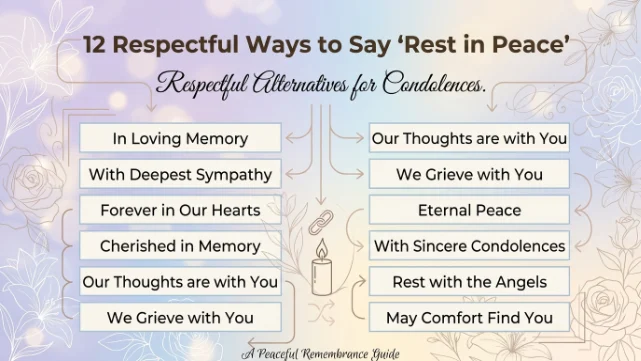
Looking for respectful alternatives to “RIP”? Try these meaningful expressions: “May you rest in peace,” “Rest easy,” “Gone but not forgotten,” “May your soul find peace,” and “You will be deeply missed.”
“RIP” – short for Requiescat in pace (Latin for “Rest in peace”) – is one of the most widely recognised expressions used to honour someone who has passed away. Whether you are writing a condolence message, delivering a eulogy, or simply offering comfort to a grieving friend, this phrase carries deep emotional weight and cultural significance.
However, repeating the same abbreviation can sometimes feel impersonal or overly casual. Learning alternatives to “Rest in peace” allows you to match your words to the relationship, the setting, and the level of formality required. When you know multiple ways to express condolences in English, you show empathy, cultural awareness, and linguistic sophistication.
Quick Categories
Formal Alternatives
- “May you rest in eternal peace”
- “May your soul find everlasting rest”
- “You have our deepest sympathy”
- “May you be at peace in the beyond”
Casual Alternatives
- “Rest easy, friend”
- “You’ll be missed”
- “Forever in our hearts”
- “Until we meet again”
Professional / Written Alternatives
- “With deepest sympathy”
- “In loving memory”
- “May you find peace”
- “You will be remembered”
Religious / Spiritual Alternatives
- “May God grant you eternal rest”
- “May the angels welcome you”
- “May your spirit soar”
- “You are now at peace”
Formal Alternatives to “Rest in Peace”
1. Phrase: May You Rest in Eternal Peace
Meaning: A prayerful wish for endless tranquility after death.
Explanation: Adds “eternal” to emphasise the permanence of peace.
Example Sentence: “May you rest in eternal peace, knowing that your legacy will live on.”
Best Use: Religious services
Worst Use: Casual conversation
Tone: Solemn, respectful, formal
2. Phrase: May Your Soul Find Everlasting Rest
Meaning: A devout hope that the departed soul is fully at ease.
Explanation: Focuses on the spiritual aspect of peace beyond the grave.
Example Sentence: “May your soul find everlasting rest in the arms of the Creator.”
Best Use: Funerals
Worst Use: Informal messages
Tone: Sacred, formal, reverent
3. Phrase: You Have Our Deepest Sympathy
Meaning: A formal expression of shared sorrow.
Explanation: Directly acknowledges grief and offers collective support.
Example Sentence: “You have our deepest sympathy during this difficult time.”
Best Use: Condolence letters
Worst Use: Personal texts
Tone: Professional, compassionate, formal
4. Phrase: May You Be at Peace in the Beyond
Meaning: A wish for tranquility in the afterlife.
Explanation: Uses “beyond” to reference the unknown without religious specificity.
Example Sentence: “May you be at peace in the beyond, free from earthly pain.”
Best Use: Secular memorials
Worst Use: Quick acknowledgements
Tone: Reflective, formal, respectful
5. Phrase: Rest in the Arms of the Divine
Meaning: A spiritual wish for protection and comfort in the afterlife.
Explanation: Appeals to a higher power for the departed’s safety.
Example Sentence: “Rest in the arms of the Divine; your journey here is complete.”
Best Use: Religious contexts
Worst Use: Non-religious settings
Tone: Sacred, formal, warm
6. Phrase: May Your Memory Be a Blessing
Meaning: A Jewish traditional expression honouring the departed’s impact.
Explanation: Shifts focus from death to the lasting positive influence of the person.
Example Sentence: “May your memory be a blessing to all who knew you.”
Best Use: Interfaith ceremonies
Worst Use: Casual remarks
Tone: Respectful, uplifting, formal
💡 Pro Tip: Formal alternatives are best for official obituaries, sympathy cards, and eulogies. They convey respect and are appropriate for all audiences, regardless of religious background.
Professional / Written Alternatives to “RIP”
7. Phrase: With Deepest Sympathy
Meaning: A standard written expression of condolence.
Explanation: Commonly used in formal letters and cards.
Example Sentence: “With deepest sympathy, we extend our thoughts to your family.”
Best Use: Condolence notes
Worst Use: Spoken casual conversation
Tone: Professional, empathetic, formal
8. Phrase: In Loving Memory
Meaning: A tribute that honours the person’s life and legacy.
Explanation: Often used on memorial plaques, obituaries, and dedications.
Example Sentence: “In loving memory of a devoted father and cherished friend.”
Best Use: Memorials
Worst Use: Quick texts
Tone: Sentimental, respectful, written
9. Phrase: May You Find Peace
Meaning: A concise hope for tranquility after death.
Explanation: Works well in both spoken and written form without religious overtones.
Example Sentence: “May you find peace in the quiet embrace of eternity.”
Best Use: Sympathy cards
Worst Use: Informal group chats
Tone: Gentle, formal, comforting
10. Phrase: You Will Be Remembered
Meaning: Assurance that the person’s life will not be forgotten.
Explanation: Focuses on legacy and ongoing remembrance.
Example Sentence: “You will be remembered for your kindness and generosity.”
Best Use: Tributes
Worst Use: Momentary condolences
Tone: Warm, professional, enduring
11. Phrase: May You Rest in Glory
Meaning: A wish for honour and majesty in the afterlife.
Explanation: Implies that the departed earned a place of high esteem.
Example Sentence: “May you rest in glory, having lived a life of courage and integrity.”
Best Use: Military or public service memorials
Worst Use: Personal friends
Tone: Honourable, formal, grand
12. Phrase: Your Legacy Endures
Meaning: Acknowledges that the person’s influence continues.
Explanation: Places emphasis on the lasting impact rather than the loss.
Example Sentence: “Your legacy endures through every life you touched.”
Best Use: Eulogies
Worst Use: Casual texts
Tone: Inspirational, professional, respectful
💡 Pro Tip: Professional alternatives are ideal for business condolences, official statements, and written tributes. They maintain a polished tone while showing genuine empathy.
Casual Alternatives to “Rest in Peace”
13. Phrase: Rest Easy, Friend
Meaning: A warm, informal wish for the departed to find comfort.
Explanation: Adds a personal, friendly tone to the traditional phrase.
Example Sentence: “Rest easy, friend – you’ve earned your peace.”
Best Use: Personal messages to close friends
Worst Use: Formal obituaries
Tone: Intimate, casual, affectionate
14. Phrase: You’ll Be Missed
Meaning: A simple, heartfelt acknowledgement of loss.
Explanation: Focuses on the absence the person leaves behind.
Example Sentence: “You’ll be missed more than words can say.”
Best Use: Social media posts
Worst Use: Official statements
Tone: Warm, personal, concise
15. Phrase: Forever in Our Hearts
Meaning: A promise that the person will always be remembered with love.
Explanation: Emphasises emotional connection and enduring love.
Example Sentence: “Forever in our hearts – we carry you with us always.”
Best Use: Memorial posts
Worst Use: Formal ceremonies
Tone: Sentimental, casual, loving
16. Phrase: Until We Meet Again
Meaning: Expresses hope for a future reunion in the afterlife.
Explanation: Provides comfort by framing death as a temporary separation.
Example Sentence: “Until we meet again, may you find peace.”
Best Use: Personal farewells
Worst Use: Secular audiences
Tone: Hopeful, casual, emotional
17. Phrase: Gone but Not Forgotten
Meaning: A classic tribute acknowledging the person’s lasting presence in memory.
Explanation: Extremely common in casual and semi-formal contexts.
Example Sentence: “Gone but not forgotten – your spirit lives on in us all.”
Best Use: Obituaries
Worst Use: Religious services
Tone: Memorable, respectful, warm
18. Phrase: May Your Journey Be Peaceful
Meaning: A gentle wish for a tranquil transition.
Explanation: Uses “journey” to metaphorically describe the passage after death.
Example Sentence: “May your journey be peaceful as you move beyond this life.”
Best Use: Personal messages
Worst Use: Formal writing
Tone: Soft, casual, comforting
💡 Pro Tip: Casual alternatives work well for personal social media tributes, text messages, and close-knit family circles. They offer comfort without feeling overly stiff.
Religious / Spiritual Alternatives to “RIP”
19. Phrase: May God Grant You Eternal Rest
Meaning: A prayerful request for divine peace.
Explanation: A direct appeal to God, common in Christian traditions.
Example Sentence: “May God grant you eternal rest, and may perpetual light shine upon you.”
Best Use: Catholic funerals
Worst Use: Non-religious audiences
Tone: Devout, formal, sacred
20. Phrase: May the Angels Welcome You
Meaning: A hope that benevolent spirits receive the departed.
Explanation: Appeals to angelic imagery to provide comfort.
Example Sentence: “May the angels welcome you into paradise.”
Best Use: Religious services
Worst Use: Secular settings
Tone: Heavenly, warm, spiritual
21. Phrase: May Your Spirit Soar
Meaning: A wish for the soul to be free and elevated.
Explanation: Uses uplifting imagery of flight and liberation.
Example Sentence: “May your spirit soar above the clouds, free at last.”
Best Use: Memorials for free spirits
Worst Use: Formal documents
Tone: Uplifting, spiritual, poetic
22. Phrase: You Are Now at Peace
Meaning: A statement that suffering has ended and rest has begun.
Explanation: Often said to comfort the bereaved after a long illness.
Example Sentence: “You are now at peace, and we find solace in that.”
Best Use: Bedside farewells
Worst Use: Public eulogies
Tone: Soothing, spiritual, compassionate
23. Phrase: May You Rest in Paradise
Meaning: A wish for the departed to reside in a heavenly place.
Explanation: Uses “paradise” to suggest a beautiful afterlife.
Example Sentence: “May you rest in paradise, surrounded by beauty and love.”
Best Use: Religious contexts
Worst Use: Casual texts
Tone: Blissful, formal, spiritual
24. Phrase: May Your Soul Be at Peace
Meaning: A traditional expression of hope for inner tranquility.
Explanation: Directly addresses the soul’s state after death.
Example Sentence: “May your soul be at peace, knowing you are dearly loved.”
Best Use: All contexts
Worst Use: None – very versatile
Tone: Gentle, respectful, spiritual
💡 Pro Tip: Religious alternatives should be chosen carefully based on the deceased’s beliefs and the sensitivity of the grieving family. When in doubt, stick to secular options.
Common Mistakes When Saying “RIP”
Mistake 1: Using “RIP” in Spoken Conversation
Explanation: “RIP” is an abbreviation that feels impersonal when spoken aloud; it is better to say the full phrase.
Example: ❌ “RIP to your grandmother.”
✓ “May your grandmother rest in peace.”
Mistake 2: Overusing the Same Phrase
Explanation: Repetition can make condolences sound robotic and insincere.
Example: ❌ Writing “RIP” on every social media post.
✓ Vary your language with phrases like “You’ll be missed” or “Forever in our hearts.”
Mistake 3: Misusing “Rest in Peace” for Animals or Objects
Explanation: While common, some people feel it is inappropriate for non-human losses.
Example: ❌ “RIP to my old car.”
✓ “I’ll always remember that car fondly.”
Mistake 4: Forgetting the Full Stop After “RIP”
Explanation: In formal writing, the abbreviation often includes periods (R.I.P.), though both forms are accepted.
Example: ❌ “RIP to a great man.” (informal)
✓ “R.I.P. to a great man.” (more traditional)
Mistake 5: Using It Before the Funeral Service
Explanation: Some traditions consider it premature to say “rest in peace” before the burial has taken place.
Example: ❌ Sending “RIP” messages immediately after death without waiting for the funeral.
✓ Offer initial condolences with “I’m so sorry for your loss” and save “rest in peace” for later tributes.
What Does “Rest in Peace” Mean?
“Rest in peace” (often abbreviated as RIP or R.I.P.) is a phrase used to express the hope that the deceased person finds eternal tranquillity and freedom from suffering. It originates from the Latin Requiescat in pace, which appears on many Christian tombstones and in liturgical prayers.
Grammar Note: The phrase is often used as a blessing or a wish. In modern usage, it can function as a complete sentence or as part of a longer tribute.
Example Sentence: “Rest in peace, dear aunt – your kindness will never be forgotten.”
When to Use “Rest in Peace”
Common Contexts:
- Obituaries and death notices – Written tributes
- Funeral services – Spoken eulogies or prayers
- Sympathy cards and letters – Written condolences
- Social media memorials – Public tributes
- Personal conversations – Offering comfort to the bereaved
Spoken vs Written:
- Spoken: Usually said as a full phrase, not the abbreviation
- Written: Both “Rest in peace” and “RIP” appear, with “RIP” being more informal
Formal vs Informal:
- Formal: Preferred in official documents, eulogies, and religious ceremonies
- Informal: Acceptable in personal messages and social media posts
Is It Professional or Polite to Say “Rest in Peace”?
The phrase “Rest in peace” is always polite, but professionalism depends on the context.
- Polite? ✔️ Yes – It expresses respect and compassion
- Professional? ✔️ Yes – In appropriate settings like official condolences; but the abbreviation “RIP” is often too casual for business correspondence
Business Example: “We extend our deepest condolences and hope that your family finds peace during this difficult time.”
Using the full phrase in a formal letter is perfectly professional; however, avoid the abbreviation in professional emails or official statements.
Pros and Cons of Using “Rest in Peace”
Pros:
- Universally understood – Recognised across cultures and languages
- Simple and direct – Clearly conveys a compassionate wish
- Works in many settings – From religious to secular contexts
- Comforting – Offers a sense of closure and peace
Cons:
- Can sound impersonal – Especially if overused or abbreviated
- Religious connotations – May not suit all beliefs
- Lacks emotional depth – Does not express personal connection
- Not always appropriate – Some cultures avoid it before burial
💡 “The right phrase can bring comfort when words matter most.”
Other Ways to Say “Rest in Peace” (With Examples)
These alternatives to “Rest in peace” will help you convey condolences more meaningfully and appropriately.
Use them according to tone, context, and the relationship you had with the departed.
25. Phrase: May You Find Comfort in Eternity
Meaning: A wish for solace in the afterlife.
Explanation: Focuses on comfort rather than just rest.
Example Sentence: “May you find comfort in eternity, surrounded by love and light.”
Best Use: Spiritual messages
Worst Use: Casual conversations
Tone: Soothing, formal, compassionate
26. Phrase: You Have Earned Your Rest
Meaning: Acknowledges a life well-lived and deserving of peace.
Explanation: Often said after a long, full life.
Example Sentence: “You have earned your rest after a lifetime of service to others.”
Best Use: Eulogies for the elderly
Worst Use: Sudden, tragic losses
Tone: Respectful, warm, admiring
27. Phrase: May Your Light Never Fade
Meaning: A hope that the person’s influence and spirit remain bright.
Explanation: Uses metaphor to keep the person’s memory alive.
Example Sentence: “May your light never fade – you have brightened so many lives.”
Best Use: Creative tributes
Worst Use: Religious ceremonies
Tone: Poetic, uplifting, informal
28. Phrase: Rest Now, Your Work Is Done
Meaning: A comforting acknowledgment that the person’s life mission is complete.
Explanation: Provides a sense of completion and relief.
Example Sentence: “Rest now, your work is done – you have left the world better than you found it.”
Best Use: Personal farewells
Worst Use: Official statements
Tone: Gentle, warm, intimate
29. Phrase: May You Be Surrounded by Love
Meaning: A wish for the departed to experience love in the afterlife.
Explanation: Emphasises the emotional connection beyond death.
Example Sentence: “May you be surrounded by love as you enter your new journey.”
Best Use: Sympathy messages
Worst Use: Formal obituaries
Tone: Tender, spiritual, personal
30. Phrase: You Will Always Be in Our Hearts
Meaning: A promise of enduring remembrance and affection.
Explanation: Similar to “Forever in our hearts,” but with a slightly more formal tone.
Example Sentence: “You will always be in our hearts, and we will carry your memory forward.”
Best Use: Memorials
Worst Use: Brief messages
Tone: Loving, respectful, lasting
Quiz: Test Your Knowledge
1. Which phrase would be most appropriate for a condolence letter to a business colleague?
A) Rest easy, mate
B) With deepest sympathy
C) You rock, RIP
D) Gone but not forgotten
Answer: B – “With deepest sympathy” is professional and appropriate for business correspondence.
2. You are speaking at a close friend’s funeral. Which alternative would best reflect your personal bond?
A) May you rest in eternal peace
B) You have earned your rest
C) Rest easy, friend
D) In loving memory
Answer: C – “Rest easy, friend” is warm, personal, and reflects a close relationship.
3. Which phrase should you avoid using if the grieving family is not religious?
A) May God grant you eternal rest
B) You will be remembered
C) Forever in our hearts
D) Rest now, your work is done
Answer: A – This is explicitly religious and may not be welcomed by a non-religious family.
4. In which context is it acceptable to write “RIP” rather than the full phrase?
A) A formal eulogy
B) A social media post
C) An official company memo
D) A handwritten condolence card
Answer: B – “RIP” is informal and commonly used on social media; it is not appropriate for formal occasions.
💡 “Choosing the right expression of sympathy shows emotional intelligence and cultural sensitivity.”
Comparison Table: Top Alternatives to “Rest in Peace”
| Phrase | Tone | Best Use |
|---|---|---|
| May you rest in eternal peace | Formal | Religious services |
| With deepest sympathy | Professional | Condolence letters |
| You will be remembered | Professional | Eulogies |
| Rest easy, friend | Casual | Personal messages |
| Forever in our hearts | Casual | Memorial posts |
| May God grant you eternal rest | Religious | Christian funerals |
| May your soul find peace | Spiritual | All contexts |
| Gone but not forgotten | Semi-formal | Obituaries |
| You are now at peace | Spiritual | Bedside farewells |
| Until we meet again | Casual | Personal farewells |
💡 “Mastering professional sympathy phrases helps you support others with grace and dignity.”
FAQs
1. Is it okay to say “RIP” instead of “Rest in peace”?
Yes, but context matters. “RIP” is acceptable in informal settings like social media and text messages. In formal writing, speeches, or official condolences, it is better to use the full phrase “Rest in peace” to show proper respect.
2. What is the best way to express condolences for someone who was not religious?
Use secular phrases such as “You will be missed,” “Forever in our hearts,” “May you find peace,” or “Your legacy endures.” These expressions offer comfort without religious connotations.
3. Can I say “Rest in peace” to someone who has lost a pet?
Absolutely. Many people use these phrases for beloved pets as well. Alternatives like “May you find peace” or “Forever in our hearts” work beautifully for animal companions too.
4. How do you say “Rest in peace” in a way that sounds more personal?
Add a personal memory or a specific compliment. For example: “Rest in peace, knowing that your laughter brightened every room.” This makes the phrase uniquely meaningful.
5. Is it appropriate to say “Rest in peace” before the funeral?
In many traditions, it is perfectly fine. However, some cultures prefer to wait until after the burial. To be safe, you can offer initial condolences with “I’m so sorry for your loss” and use “Rest in peace” in later tributes.
Conclusion
Learning other ways to say “Rest in peace” empowers you to offer more heartfelt, appropriate, and varied condolences. Whether you are drafting a formal letter, speaking at a memorial, or sending a quick message to a grieving friend, having a range of expressions allows you to match your words to the situation and the relationship.
Remember that the most important thing is sincerity and empathy. The right phrase, chosen with care, can bring comfort to those who are mourning. Practice using these alternatives, and you will develop greater fluency in expressing sympathy in English.