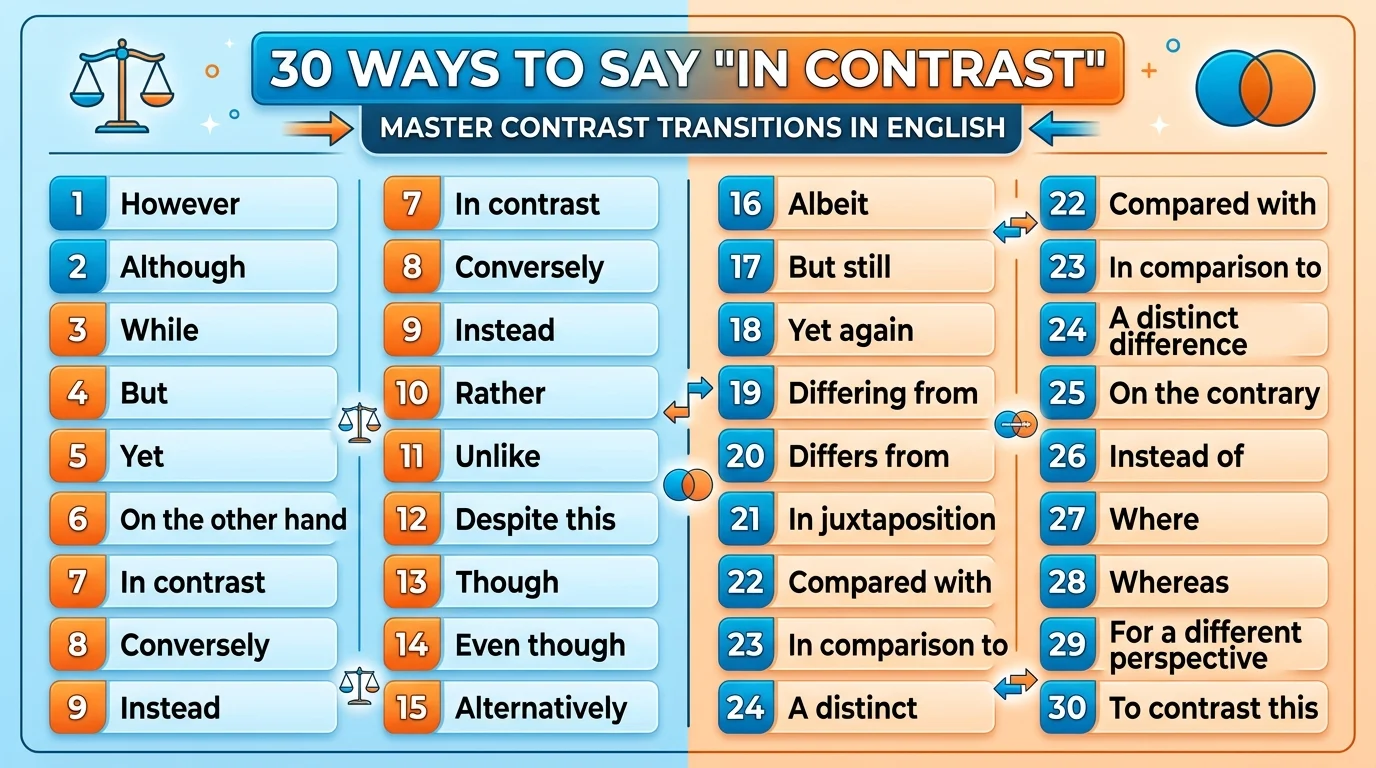
Need to highlight differences more powerfully? Try these alternatives: “Conversely,” “On the other hand,” “By comparison,” “Whereas,” “While,” “Unlike,” “Conversely,” “In opposition,” “Yet,” and “However.” Each adds nuance to your comparative writing.
“In contrast” is a cornerstone transitional phrase used to highlight differences between two ideas, objects, or situations. Whether you’re writing an academic essay, preparing a business report, or crafting a persuasive argument, showing contrast helps clarify distinctions and strengthens your reasoning. However, repeating the same phrase can make your writing feel mechanical and dull.
Learning alternatives to “in contrast” allows you to vary your language, match the formality of your context, and express subtle shades of comparison. Mastering these other ways to show contrast in English will elevate your fluency and make your communication more engaging and precise.
Quick Categories
Formal Alternatives
- “Conversely”
- “On the contrary”
- “In opposition”
- “By way of contrast”
Casual Alternatives
- “On the flip side”
- “Then again”
- “But then”
- “At the same time, though”
Professional Alternatives
- “Conversely”
- “In comparison”
- “By comparison”
- “Wherein”
Informal Expressions
- “Meanwhile, though”
- “Not so for”
- “Different story”
- “That said, though”
Formal Alternatives to “In Contrast”
1. Phrase: Conversely
Meaning: Introduces a statement that is the opposite of what has just been said.
Explanation: A precise, academic word indicating a direct reversal.
Example Sentence: “The first study supports the theory; conversely, the second study refutes it entirely.”
Best Use: Academic writing
Worst Use: Casual conversation
Tone: Formal, logical, precise
2. Phrase: On the Contrary
Meaning: Used to assert that the opposite is true.
Explanation: Often used to contradict a previous statement, not just to note a difference.
Example Sentence: “The results did not show improvement; on the contrary, they revealed a decline in performance.”
Best Use: Argumentative essays
Worst Use: Neutral comparisons
Tone: Formal, assertive, contrasting
3. Phrase: In Opposition
Meaning: Indicates that two ideas or positions are in conflict.
Explanation: Stronger than “in contrast,” implies active disagreement.
Example Sentence: “The board favoured expansion; in opposition, the staff advocated for consolidation.”
Best Use: Policy debates
Worst Use: Simple comparisons
Tone: Formal, adversarial, professional
4. Phrase: By Way of Contrast
Meaning: A more elaborate version of “in contrast,” used for emphasis.
Explanation: Adds formality and introduces a deliberate comparison.
Example Sentence: “By way of contrast, consider the economic policies adopted by neighbouring countries.”
Best Use: Analytical reports
Worst Use: Quick notes
Tone: Formal, explanatory, deliberate
5. Phrase: Whereas
Meaning: Used to compare two facts and highlight a difference.
Explanation: A conjunction that can connect two clauses directly.
Example Sentence: “The northern region experienced drought, whereas the south had abundant rainfall.”
Best Use: Comparative writing
Worst Use: Oral conversation
Tone: Formal, neutral, clarifying
6. Phrase: While
Meaning: Similar to “whereas,” but less formal; still acceptable in professional writing.
Explanation: Can introduce contrast or concession.
Example Sentence: “While the first proposal was cost-effective, the second offered superior quality.”
Best Use: Professional reports
Worst Use: Very formal legal texts
Tone: Professional, balanced, accessible
7. Phrase: Yet
Meaning: Introduces a contrast or exception to a preceding statement.
Explanation: Shows that despite something, there is a different aspect.
Example Sentence: “The strategy was ambitious; yet, it failed to consider key market trends.”
Best Use: Persuasive writing
Worst Use: Listing differences
Tone: Formal, sophisticated, nuanced
💡 Pro Tip: In formal writing, use “conversely” to signal logical opposition and “whereas” for straightforward side‑by‑side comparisons. Avoid overusing any single term to maintain variety.
Professional Alternatives to “In Contrast”
8. Phrase: In Comparison
Meaning: Highlights a difference when comparing two things.
Explanation: Useful for objective contrasts in data and analysis.
Example Sentence: “Our sales increased by 20%; in comparison, our competitors saw only a 5% rise.”
Best Use: Business reports
Worst Use: Personal anecdotes
Tone: Professional, analytical, clear
9. Phrase: By Comparison
Meaning: Similar to “in comparison,” often used to emphasize a notable difference.
Explanation: Suggests that one item is evaluated against another.
Example Sentence: “The first proposal was costly; by comparison, the second was remarkably affordable.”
Best Use: Decision-making contexts
Worst Use: Casual chat
Tone: Professional, balanced, evaluative
10. Phrase: Wherein
Meaning: Formal way to say “in which” or “where” – can introduce a contrasting element.
Explanation: Often used in legal or contractual language.
Example Sentence: “The agreement favours the seller, wherein the buyer assumes all risk.”
Best Use: Contracts, legal writing
Worst Use: Everyday writing
Tone: Very formal, legalistic, precise
11. Phrase: In a Different Vein
Meaning: Indicates a shift to a contrasting topic or perspective.
Explanation: Softens the contrast, suggesting a different angle rather than direct opposition.
Example Sentence: “Our customer service excels; in a different vein, our product quality needs attention.”
Best Use: Strategic reviews
Worst Use: Direct arguments
Tone: Professional, diplomatic, constructive
12. Phrase: On the Other Hand
Meaning: Classic phrase for showing two opposing viewpoints.
Explanation: Widely accepted in both spoken and written professional English.
Example Sentence: “The new policy saves time; on the other hand, it increases workload for managers.”
Best Use: Balanced discussions
Worst Use: Very formal academic papers
Tone: Professional, moderate, accessible
13. Phrase: Alternatively
Meaning: Presents a different possibility or option.
Explanation: Often used to present a contrasting choice, not just a fact.
Example Sentence: “We could invest in technology; alternatively, we could hire more staff.”
Best Use: Proposing options
Worst Use: Describing fixed differences
Tone: Professional, solution-oriented, clear
💡 Pro Tip: In professional settings, pair contrast phrases with specific data or examples to strengthen your argument. “In comparison” works well with numbers and statistics.
Casual Alternatives to “In Contrast”
14. Phrase: On the Flip Side
Meaning: Informal way to introduce an opposing perspective.
Explanation: Lighthearted and conversational.
Example Sentence: “The job pays well; on the flip side, the hours are brutal.”
Best Use: Friendly conversations
Worst Use: Formal writing
Tone: Casual, approachable, easygoing
15. Phrase: Then Again
Meaning: Indicates reconsideration or an alternative viewpoint.
Explanation: Often introduces a contradictory thought after initial agreement.
Example Sentence: “I thought the movie was great; then again, the ending was a bit confusing.”
Best Use: Personal opinions
Worst Use: Objective comparisons
Tone: Casual, reflective, conversational
16. Phrase: But Then
Meaning: Similar to “then again,” introducing a contrast.
Explanation: Very informal and often used in speech.
Example Sentence: “She loves city life, but then she also enjoys peace and quiet.”
Best Use: Everyday talk
Worst Use: Any written form
Tone: Informal, spontaneous, spoken
17. Phrase: At the Same Time, Though
Meaning: Acknowledges a contrasting point while maintaining the previous idea.
Explanation: Adds nuance and shows balance.
Example Sentence: “The restaurant is expensive; at the same time, though, the food is incredible.”
Best Use: Personal recommendations
Worst Use: Professional reports
Tone: Casual, conversational, balanced
18. Phrase: That Said
Meaning: Softens the contrast and introduces an exception.
Explanation: Very common in both spoken and informal written English.
Example Sentence: “The project was successful; that said, we faced many challenges along the way.”
Best Use: Personal or semi-formal writing
Worst Use: Academic papers
Tone: Moderate, clear, friendly
19. Phrase: Now, in Contrast
Meaning: A more direct casual variant that keeps the original phrase but adds “now.”
Explanation: Used in narrative or storytelling.
Example Sentence: “Back then, everything was simple; now, in contrast, life is much more complex.”
Best Use: Storytelling
Worst Use: Business writing
Tone: Casual, narrative, engaging
💡 Pro Tip: Casual alternatives work best in informal emails, blog posts, and presentations to keep your audience engaged. Use them to create a friendly tone, but avoid in formal documents.
Informal Expressions to Show Contrast
20. Phrase: Meanwhile, Though
Meaning: Introduces a contrast that happens concurrently.
Explanation: Adds a conversational pause.
Example Sentence: “Our team finished early; meanwhile, though, the others were just starting.”
Best Use: Casual updates
Worst Use: Formal writing
Tone: Informal, conversational, light
21. Phrase: Not So For
Meaning: Used to say that something is different for another party.
Explanation: Often used when comparing two groups.
Example Sentence: “Many people enjoy the heat; not so for those who prefer cooler weather.”
Best Use: Personal comparisons
Worst Use: Academic writing
Tone: Informal, direct, simple
22. Phrase: Different Story
Meaning: Indicates that another situation or person is very different.
Explanation: A very casual idiom.
Example Sentence: “The first test was easy; the second was a different story entirely.”
Best Use: Oral storytelling
Worst Use: Written formal work
Tone: Very informal, idiomatic, vivid
23. Phrase: Just the Opposite
Meaning: Emphasises a complete reversal.
Explanation: Stronger than a simple contrast.
Example Sentence: “I expected him to be upset; just the opposite, he was thrilled.”
Best Use: Personal anecdotes
Worst Use: Professional analysis
Tone: Informal, expressive, emphatic
24. Phrase: In Direct Contrast
Meaning: Stresses that the difference is obvious and deliberate.
Explanation: Even in informal use, this retains some weight.
Example Sentence: “She loves attention; in direct contrast, her sister avoids the spotlight.”
Best Use: Personal comparisons
Worst Use: Formal essays (too wordy)
Tone: Moderate, clear, contrasting
💡 Pro Tip: Informal expressions are effective for social media, blogs, and personal emails. They make your writing feel relatable and genuine, but always consider your audience.
Common Mistakes When Using “In Contrast”
Mistake 1: Using “In Contrast” Where No Real Difference Exists
Explanation: Only use contrast phrases when the differences are significant.
Example: ❌ “The cat is furry; in contrast, the dog is also furry.”
✓ “The cat is independent; in contrast, the dog is highly social.”
Mistake 2: Confusing “In Contrast” with “By Contrast”
Explanation: “In contrast” is used to compare two things; “by contrast” is more colloquial and often introduces a single opposing element. They are often interchangeable, but “by contrast” is less formal.
Example: ❌ “The first option was cheap. In contrast, the second was expensive.” (Actually acceptable, but careful: many style guides prefer “by contrast” when the second item is singled out.)
✓ “The first option was cheap. By contrast, the second was expensive.”
Mistake 3: Overusing the Phrase in a Short Text
Explanation: Repetition makes writing dull; vary your language.
Example: ❌ “The team worked hard. In contrast, the other team slacked. In contrast, management ignored the issue.”
✓ “The team worked hard; conversely, the other team slacked. Meanwhile, management remained indifferent.”
Mistake 4: Using “In Contrast” Instead of “On the Contrary”
Explanation: “On the contrary” is used to contradict a statement, while “in contrast” shows a difference between two separate items.
Example: ❌ “He is not lazy; in contrast, he is very hardworking.” (Should be “on the contrary”)
✓ “He is not lazy; on the contrary, he is very hardworking.”
Mistake 5: Forgetting to Pair It with Clear Referents
Explanation: Always make clear what two things are being contrasted.
Example: ❌ “The results were positive. In contrast, some issues arose.” (What is being compared?)
✓ “The results were positive. In contrast, the methodology revealed some issues.”
What Does “In Contrast” Mean?
“In contrast” is a transitional phrase used to point out a clear difference between two or more things, ideas, or situations. It signals that the following statement will diverge from the preceding one, often highlighting opposing qualities, data, or perspectives.
Grammar Note: “In contrast” is a prepositional phrase. It is often followed by a comma when placed at the beginning of a sentence. It can also appear mid-sentence with “to” (e.g., “In contrast to previous years…”).
Example Sentence: “The urban population has grown rapidly; in contrast, rural areas have seen a steady decline.”
When to Use “In Contrast”
Common Contexts:
- Academic essays: Comparing theories, studies, or historical periods
- Business reports: Analysing market trends, competitors, or financial data
- Persuasive writing: Highlighting advantages over alternatives
- Presentations: Making points clear through side-by-side comparison
- Everyday conversation: Noting differences between people, experiences, or opinions
Spoken vs Written:
- Spoken: Used frequently in formal speeches, debates, and structured conversations
- Written: More common in essays, reports, articles, and professional correspondence
Formal vs Informal:
- Formal: Preferred in academic and legal documents
- Informal: Can be used in casual writing, but simpler alternatives often work better
Is It Professional or Polite to Say “In Contrast”?
Yes, “in contrast” is both professional and polite. It is a neutral, standard phrase accepted in all English registers.
- Polite? ✔️ Yes – It is respectful and avoids confrontation
- Professional? ✔️ Yes – It is widely used in business and academic writing
Business Example: “Our Q4 revenue increased by 15%; in contrast, Q3 revenue showed only a 2% growth.”
Pros and Cons of Using “In Contrast”
Pros:
- Clear and unambiguous – Everyone understands the meaning
- Neutral tone – Does not imply judgment or bias
- Versatile – Works in formal, professional, and informal contexts
- Easy to use – Straightforward structure
Cons:
- Overused – Can become repetitive and boring
- Lacks nuance – Does not convey subtle shades of contrast (e.g., concession, surprise)
- Sometimes too blunt – May oversimplify complex relationships
- Not always the best fit – For dramatic or emphatic contrasts, other phrases may be stronger
💡 “Mastering contrast phrases helps you write with clarity and sophistication.”
Other Ways to Say “In Contrast” (With Examples)
These alternatives to “in contrast” will help you express differences more dynamically. Use them to match your tone, context, and audience.
25. Phrase: As Opposed To
Meaning: Indicates a clear alternative or difference.
Explanation: Often used to compare two options or viewpoints.
Example Sentence: “We chose the direct approach, as opposed to the more indirect strategy.”
Best Use: Decision making
Worst Use: Listing similarities
Tone: Neutral, clear, professional
26. Phrase: Unlike
Meaning: Highlights how two things are not similar.
Explanation: Simple and direct.
Example Sentence: “Unlike his predecessor, the new CEO values transparency.”
Best Use: Personal comparisons
Worst Use: Comparative statistics
Tone: Neutral, concise, effective
27. Phrase: Rather Than
Meaning: Expresses preference for one over another.
Explanation: Focuses on choice and opposition.
Example Sentence: “They invested in technology rather than in training.”
Best Use: Options and choices
Worst Use: Describing inherent differences
Tone: Professional, comparative, clear
28. Phrase: In Another Light
Meaning: Presents a different perspective.
Explanation: Suggests reinterpreting previous information.
Example Sentence: “The policy seemed strict; in another light, it was actually protective.”
Best Use: Opinion pieces
Worst Use: Data analysis
Tone: Reflective, nuanced, rhetorical
29. Phrase: Set Against
Meaning: Places two things in comparison to highlight contrast.
Explanation: Often used in critical analysis.
Example Sentence: “Set against the backdrop of economic growth, the social inequalities become stark.”
Best Use: Academic writing
Worst Use: Everyday speech
Tone: Formal, literary, analytical
30. Phrase: In a Different Context
Meaning: Shows that interpretation changes under different circumstances.
Explanation: Contrasts based on context, not inherent properties.
Example Sentence: “The same gesture is friendly in one culture; in a different context, it can be offensive.”
Best Use: Cultural comparisons
Worst Use: Objective data
Tone: Informative, diplomatic, clear
Quiz: Test Your Knowledge
1. Which phrase is most appropriate for an academic paper comparing two theories?
A) On the flip side
B) Conversely
C) Then again
D) Just the opposite
Answer: B – “Conversely” is formal and precise for academic writing.
2. You’re writing a blog post about two vacation destinations. Which casual alternative would work best?
A) Whereas
B) In opposition
C) On the other hand
D) In a different vein
Answer: C – “On the other hand” is clear and moderately casual, fitting for blog posts.
3. In a business report comparing quarterly sales, which phrase is best?
A) Meanwhile, though
B) In comparison
C) Different story
D) Not so for
Answer: B – “In comparison” is professional and data-friendly.
4. Which phrase should you use to contradict a false assumption?
A) In contrast
B) On the contrary
C) By way of contrast
D) Alternatively
Answer: B – “On the contrary” directly denies a prior statement.
💡 “The right contrast phrase can turn a bland sentence into a compelling argument.”
Comparison Table: Top Alternatives to “In Contrast”
| Phrase | Tone | Best Use |
|---|---|---|
| Conversely | Formal | Logical opposition |
| On the other hand | Professional | Balanced comparisons |
| In comparison | Professional | Data and analysis |
| Whereas | Formal | Side‑by‑side differences |
| While | Professional | Concession and contrast |
| By contrast | Professional | Emphasising a single opposite |
| On the flip side | Casual | Friendly alternatives |
| Then again | Casual | Reconsidering opinions |
| Unlike | Neutral | Direct differences |
| Set against | Formal | Literary analysis |
💡 “Using varied contrast language shows your command of English structure.”
FAQs
1. Is “in contrast” the same as “on the contrary”?
No. “In contrast” points out differences between two separate things. “On the contrary” is used to deny a previous statement and assert the opposite. Example: “He is not lazy; on the contrary, he is very hardworking.” (Not “in contrast” here.)
2. Can I start a sentence with “In contrast”?
Yes. It is common to start a sentence with “In contrast” followed by a comma. For example: “In contrast, the second experiment yielded different results.”
3. What is a good synonym for “in contrast” in formal writing?
“Conversely,” “whereas,” “by way of contrast,” and “in opposition” are excellent formal synonyms. Choose based on the nuance you need.
4. How do you use “in contrast to” in a sentence?
Use it to directly compare two nouns: “In contrast to the previous year, this year saw record profits.” Note the preposition “to” when followed by a noun phrase.
5. Is “in contrast” appropriate for spoken English?
Yes, especially in formal speeches, presentations, and academic discussions. In casual conversation, simpler expressions like “on the other hand” or “but then” are more natural.
Conclusion
Expanding your vocabulary with alternatives to “in contrast” dramatically improves the quality of your writing and speaking. Whether you are drafting a research paper, preparing a business proposal, or simply sharing an opinion, choosing the right phrase adds clarity, sophistication, and engagement. By varying your contrast language, you avoid monotony and demonstrate linguistic flexibility.
Remember to match your choice to the context: formal for academic and legal, professional for reports and business, and casual for everyday interactions. Practice using these alternatives regularly, and soon you’ll effortlessly weave them into your communication.