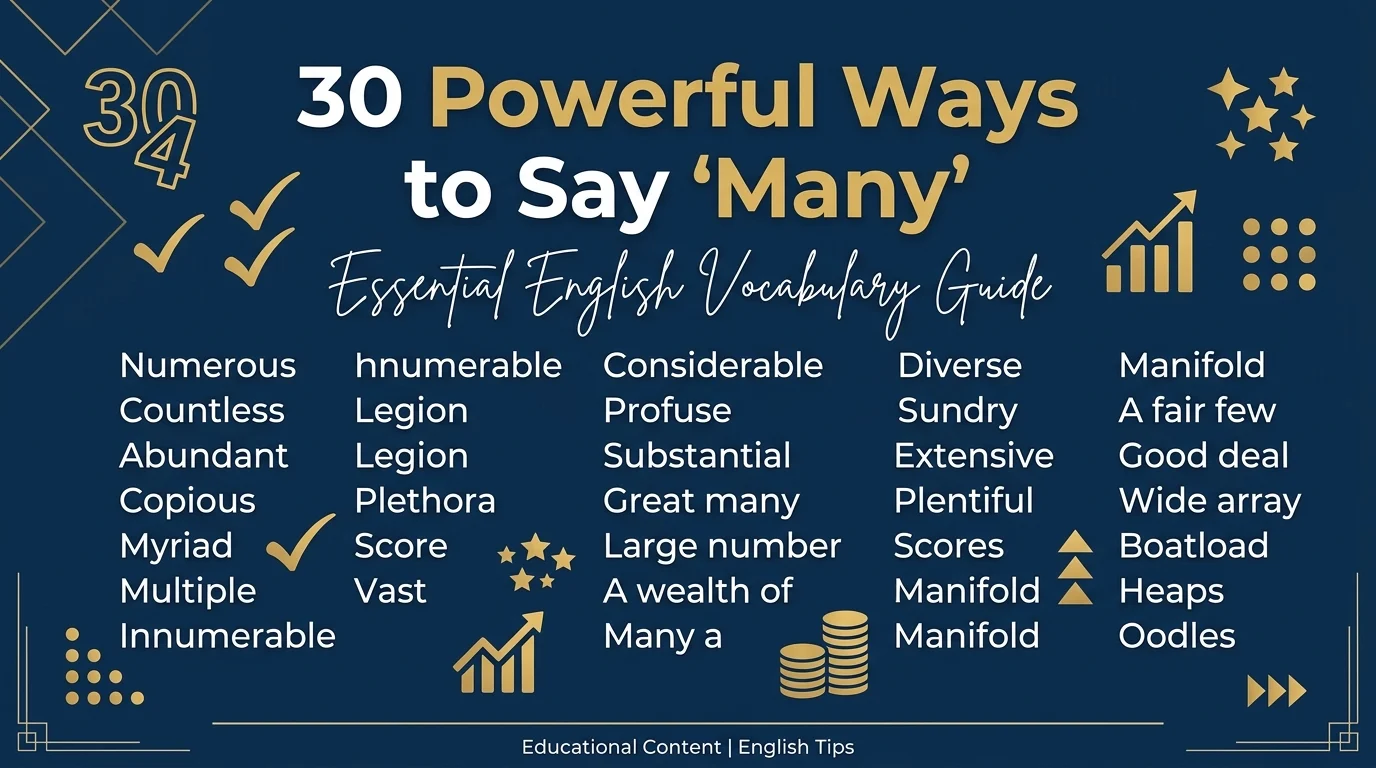
Need variety instead of repeating “many”? Try these powerful alternatives: “numerous,” “countless,” “a multitude of,” “an abundance of,” “several,” and “a wide range of.” These alternatives will help you sound more fluent, precise, and professional.
“Many” is one of the most frequently used words in English. We rely on it to describe quantities, express abundance, and emphasize numbers. From everyday conversations to professional reports, this versatile word appears everywhere.
However, English learners and even native speakers often overuse “many,” making their writing repetitive and less engaging. Learning alternatives to “many” dramatically improves your fluency and precision. When you know multiple ways to express quantity in English, your communication becomes more vivid, accurate, and sophisticated. Whether you’re writing academic papers, business reports, or casual emails, varying your vocabulary shows command of the language.
Quick Categories
Formal Alternatives
- “Numerous”
- “A multitude of”
- “A plethora of”
- “An abundance of”
Casual Alternatives
- “A lot of”
- “Plenty of”
- “Lots of”
- “Heaps of”
Professional Alternatives
- “A considerable number”
- “A substantial amount”
- “A significant number”
- “A wide array of”
Informal Expressions
- “A ton of”
- “Loads of”
- “A bunch of”
- “A boatload of”
Formal Alternatives to “Many”
1. Phrase: Numerous
Meaning: Existing in large numbers; many.
Explanation: A direct, professional synonym that works well in academic and formal writing.
Example Sentence: “Numerous studies have confirmed the benefits of regular exercise.”
Best Use: Academic writing
Worst Use: Casual conversation
Tone: Formal, precise, academic
2. Phrase: A Multitude Of
Meaning: A very large number of people or things.
Explanation: Emphasizes an impressive quantity in a sophisticated way.
Example Sentence: “The organization faces a multitude of challenges in the coming year.”
Best Use: Business reports
Worst Use: Everyday speech
Tone: Formal, impressive, professional
3. Phrase: A Plethora Of
Meaning: An excessive or abundant amount of something.
Explanation: Often used to emphasize abundance, sometimes with a positive or negative connotation.
Example Sentence: “The conference offered a plethora of networking opportunities.”
Best Use: Professional writing
Worst Use: Brief remarks
Tone: Formal, sophisticated, descriptive
4. Phrase: An Abundance Of
Meaning: A very large quantity of something.
Explanation: Carries a positive connotation of richness or generosity.
Example Sentence: “The region is known for its abundance of natural resources.”
Best Use: Economic reports
Worst Use: Casual text messages
Tone: Formal, positive, descriptive
5. Phrase: A Profusion Of
Meaning: An exceptionally large quantity that seems to pour forth.
Explanation: Suggests abundance that is almost overwhelming.
Example Sentence: “The garden displayed a profusion of colorful flowers in spring.”
Best Use: Creative writing
Worst Use: Technical documents
Tone: Poetic, formal, vivid
6. Phrase: Considerable
Meaning: Great in amount, size, or importance.
Explanation: Emphasizes significance along with quantity.
Example Sentence: “The project required a considerable amount of resources.”
Best Use: Business contexts
Worst Use: Personal conversations
Tone: Professional, measured, formal
💡 Pro Tip: Formal alternatives to “many” work best in academic papers, business reports, and professional correspondence. They demonstrate vocabulary sophistication and precision.
Professional Alternatives to “Many”
7. Phrase: A Considerable Number
Meaning: A large quantity that is noticeable and significant.
Explanation: Emphasizes the importance of the quantity mentioned.
Example Sentence: “A considerable number of employees have enrolled in the training program.”
Best Use: Reports
Worst Use: Quick notes
Tone: Professional, objective, precise
8. Phrase: A Substantial Amount
Meaning: A significant or sizable quantity.
Explanation: Suggests that the amount matters and deserves attention.
Example Sentence: “The company invested a substantial amount in research and development.”
Best Use: Financial contexts
Worst Use: Informal emails
Tone: Formal, businesslike, serious
9. Phrase: A Significant Number
Meaning: A quantity that is large enough to be important.
Explanation: Adds the dimension of importance to the quantity.
Example Sentence: “A significant number of customers have requested this feature.”
Best Use: Business communication
Worst Use: Casual descriptions
Tone: Professional, impactful, measured
10. Phrase: A Wide Array Of
Meaning: A broad and varied range of things.
Explanation: Emphasizes variety and choice within quantity.
Example Sentence: “Our store offers a wide array of products to suit every need.”
Best Use: Marketing
Worst Use: Statistics
Tone: Professional, appealing, descriptive
11. Phrase: Extensive
Meaning: Covering a large area or quantity.
Explanation: Suggests breadth and comprehensiveness.
Example Sentence: “The team conducted extensive research before making recommendations.”
Best Use: Project updates
Worst Use: Person communication
Tone: Professional, thorough, impressive
12. Phrase: Myriad
Meaning: Countless or extremely numerous.
Explanation: Often used in plural form “myriad of” to suggest countless possibilities.
Example Sentence: “There are myriad reasons why this approach is effective.”
Best Use: Professional presentations
Worst Use: Simple sentences
Tone: Sophisticated, formal, expressive
💡 Pro Tip: In professional settings, pair these alternatives with specific numbers or percentages when possible. This adds credibility to your statements.
Casual Alternatives to “Many”
13. Phrase: A Lot Of
Meaning: A large quantity or number.
Explanation: The most common casual alternative, versatile and universally understood.
Example Sentence: “There are a lot of great restaurants in this neighborhood.”
Best Use: Everyday speech
Worst Use: Formal writing
Tone: Neutral, casual, friendly
14. Phrase: Plenty Of
Meaning: Enough or more than enough.
Explanation: Suggests not just many, but enough for everyone.
Example Sentence: “Don’t worry—there are plenty of seats available.”
Best Use: Reassuring others
Worst Use: Official documents
Tone: Casual, reassuring, positive
15. Phrase: Lots Of
Meaning: A great quantity of something.
Explanation: Slightly more informal than “a lot of” and common in conversational English.
Example Sentence: “We’ve got lots of time to finish this project.”
Best Use: Daily conversation
Worst Use: Academic writing
Tone: Friendly, relaxed, informal
16. Phrase: Heaps Of
Meaning: A large amount or number.
Explanation: Popular in British English and informal American speech.
Example Sentence: “She’s got heaps of experience in digital marketing.”
Best Use: Informal situations
Worst Use: Formal writing
Tone: Casual, expressive, friendly
17. Phrase: Loads Of
Meaning: A large quantity of something.
Explanation: Emphasizes abundance in a relaxed way.
Example Sentence: “We’ve got loads of options to choose from.”
Best Use: Decision-making
Worst Use: Business emails
Tone: Casual, positive, encouraging
18. Phrase: A Good Number Of
Meaning: A satisfactory or substantial quantity.
Explanation: Adds a positive judgment to the quantity mentioned.
Example Sentence: “A good number of students attended the workshop.”
Best Use: Reports
Worst Use: Formal presentations
Tone: Neutral, descriptive, balanced
💡 Pro Tip: Casual alternatives to “many” help you sound natural in everyday conversation. They build rapport and make your speech more relatable.
Informal Expressions to Replace “Many”
19. Phrase: A Ton Of
Meaning: An extremely large amount.
Explanation: Emphasizes abundance with hyperbole.
Example Sentence: “I’ve got a ton of work to do before the deadline.”
Best Use: Expressing workload
Worst Use: Academic writing
Tone: Informal, expressive, exaggerated
20. Phrase: A Bunch Of
Meaning: A group or collection of things.
Explanation: Common in American English for informal contexts.
Example Sentence: “There are a bunch of reasons why we should try this approach.”
Best Use: Personal conversations
Worst Use: Business reports
Tone: Casual, American, friendly
21. Phrase: A Boatload Of
Meaning: A large quantity, often excessive.
Explanation: Informal expression emphasizing excess.
Example Sentence: “They made a boatload of money on that investment.”
Best Use: Emphasizing extremes
Worst Use: Professional contexts
Tone: Informal, vivid, humorous
22. Phrase: Scads Of
Meaning: A large number or quantity.
Explanation: Playful and informal, often used in North American speech.
Example Sentence: “There are scads of opportunities for growth in this field.”
Best Use: Encouraging others
Worst Use: Formal presentations
Tone: Playful, informal, positive
23. Phrase: A Gazillion
Meaning: An extremely large, indefinite number.
Explanation: Deliberate exaggeration for humorous effect.
Example Sentence: “I’ve told you a gazillion times to be careful!”
Best Use: Comic emphasis
Worst Use: Any serious context
Tone: Humorous, exaggerated, playful
24. Phrase: Countless
Meaning: Too many to be counted.
Explanation: Emphasizes that the number is so large it’s impossible to quantify.
Example Sentence: “She has received countless awards for her work.”
Best Use: Expressing admiration
Worst Use: Precise measurements
Tone: Expressive, emphatic, admiring
💡 Pro Tip: Use informal expressions in creative writing, personal emails, and social media. They add personality and color to your communication.
Common Mistakes When Using “Many”
Mistake 1: Using “Many” with Uncountable Nouns
Explanation: “Many” is for countable nouns; “much” is for uncountable nouns.
Example: ❌ “There is many water in the bottle.”
✓ “There is much water in the bottle” or “There is a lot of water in the bottle.”
Mistake 2: Using “Many” When “A Lot” Sounds More Natural
Explanation: “Many” sounds too formal in casual contexts.
Example: ❌ “I have many friends coming to the party.”
✓ “I have a lot of friends coming to the party.”
Mistake 3: Repeating “Many” Within the Same Sentence
Explanation: Creates awkward redundancy and stylistic weakness.
Example: ❌ “Many people in many countries speak many languages.”
✓ “People in numerous countries speak several languages.”
Mistake 4: Using “Many” in Negative Sentences Without “Not”
Explanation: Creates confusion about meaning and quantity.
Example: ❌ “There aren’t many options but we have many choices.”
✓ “There aren’t many options, but we do have a few choices.”
Mistake 5: Overusing “Many” When Specificity Helps
Explanation: Vague quantities weaken credibility.
Example: ❌ “Many customers complained.”
✓ “Over 200 customers complained” or “A significant number of customers complained.”
What Does “Many” Mean?
“Many” is a determiner, adjective, and pronoun used to indicate a large but indefinite number of countable items or people. It refers to quantity beyond “some” but without specifying an exact figure.
Grammar Note: “Many” is used with countable nouns (many books, many ideas, many people). For uncountable nouns, use “much” (much water, much information). In positive statements, “many” is more common in formal English. In casual speech, “a lot of” often replaces it.
Example Sentence: “Many students chose to study engineering at the university.”
When to Use “Many”
Common Contexts:
- Describing quantities: Survey results, data analysis, statistical information
- Academic writing: Research papers, essays, literature reviews
- Everyday conversation: Talking about experiences, people, and events
- Business communication: Reports, proposals, presentations
- Writing: Articles, books, emails, social media posts
Spoken vs Written:
- Spoken: Frequently used in formal speeches, presentations, professional discussions
- Written: Common in essays, reports, articles, and professional correspondence
Formal vs Informal:
- Formal: Used in academic and professional contexts
- Informal: Replaced by “a lot of,” “lots of,” “plenty of” in daily conversation
Is “Many” Professional or Polite to Say?
“Many” is both professional and polite in appropriate contexts. It is the standard, neutral choice for describing quantity in English.
- Polite? ✔️ Yes – It’s a respectful and formal way to describe quantity
- Professional? ✔️ Yes – It’s appropriate for business and academic settings
Business Example: “Many stakeholders have expressed interest in this initiative.”
However, while “many” is always correct, using alternatives demonstrates greater vocabulary range and precision. In formal writing, varying your word choice shows sophistication.
Pros and Cons of Using “Many”
Pros:
- Universally understood – Everyone knows what “many” means
- Grammatically correct – Works in all types of sentences
- Neutral tone – Never too casual or too formal
- Easy to use – Simple and straightforward
Cons:
- Overused – Can make writing feel repetitive
- Imprecise – Lacks specificity about exact numbers
- Not vivid – Fails to paint a picture or create impact
- Limited nuance – Doesn’t convey emotional weight or emphasis
💡 “Choosing the right quantifier adds precision and sophistication to your English.”
Other Ways to Say “Many” (With Examples)
These alternatives to “many” will help you sound more fluent, confident, and natural in different situations.
Use them according to tone, context, and audience to express quantity with greater precision.
25. Phrase: Several
Meaning: More than two but not very many.
Explanation: A precise alternative that indicates a specific but indefinite small number.
Example Sentence: “Several team members volunteered to work on the project.”
Best Use: Specific tasks
Worst Use: Large quantities
Tone: Precise, neutral, professional
26. Phrase: Various
Meaning: Several different types or kinds.
Explanation: Emphasizes variety alongside quantity.
Example Sentence: “We explored various approaches before choosing this one.”
Best Use: Describing options
Worst Use: Single categories
Tone: Diverse, descriptive, professional
27. Phrase: Diverse
Meaning: Showing a great variety.
Explanation: Emphasizes differences and range within the quantity.
Example Sentence: “The city is home to diverse communities from around the world.”
Best Use: Cultural contexts
Worst Use: Numbers only
Tone: Inclusive, descriptive, positive
28. Phrase: Innumerable
Meaning: Too many to count.
Explanation: Emphasizes that the quantity is impossibly large.
Example Sentence: “There are innumerable reasons to explore a career in healthcare.”
Best Use: Emphasizing importance
Worst Use: Precise contexts
Tone: Dramatic, formal, expressive
29. Phrase: A Host Of
Meaning: A large number of people or things.
Explanation: Suggests an impressive, organized collection.
Example Sentence: “The conference attracted a host of industry experts.”
Best Use: Events
Worst Use: Casual lists
Tone: Formal, professional, impressive
30. Phrase: A Wealth Of
Meaning: A large amount of something valuable.
Explanation: Implies quality and value, not just quantity.
Example Sentence: “The country has a wealth of natural resources.”
Best Use: Describing resources
Worst Use: Neutral facts
Tone: Positive, valuable, impressive
31. Phrase: Umpteen
Meaning: Very many, but an unspecified number.
Explanation: Informal and playful, often expressing mild annoyance or amusement.
Example Sentence: “I’ve told you umpteen times to be more careful!”
Best Use: Frustrated contexts
Worst Use: Professional writing
Tone: Playful, frustrated, informal
32. Phrase: A Host Of
Meaning: A large number of people or things.
Explanation: Emphasizes abundance with a slightly formal tone.
Example Sentence: “A host of opportunities await our graduates.”
Best Use: Educational contexts
Worst Use: Daily conversations
Tone: Formal, encouraging, professional
💡 “Varying your vocabulary shows language mastery and keeps your audience engaged.”
Quiz: Test Your Knowledge
1. Which phrase is most appropriate in an academic research paper?
A) A ton of
B) Numerous
C) A bunch of
D) Loads of
Answer: B – “Numerous” is formal and appropriate for academic writing.
2. You’re giving a casual presentation to colleagues. Which is most appropriate?
A) A plethora of
B) Considerable
C) A lot of
D) A multitude of
Answer: C – “A lot of” is neutral enough for a casual presentation.
3. Which phrase emphasizes variety, not just quantity?
A) Many
B) A substantial number
C) Diverse
D) Countless
Answer: C – “Diverse” specifically emphasizes variety and range.
4. Which phrase should you avoid in formal business writing?
A) Numerous
B) Considerable
C) A bunch of
D) A significant number
Answer: C – “A bunch of” is too informal for business writing.
💡 “Quantifiers shape your message—choose them wisely for maximum impact.”
Comparison Table: Top Alternatives to “Many”
| Phrase | Tone | Best Use |
|---|---|---|
| Numerous | Formal | Academic writing |
| Considerable | Formal | Business reports |
| A plethora of | Formal | Professional descriptions |
| A multitude of | Formal | Professional communication |
| Extensive | Professional | Research contexts |
| A significant number | Professional | Data analysis |
| A lot of | Casual | Everyday speech |
| Plenty of | Casual | Reassuring others |
| Loads of | Informal | Friendly conversations |
| Countless | Informal | Expressive contexts |
FAQs
1. Is it grammatically correct to use “many” with uncountable nouns?
No, “many” is used only with countable nouns. For uncountable nouns, use “much,” “a lot of,” or “plenty of.” For example, “much water” (not “many water”) or “a lot of information.”
2. What’s the difference between “many” and “a lot of”?
“Many” is more formal and is typically used in negative sentences and questions. “A lot of” is more casual and common in positive statements. For example, “How many?” but “There are a lot of people here.”
3. Can “many” be used alone without a noun?
Yes, “many” can function as a pronoun. For example, “Many have tried, but few have succeeded.” It can also be used in phrases like “many of us” or “many of them.”
4. What is the best alternative to “many” in a job interview?
Use professional alternatives like “considerable,” “significant,” or “extensive.” For example, “I have considerable experience in this field” sounds more impressive than “I have a lot of experience.”
5. How do you say “many” in a way that expresses a positive quantity?
Use positive alternatives like “an abundance of,” “a wealth of,” “plenty of,” or “ample.” These words suggest generosity and value. For example, “We have an abundance of resources available.”
Conclusion
Mastering alternatives to “many” elevates your English from functional to impressive. Whether you’re writing a business report, academic paper, or casual email, choosing the right quantifier adds precision, variety, and sophistication to your language.
Remember that context determines which alternative is appropriate. Formal situations call for words like “numerous” and “considerable,” while casual conversations welcome “a bunch of” or “loads of.” By building your vocabulary of quantifiers, you’ll communicate with greater clarity and confidence in every situation.