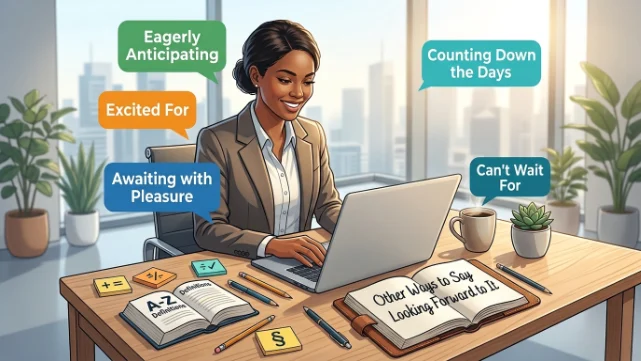
Need alternatives to “looking forward to it”? Try these 5 top options: Can’t wait, Eagerly awaiting, Anticipating, Excited about, and Counting down the days. Each adds variety and enthusiasm to your communication.
Do you find yourself ending emails and conversations with the same phrase “looking forward to it”? While this expression is perfectly polite and positive, overusing it can make your English sound repetitive and less engaging.
Learning alternatives to “looking forward to it” helps you express anticipation in English more naturally and appropriately for any situation. Whether you’re responding to a meeting invitation, acknowledging a future event, or expressing excitement about upcoming plans, having a varied vocabulary makes you sound more fluent, professional, and genuinely enthusiastic.
“The right phrase can transform a routine response into a memorable connection.”
Quick Categories Section
Formal Alternatives to “Looking Forward to It”
- I eagerly anticipate
- I await with interest
- I look forward with great anticipation
- I am very much looking forward
Professional Alternatives
- I look forward to our meeting
- I eagerly await your response
- I am excited about this opportunity
- I am pleased to anticipate
Casual Alternatives
- Can’t wait
- Counting down the days
- Bring it on
- I’m all in
Enthusiastic Expressions
- I’m pumped
- I’m hyped
- I’m thrilled
- I’m so ready
Pro Tip Box
Match your alternative to the context. Formal alternatives build credibility in professional settings, while casual ones strengthen personal connections and show genuine enthusiasm.
Common Mistakes Section
1. Overusing the Same Phrase
Mistake: Ending every email with “looking forward to it.”
Example: Multiple emails to the same client all ending with “Looking forward to it” — sounds robotic and insincere.
2. Being Too Casual in Professional Emails
Mistake: Using “Can’t wait!” in a formal business email.
Example: “Thanks for the proposal. Can’t wait to review it!” — too informal for clients.
3. Using the Wrong Verb Form
Mistake: Incorrect grammar with the phrase.
Example: “I look forward to meet you” — should be “I look forward to meeting you.”
4. Forgetting to Specify the “It”
Mistake: Using “looking forward to it” when the context isn’t clear.
Example: “Looking forward to it!” without mentioning what “it” refers to — can confuse the reader.
5. Overpromising Enthusiasm
Mistake: Being overly enthusiastic in inappropriate contexts.
Example: “I’m absolutely thrilled about your funeral arrangements” — inappropriate tone for serious matters.
“Context is everything. The same phrase can sound perfect or completely wrong depending on the situation.”
What Does “Looking Forward to It” Mean?
Definition: “Looking forward to it” is an expression used to convey anticipation, excitement, or positive expectation about a future event, meeting, or outcome.
Grammar Explanation: This phrase uses the phrasal verb “look forward to,” which takes a gerund (verb + -ing). The correct structure is “look forward to + gerund/noun.” The pronoun “it” refers to the previously mentioned event or situation.
Example Sentence: “The conference is next week — I’m really looking forward to it.”
When to Use “Looking Forward to It”
Common Contexts:
- Responding to meeting invitations
- Confirming appointments
- Expressing excitement about events
- Acknowledging future plans
- Showing enthusiasm for opportunities
Spoken vs Written:
- Spoken: Common in everyday conversations
- Written: Standard in professional emails and letters
Formal vs Informal:
- Formal: Widely accepted and considered polite
- Informal: Natural and friendly
Is It Professional or Polite to Say “Looking Forward to It”?
Politeness: ✔️ Yes — it’s always polite and expresses positive engagement.
Professionalism: ✔️ Yes — widely used in business communication.
Business Example:
- Formal: “We are looking forward to your presentation.”
- Alternative: “We eagerly await your presentation.”
Verdict: Safe to use in most contexts, but variety demonstrates stronger communication skills.
Pros and Cons of Using “Looking Forward to It”
Pros:
- Clear and universally understood
- Expresses genuine anticipation
- Polite and professional
- Easy to understand for all English levels
Cons:
- Overused in emails
- Can sound generic
- Lacks emotional depth
- May seem impersonal in some contexts
“Professional reaction phrases are essential for making a strong impression in the workplace.”
Other Ways to Say “Looking Forward to It” (With Examples)
These alternatives will help you sound more fluent, confident, and natural in different situations. Use them according to tone, context, and audience to express anticipation in English effectively.
1. Phrase: I can’t wait
Meaning: I am very excited and eager.
Explanation: An enthusiastic, casual expression of anticipation.
Example Sentence: “I can’t wait for the team lunch tomorrow!”
Best Use: Casual conversations
Worst Use: Professional emails
Tone: Enthusiastic, casual
Context Variability: casual / spoken
2. Phrase: I eagerly await
Meaning: I wait with great enthusiasm.
Explanation: A formal and professional expression of anticipation.
Example Sentence: “I eagerly await your feedback on the proposal.”
Best Use: Professional correspondence
Worst Use: Casual conversations
Tone: Formal, professional
Context Variability: professional / academic
3. Phrase: I’m excited about
Meaning: I feel enthusiastic and eager.
Explanation: A warm and genuine expression of positive anticipation.
Example Sentence: “I’m really excited about the upcoming project launch.”
Best Use: Personal and professional enthusiasm
Worst Use: Formal reports
Tone: Warm, enthusiastic
Context Variability: casual / professional / spoken
4. Phrase: Counting down the days
Meaning: Eagerly anticipating a future event.
Explanation: An emphatic, casual expression of excitement.
Example Sentence: “I’m counting down the days until our vacation.”
Best Use: Personal events
Worst Use: Professional contexts
Tone: Excited, informal
Context Variability: casual / spoken
5. Phrase: I’m thrilled
Meaning: I am extremely excited and pleased.
Explanation: A strong, emotional expression of anticipation.
Example Sentence: “I’m thrilled to be part of this exciting project.”
Best Use: Significant opportunities
Worst Use: Routine matters
Tone: Emotional, enthusiastic
Context Variability: casual / professional / spoken
6. Phrase: I’m looking forward to it immensely
Meaning: I am anticipating it with great pleasure.
Explanation: An intensified, formal version of the original phrase.
Example Sentence: “I’m looking forward to the conference immensely.”
Best Use: Formal invitations
Worst Use: Everyday conversations
Tone: Formal, emphatic
Context Variability: professional / academic
7. Phrase: I anticipate with great interest
Meaning: I am very interested in what will happen.
Explanation: A formal, professional expression of curiosity.
Example Sentence: “I anticipate the research findings with great interest.”
Best Use: Academic and professional contexts
Worst Use: Personal conversations
Tone: Formal, academic
Context Variability: professional / academic
8. Phrase: I’m eager to
Meaning: I am very enthusiastic and ready.
Explanation: Expresses strong positive desire.
Example Sentence: “I’m eager to hear your thoughts on the draft.”
Best Use: Professional feedback
Worst Use: Overly emotional situations
Tone: Enthusiastic, professional
Context Variability: professional / academic / spoken
9. Phrase: Bring it on
Meaning: I am ready and excited for a challenge.
Explanation: A confident, informal expression of readiness.
Example Sentence: “The new project sounds challenging — bring it on!”
Best Use: Team motivation
Worst Use: Formal settings
Tone: Confident, casual
Context Variability: casual / spoken
10. Phrase: I’m pumped
Meaning: I am very excited and ready.
Explanation: A highly informal, energetic expression.
Example Sentence: “I’m pumped for the concert tonight!”
Best Use: Friends and peers
Worst Use: Professional contexts
Tone: Energetic, informal
Context Variability: casual / spoken
11. Phrase: I’m hyped
Meaning: I am very excited and enthusiastic.
Explanation: Another highly informal, modern expression.
Example Sentence: “I’m so hyped about the new product launch!”
Best Use: Young audiences
Worst Use: Professional emails
Tone: Modern, casual
Context Variability: casual / spoken
12. Phrase: I’m all in
Meaning: I am fully committed and excited.
Explanation: Expresses complete enthusiasm and commitment.
Example Sentence: “The proposal sounds excellent — I’m all in!”
Best Use: Team contexts
Worst Use: Formal writing
Tone: Committed, casual
Context Variability: casual / professional / spoken
13. Phrase: I’m so ready
Meaning: I am fully prepared and excited.
Explanation: Combines readiness with enthusiasm.
Example Sentence: “I’m so ready for this opportunity!”
Best Use: Personal and casual contexts
Worst Use: Formal situations
Tone: Confident, casual
Context Variability: casual / spoken
14. Phrase: That sounds great
Meaning: That is positive and appealing.
Explanation: A polite and friendly way to show interest.
Example Sentence: “That sounds great — I’ll check my calendar.”
Best Use: Responding to invitations
Worst Use: Official communication
Tone: Friendly, positive
Context Variability: casual / professional / spoken
15. Phrase: I can hardly wait
Meaning: I am extremely excited and impatient.
Explanation: An emphatic version of “can’t wait.”
Example Sentence: “I can hardly wait for the weekend to arrive!”
Best Use: Personal excitement
Worst Use: Professional contexts
Tone: Emphatic, casual
Context Variability: casual / spoken
16. Phrase: I’m anxiously awaiting
Meaning: I am waiting with a mix of excitement and nervousness.
Explanation: Expresses anticipation with some nervousness.
Example Sentence: “I’m anxiously awaiting the interview results.”
Best Use: Significant outcomes
Worst Use: Positive events
Tone: Nervous, anticipatory
Context Variability: professional / academic
17. Phrase: I look forward with enthusiasm
Meaning: I anticipate with positive energy.
Explanation: A formal and enthusiastic expression.
Example Sentence: “I look forward with enthusiasm to our collaboration.”
Best Use: Business partnerships
Worst Use: Routine matters
Tone: Formal, enthusiastic
Context Variability: professional
18. Phrase: I’m very much looking forward
Meaning: I am significantly anticipating.
Explanation: An intensified, formal alternative.
Example Sentence: “I’m very much looking forward to your presentation.”
Best Use: Professional events
Worst Use: Casual conversations
Tone: Formal, polite
Context Variability: professional / academic
19. Phrase: I’m enthusiastic about
Meaning: I feel great interest and excitement.
Explanation: A positive and professional alternative.
Example Sentence: “I’m enthusiastic about the possibilities this partnership offers.”
Best Use: Business opportunities
Worst Use: Everyday matters
Tone: Positive, professional
Context Variability: professional / spoken
20. Phrase: I’m keen to
Meaning: I am very interested and eager.
Explanation: Common in British English for expressing interest.
Example Sentence: “I’m keen to explore this opportunity further.”
Best Use: British English contexts
Worst Use: American formal writing
Tone: Interested, positive
Context Variability: casual / professional / spoken
21. Phrase: I await with interest
Meaning: I wait with curiosity and attention.
Explanation: A formal and measured expression.
Example Sentence: “I await your response with interest.”
Best Use: Formal correspondence
Worst Use: Personal conversations
Tone: Formal, measured
Context Variability: professional / academic
22. Phrase: I’m positively anticipating
Meaning: I am looking forward with a positive outlook.
Explanation: Emphasizes the positive aspect of anticipation.
Example Sentence: “I’m positively anticipating the upcoming conference.”
Best Use: Professional events
Worst Use: Routine matters
Tone: Positive, formal
Context Variability: professional
23. Phrase: This is something to look forward to
Meaning: This event is worth being excited about.
Explanation: A reflective way to express anticipation.
Example Sentence: “The team retreat is something to look forward to.”
Best Use: Describing events to others
Worst Use: Direct responses
Tone: Reflective, positive
Context Variability: casual / professional / spoken
24. Phrase: I’m counting the minutes
Meaning: I am extremely impatient and excited.
Explanation: An intensified version emphasizing immediacy.
Example Sentence: “I’m counting the minutes until the presentation ends!”
Best Use: Highly anticipated moments
Worst Use: Professional contexts
Tone: Impatient, casual
Context Variability: casual / spoken
25. Phrase: I’m delighted to
Meaning: I am very pleased and happy.
Explanation: Expresses pleasure and positive expectation.
Example Sentence: “I’m delighted to accept your invitation.”
Best Use: Formal acceptances
Worst Use: Routine responses
Tone: Formal, pleased
Context Variability: professional / academic
26. Phrase: I’m looking forward to hearing from you
Meaning: I await your response with positive expectation.
Explanation: A specific version for communication.
Example Sentence: “I’m looking forward to hearing from you soon.”
Best Use: Ending emails
Worst Use: In-person conversations
Tone: Professional, polite
Context Variability: professional
27. Phrase: I’m looking forward to meeting you
Meaning: I anticipate our meeting with interest.
Explanation: A specific version for introductions.
Example Sentence: “I’m looking forward to meeting you in person next week.”
Best Use: Professional introductions
Worst Use: Social media messages
Tone: Professional, polite
Context Variability: professional
28. Phrase: I’m looking forward to seeing you
Meaning: I anticipate our meeting with pleasure.
Explanation: A personal and friendly version.
Example Sentence: “I’m looking forward to seeing you at the reunion.”
Best Use: Personal invitations
Worst Use: Formal business letters
Tone: Warm, friendly
Context Variability: casual / professional
29. Phrase: I’m looking forward to working with you
Meaning: I anticipate our collaboration with enthusiasm.
Explanation: A professional version for team contexts.
Example Sentence: “I’m looking forward to working with you on this project.”
Best Use: New collaborations
Worst Use: Social gatherings
Tone: Professional, collaborative
Context Variability: professional
30. Phrase: I’m looking forward to your thoughts
Meaning: I await your feedback with interest.
Explanation: A specific version for feedback situations.
Example Sentence: “I’m looking forward to your thoughts on the proposal.”
Best Use: Seeking feedback
Worst Use: General conversations
Tone: Professional, open
Context Variability: professional
“Expressing anticipation in English is an art. The right phrase conveys genuine excitement and professionalism.”
Mini Quiz / Self-Check
Question 1: You’re writing a formal business email to a client. Which phrase is most appropriate?
A) Can’t wait!
B) I’m pumped
C) I eagerly await your response
D) Bring it on
Answer: C — “I eagerly await your response” is professional and formal.
Question 2: A friend tells you about a concert next week. What’s the most natural response?
A) I anticipate with great interest
B) I’m so ready!
C) I look forward with enthusiasm
D) I’m thrilled
Answer: B — “I’m so ready!” is natural and enthusiastic for casual conversations.
Question 3: You’re accepting a job offer. Which phrase should you use?
A) I’m pumped about this job
B) Can’t wait to start
C) I’m delighted to accept this position
D) Bring it on
Answer: C — “I’m delighted to accept this position” is professional and appropriate.
Question 4: You’re responding to an email asking for feedback. What’s the best response?
A) I’m looking forward to your thoughts
B) Can’t wait to read it
C) Bring it on
D) I’m hyped
Answer: A — “I’m looking forward to your thoughts” is professional and contextually appropriate.
Comparison Table: Top Alternatives
| Phrase | Tone | Best Use |
|---|---|---|
| I eagerly await | Formal | Professional correspondence |
| I can’t wait | Casual | Friendly conversations |
| I’m thrilled | Emotional | Significant opportunities |
| I anticipate with interest | Academic | Research contexts |
| I’m excited about | Warm | Personal and professional |
| I’m delighted to | Formal | Accepting invitations |
| I’m keen to | Professional | British English contexts |
| Counting down the days | Informal | Personal events |
| I’m all in | Committed | Team contexts |
| I’m looking forward to hearing from you | Polite | Ending emails |
FAQs
Q1: What is a formal way to say “looking forward to it”?
Formal alternatives include “I eagerly await,” “I anticipate with great interest,” “I await with interest,” and “I look forward with enthusiasm” — all appropriate for professional and academic writing.
Q2: Is “looking forward to it” grammatically correct?
Yes, it’s grammatically correct. The full phrase is “I am looking forward to it,” where “to” functions as a preposition followed by the object “it.”
Q3: What are some casual alternatives to “looking forward to it”?
Casual alternatives include “Can’t wait,” “Counting down the days,” “Bring it on,” “I’m pumped,” and “I’m hyped” — each suitable for informal conversations.
Q4: How can I express anticipation in English professionally?
Use alternatives like “I am very much looking forward,” “I’m excited about this opportunity,” “I eagerly await,” or “I’m keen to” to express anticipation professionally.
Q5: When should I avoid using “looking forward to it”?
Avoid it when you need to sound more formal, when you’ve already used it multiple times, or when the context requires a more specific expression of anticipation.
Conclusion
Mastering alternatives to “looking forward to it” enriches your English communication, allowing you to express anticipation in English with greater variety and nuance. Whether you’re writing professional emails or chatting with friends, choosing the right phrase shows emotional intelligence and linguistic skill.
Practice using these alternatives in your daily communications. Pay attention to the context and audience, selecting the most appropriate expression for each situation. Your listeners and readers will appreciate the variety and the genuine enthusiasm you convey.