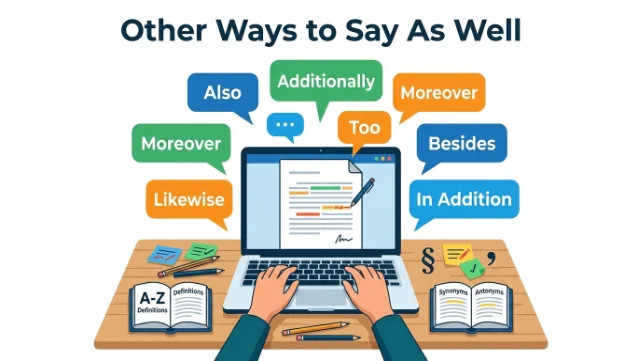
Need alternatives to “as well as” for your writing? Try these 5 top options: In addition to, Along with, Together with, Plus, and Furthermore. Each adds variety and precision to your academic and professional writing.
Do you find yourself repeatedly using “as well as” to connect ideas in your essays and professional documents? While this phrase is grammatically correct and useful, overusing it can make your writing feel monotonous and less sophisticated.
Learning alternatives to “as well as” enhances your academic and professional writing by providing variety and precision. Whether you’re constructing complex sentences, listing items, or connecting related concepts, having a diverse vocabulary of connecting phrases improves clarity and keeps readers engaged.
“Strong writing connects ideas seamlessly. The words you choose between them matter.”
Quick Categories Section
Formal Alternatives to “As Well As”
- In addition to
- Along with
- Together with
- Furthermore
- Moreover
Casual Alternatives
- Plus
- And also
- Too
- As well
Professional Alternatives
- Additionally
- In conjunction with
- Coupled with
- Alongside
Academic Phrases
- Not only… but also
- Besides
- Apart from
- Aside from
Pro Tip Box
Academic writing demands precision. Match your connecting phrase to the relationship between ideas—coordination, addition, or emphasis.
Common Mistakes Section
1. Using “As Well As” with Subject-Verb Agreement Errors
Mistake: Treating “as well as” like “and” for subject-verb agreement.
Example: “The teacher, as well as the students, are attending” — incorrect; should be “is attending” because the main subject is “teacher.”
2. Overusing “As Well As”
Mistake: Using “as well as” multiple times in one sentence.
Example: “We need milk, as well as eggs, as well as bread, as well as butter” — awkward and repetitive.
3. Using “As Well As” When “And” Is More Appropriate
Mistake: Using “as well as” for simple lists.
Example: “We visited Paris as well as Rome” — “and” would be more natural for equal items.
4. Incorrect Punctuation
Mistake: Forgetting commas with “as well as” in non-restrictive phrases.
Example: “The manager as well as the team attended” — should have commas: “The manager, as well as the team, attended.”
5. Using “As Well As” to Introduce New Arguments
Mistake: Using “as well as” at the start of a sentence in formal writing.
Example: “As well as financial benefits, there are social advantages” — “In addition to” would be more formal.
What Does “As Well As” Mean?
Definition: “As well as” is a conjunction and preposition used to add information, indicating that one thing is included in addition to another. It functions similarly to “and” but places slightly more emphasis on the first element.
Grammar Explanation: “As well as” is a multi-word preposition or conjunction. When it connects two subjects, the verb agrees with the first subject, not the second. For example, “The manager, as well as the employees, is present” (verb agrees with “manager”).
Example Sentence: “The course covers grammar, as well as vocabulary and pronunciation.”
When to Use “As Well As”
Common Contexts:
- Academic essays and research papers
- Business reports and proposals
- Professional emails and correspondence
- Formal presentations and speeches
- Descriptive and analytical writing
Spoken vs Written:
- Spoken: Common and natural in conversation
- Written: Appropriate but often overused in formal writing
Formal vs Informal:
- Formal: Accepted but should be used sparingly
- Informal: Very common and natural
“Precision in connecting phrases elevates your writing from adequate to excellent.”
Is It Professional or Polite to Say “As Well As”?
Politeness: ✔️ Yes — it’s polite and inclusive.
Professionalism: ✔️ Yes — widely accepted in professional writing.
Business Example:
- Standard: “We offer consulting, as well as training services.”
- Enhanced: “We offer consulting in addition to training services.”
Verdict: Acceptable in professional writing, but variety demonstrates stronger language skills.
Pros and Cons of Using “As Well As”
Pros:
- Widely understood and accepted
- Useful for adding information
- Creates smooth sentence flow
- Less repetitive than “and”
Cons:
- Subject-verb agreement can be tricky
- Often overused by English learners
- Can sound overly formal in casual contexts
- Sometimes misused as a simple synonym for “and”
“The right connecting phrase clarifies your meaning and strengthens your argument.”
Other Ways to Say “As Well As” (With Examples)
These alternatives will help you sound more fluent, confident, and natural in different writing situations. Use them according to tone, context, and audience to enhance your academic and professional writing.
1. Phrase: In addition to
Meaning: Used to introduce an additional item or point.
Explanation: A formal and direct alternative that works in academic writing.
Example Sentence: “In addition to financial support, the program offers mentorship.”
Best Use: Academic papers
Worst Use: Casual conversation
Tone: Formal, clear
Context Variability: professional / academic
2. Phrase: Along with
Meaning: Together with; in company with.
Explanation: Suggests accompaniment or connection between items.
Example Sentence: “The package includes a laptop, along with a carrying case.”
Best Use: Listing items
Worst Use: Abstract concepts
Tone: Neutral, clear
Context Variability: professional / academic / spoken
3. Phrase: Together with
Meaning: In combination with.
Explanation: Emphasizes the combined effect of two elements.
Example Sentence: “Together with the marketing team, sales exceeded targets.”
Best Use: Collaborative contexts
Worst Use: Simple lists
Tone: Formal, collaborative
Context Variability: professional / academic
4. Phrase: Furthermore
Meaning: In addition; moreover.
Explanation: A powerful transition for introducing additional arguments.
Example Sentence: “The policy is cost-effective. Furthermore, it is environmentally sustainable.”
Best Use: Essay arguments
Worst Use: Listing items
Tone: Academic, persuasive
Context Variability: professional / academic
5. Phrase: Moreover
Meaning: In addition to what has been said.
Explanation: Similar to “furthermore,” adds emphasis to additional points.
Example Sentence: “The proposal is practical. Moreover, it aligns with company values.”
Best Use: Persuasive writing
Worst Use: Simple lists
Tone: Formal, emphatic
Context Variability: professional / academic
6. Phrase: Additionally
Meaning: As an extra element or factor.
Explanation: A straightforward, professional alternative.
Example Sentence: “Additionally, we recommend a follow-up meeting.”
Best Use: Reports and proposals
Worst Use: Casual writing
Tone: Professional, clear
Context Variability: professional / academic
7. Phrase: Plus
Meaning: With the addition of.
Explanation: A casual, conversational alternative.
Example Sentence: “We need a venue, plus catering and decorations.”
Best Use: Informal writing
Worst Use: Academic papers
Tone: Casual, friendly
Context Variability: casual / spoken
8. Phrase: And also
Meaning: In addition.
Explanation: A simple but sometimes redundant alternative.
Example Sentence: “The course covers grammar, and also writing skills.”
Best Use: General writing
Worst Use: Formal documents
Tone: Neutral, clear
Context Variability: casual / professional / spoken
9. Phrase: Too
Meaning: In addition; also.
Explanation: A short, versatile alternative placed at the end of sentences.
Example Sentence: “We offer consulting services too.”
Best Use: Casual and spoken English
Worst Use: Formal writing
Tone: Casual, simple
Context Variability: casual / spoken
10. Phrase: As well
Meaning: Also; in addition.
Explanation: Similar to “too,” commonly used at the end of sentences.
Example Sentence: “The project requires funding, and time as well.”
Best Use: Spoken and informal writing
Worst Use: Academic papers
Tone: Casual, natural
Context Variability: casual / spoken
11. Phrase: In conjunction with
Meaning: Combined with; working together with.
Explanation: A formal alternative suggesting partnership or coordination.
Example Sentence: “The medication is used in conjunction with therapy.”
Best Use: Medical and technical writing
Worst Use: Everyday contexts
Tone: Formal, technical
Context Variability: professional / academic
12. Phrase: Coupled with
Meaning: Combined or linked with.
Explanation: Emphasizes the combination and interaction of two elements.
Example Sentence: “Coupled with rising demand, prices have increased significantly.”
Best Use: Causal relationships
Worst Use: Simple lists
Tone: Formal, analytical
Context Variability: professional / academic
13. Phrase: Alongside
Meaning: Next to; together with.
Explanation: Suggests simultaneous existence or occurrence.
Example Sentence: “Alongside economic growth, we must consider environmental impact.”
Best Use: Comparative contexts
Worst Use: Simple additions
Tone: Formal, balanced
Context Variability: professional / academic
14. Phrase: Besides
Meaning: In addition to; apart from.
Explanation: Can also mean “apart from” and should be used carefully.
Example Sentence: “Besides grammar, the course covers writing skills.”
Best Use: Adding contrasting points
Worst Use: Formal academic writing
Tone: Neutral, versatile
Context Variability: casual / professional / spoken
15. Phrase: Apart from
Meaning: Except for; in addition to.
Explanation: Can mean “except for” or “in addition to” depending on context.
Example Sentence: “Apart from tuition, there are additional fees.”
Best Use: Exceptions and additions
Worst Use: Formal reports
Tone: Neutral, clear
Context Variability: casual / professional / spoken
16. Phrase: Aside from
Meaning: In addition to; besides.
Explanation: Similar to “apart from,” used to add or exclude.
Example Sentence: “Aside from financial benefits, the job offers flexibility.”
Best Use: Balanced arguments
Worst Use: Formal academic writing
Tone: Neutral, conversational
Context Variability: casual / professional / spoken
17. Phrase: Not only… but also
Meaning: Emphasizes two connected points.
Explanation: A powerful correlative conjunction that adds emphasis.
Example Sentence: “The policy is not only cost-effective but also environmentally friendly.”
Best Use: Emphasis and persuasion
Worst Use: Simple lists
Tone: Formal, emphatic
Context Variability: professional / academic / spoken
18. Phrase: And
Meaning: Used to connect words or clauses.
Explanation: The simplest and most common connector.
Example Sentence: “The course covers grammar and writing skills.”
Best Use: Simple lists
Worst Use: Emphatic writing
Tone: Neutral, universal
Context Variability: casual / professional / academic / spoken
19. Phrase: Including
Meaning: Containing as part of the whole.
Explanation: Introduces specific examples within a broader category.
Example Sentence: “Several factors contribute, including economic conditions.”
Best Use: Providing examples
Worst Use: Equal connections
Tone: Formal, explanatory
Context Variability: professional / academic
20. Phrase: Among other things
Meaning: In addition to various other things.
Explanation: Indicates there are other items not listed.
Example Sentence: “The report addresses, among other things, budget concerns.”
Best Use: Partial lists
Worst Use: Complete lists
Tone: Formal, comprehensive
Context Variability: professional / academic
21. Phrase: On top of
Meaning: In addition to.
Explanation: A casual, metaphorical alternative.
Example Sentence: “On top of her regular duties, she manages the team.”
Best Use: Informal contexts
Worst Use: Academic writing
Tone: Casual, conversational
Context Variability: casual / spoken
22. Phrase: In combination with
Meaning: Joined or mixed together with.
Explanation: Formal alternative for combined effects.
Example Sentence: “In combination with diet, exercise improves health outcomes.”
Best Use: Scientific and technical writing
Worst Use: Everyday contexts
Tone: Formal, scientific
Context Variability: professional / academic
23. Phrase: Over and above
Meaning: In addition to; beyond.
Explanation: Emphasizes exceeding expectations.
Example Sentence: “Over and above salary, employees receive performance bonuses.”
Best Use: Business contexts
Worst Use: Casual conversation
Tone: Formal, emphatic
Context Variability: professional
24. Phrase: Together with
Meaning: In combination with.
Explanation: Suggests cooperation or combination.
Example Sentence: “Together with the board, the CEO made the decision.”
Best Use: Collaborative contexts
Worst Use: Simple lists
Tone: Formal, collaborative
Context Variability: professional / academic
25. Phrase: In addition
Meaning: As an extra person or thing.
Explanation: A standalone phrase (without “to”) used to start sentences.
Example Sentence: “The proposal is practical. In addition, it is affordable.”
Best Use: Starting new sentences
Worst Use: Within sentences
Tone: Formal, clear
Context Variability: professional / academic
26. Phrase: Again
Meaning: In addition; furthermore.
Explanation: Emphasizes repetition of similar ideas.
Example Sentence: “Again, we must consider the ethical implications.”
Best Use: Emphasis and repetition
Worst Use: Lists
Tone: Formal, emphatic
Context Variability: professional / academic / spoken
27. Phrase: Also
Meaning: In addition; too.
Explanation: A simple, versatile alternative.
Example Sentence: “The course covers grammar. Also, it includes writing practice.”
Best Use: General writing
Worst Use: Formal academic papers
Tone: Neutral, versatile
Context Variability: casual / professional / spoken
28. Phrase: For that matter
Meaning: As far as that is concerned.
Explanation: Indicates relevance to previous points.
Example Sentence: “The design is flawed. For that matter, so is the execution.”
Best Use: Additions to arguments
Worst Use: Simple lists
Tone: Formal, reasoned
Context Variability: professional / academic / spoken
29. Phrase: What’s more
Meaning: In addition; moreover.
Explanation: A conversational transition for adding points.
Example Sentence: “The product is affordable. What’s more, it’s high quality.”
Best Use: Persuasive writing
Worst Use: Academic papers
Tone: Casual, persuasive
Context Variability: casual / spoken
30. Phrase: To say nothing of
Meaning: Without even mentioning.
Explanation: Emphasizes that even one item is notable.
Example Sentence: “The project requires time, to say nothing of financial resources.”
Best Use: Emphasis
Worst Use: Formal academic writing
Tone: Formal, emphatic
Context Variability: professional / academic
“Mastering connecting phrases transforms your writing from basic to brilliant.”
Mini Quiz / Self-Check
Question 1: You’re writing a research paper. Which phrase is most appropriate?
A) Plus
B) On top of
C) In addition to
D) What’s more
Answer: C — “In addition to” is appropriately formal for academic writing.
Question 2: You’re sending a casual email to a colleague. Which phrase fits best?
A) Together with
B) Plus
C) Furthermore
D) Not only… but also
Answer: B — “Plus” is casual and appropriate for informal communication.
Question 3: You’re writing a persuasive essay. Which phrase strengthens your argument?
A) Alongside
B) Apart from
C) Not only… but also
D) Too
Answer: C — “Not only… but also” adds emphasis and strengthens arguments.
Question 4: Which sentence has correct subject-verb agreement with “as well as”?
A) The manager, as well as the employees, are attending.
B) The manager, as well as the employees, is attending.
C) The manager as well as the employees are attending.
D) The manager as well as the employees is attending.
Answer: B — The verb agrees with the first subject (“manager”). Commas are also needed for non-restrictive phrases.
“Choosing the right connecting phrase clarifies your meaning and strengthens your writing.”
Comparison Table: Top Alternatives
| Phrase | Tone | Best Use |
|---|---|---|
| In addition to | Formal | Academic papers |
| Along with | Neutral | Listing items |
| Furthermore | Academic | Essay arguments |
| Moreover | Formal | Persuasive writing |
| Additionally | Professional | Reports and proposals |
| Coupled with | Formal | Causal relationships |
| Not only… but also | Emphatic | Persuasive writing |
| In conjunction with | Technical | Medical/scientific writing |
| Plus | Casual | Informal writing |
| As well | Casual | Spoken English |
FAQs
Q1: What is a better way to say “as well as” in an essay?
Better alternatives include “In addition to,” “Furthermore,” “Moreover,” “Additionally,” and “Together with.” These phrases add variety and professionalism to academic writing.
Q2: Can I use “and” instead of “as well as”?
Yes, but “and” is simpler and less emphatic. Use “as well as” when you want to emphasize the first item or add information in a more sophisticated way.
Q3: Is “as well as” grammatically correct?
Yes, “as well as” is grammatically correct. However, remember that verb agreement follows the first subject, not the second: “The teacher, as well as the students, is attending.”
Q4: What’s the difference between “as well as” and “and”?
“And” suggests equal importance, while “as well as” emphasizes the first item. For example, “Apples, as well as oranges, are fruits” suggests apples are the primary focus.
Q5: Is “as well as” formal or informal?
“As well as” is neutral and can be used in both formal and informal contexts. However, in academic writing, varying with alternatives like “in addition to” and “furthermore” is recommended.
Conclusion
Mastering alternatives to “as well as” elevates your academic and professional writing, making it more varied, precise, and engaging. Different connecting phrases serve different purposes some emphasize addition, others suggest combination, and still others introduce new arguments.
Practice using these alternatives in your writing. Pay attention to the relationship between the ideas you’re connecting and choose the most precise phrase. Your readers will appreciate the variety and clarity.