The word “says” is one of the most commonly used verbs in English, appearing constantly in both spoken and written communication. Whether you’re writing dialogue, reporting speech, or sharing opinions, this simple word seems unavoidable. However, relying too heavily on “says” can make your English sound repetitive, dull, and unsophisticated.
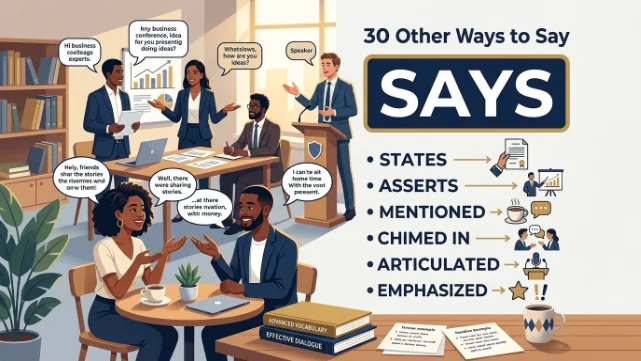
Learning alternatives to says will dramatically improve your writing and speaking fluency. By varying your vocabulary, you can convey tone, emotion, and intention with precision and impact. When you express excitement in English or convey authority through your word choices, you become a more compelling communicator. This guide provides 30 powerful alternatives to help you sound more articulate, professional, and engaging in any context.
Quick Categories
- Formal alternatives to “says”
- Neutral alternatives
- Assertive & Authoritative alternatives
- Emotional & Expressive alternatives
- Informal & Casual alternatives
- Soft & Gentle alternatives
What Does “Says” Mean?
At its core, “says” is a verb meaning to utter words, express thoughts, or communicate information verbally. It’s the third person singular present form of “say” and is one of the most frequently used reporting verbs in English.
Example Sentence: “She says the project will be completed by Friday.”
Grammar Note: “Says” is used with third person singular subjects (he, she, it, or singular nouns). For other subjects, use “say.” As a reporting verb, it introduces quoted or reported speech.
When to Use “Says”
- Everyday conversation: Reporting what someone told you
- Dialogue attribution: Identifying who is speaking in stories
- Professional communication: Sharing statements or opinions
- Academic writing: Referring to sources or authors
- News reporting: Quoting official statements or interviews
- Personal writing: Sharing conversations or thoughts
Spoken vs Written: “Says” works equally well in both casual conversation and professional writing, but overuse reduces impact and sophistication in both.
Formal vs Informal: The word itself is neutral and versatile, but in formal writing, alternatives to says create a more polished and varied text.
Is “Says” Professional or Polite?
Polite? ✔️ Yes
Professional? ✔️ Yes (but overuse is unprofessional)
“Says” is perfectly acceptable in professional contexts, but sophisticated communicators vary their vocabulary with professional reaction phrases to demonstrate linguistic range and precision.
Business Example: “The CEO says the company is on track for record profits.”
Better Alternative: “The CEO states that the company is on track for record profits.”
Pros and Cons of Using “Says”
Pros
- Simple and direct – Instantly understood by all speakers
- Versatile – Works across all contexts
- Natural – Common in everyday speech
- Accessible – Appropriate for all audiences
Cons
- Overused – Can make writing feel repetitive
- Lacks nuance – Doesn’t convey tone or emotion
- Limited descriptive power – Fails to capture intensity or softness
- Reduces impact – Diminishes the weight of important statements
“Replacing ‘says’ with precise alternatives transforms your writing from ordinary to extraordinary.”
30 Powerful Alternatives to “Says” (With Examples)
These alternatives will help you sound more fluent, confident, and expressive in English. Use them according to tone, context, and audience to convey exactly what you mean.
Formal Alternatives to “Says”
1. Phrase: States
Meaning: Expresses something officially or formally
Explanation: Suggests authority, clarity, and official communication
Example Sentence: “The report states that climate change poses significant risks.”
Best Use: Professional reports
Worst Use: Casual conversation
Tone: Authoritative, formal
Context Variability: Professional: “The policy states clearly that all employees must comply.”
2. Phrase: Remarks
Meaning: Makes a brief, often thoughtful comment
Explanation: Suggests observation rather than declaration
Example Sentence: “The professor remarks that the research shows promising results.”
Best Use: Academic contexts
Worst Use: Emotional declarations
Tone: Observational, thoughtful
Context Variability: Professional: “She remarks that the data requires further analysis.”
3. Phrase: Declares
Meaning: Announces something formally and emphatically
Explanation: Implies authority and official proclamation
Example Sentence: “The president declares the new policy will take effect immediately.”
Best Use: Official announcements
Worst Use: Private conversations
Tone: Official, authoritative
Context Variability: Professional: “The board declares a dividend of $2 per share.”
4. Phrase: Asserts
Meaning: States something confidently and forcefully
Explanation: Suggests defending a position or claim
Example Sentence: “The lawyer asserts that her client is innocent.”
Best Use: Legal or debate contexts
Worst Use: Casual chat
Tone: Confident, forceful
Context Variability: Professional: “He asserts that the methodology is sound.”
5. Phrase: Expresses
Meaning: Conveys thoughts, feelings, or ideas
Explanation: Emphasizes the communication of internal states
Example Sentence: “The report expresses concern about rising inflation.”
Best Use: Emotional or opinion based statements
Worst Use: Simple facts
Tone: Reflective, communicative
Context Variability: Professional: “The memo expresses the company’s commitment to sustainability.”
6. Phrase: Notes
Meaning: Observes or points out something
Explanation: Suggests mild emphasis or addition
Example Sentence: “The author notes that further research is needed.”
Best Use: Academic writing
Worst Use: Strong opinions
Tone: Observational, neutral
Context Variability: Professional: “The study notes a correlation between the variables.”
7. Phrase: Confirms
Meaning: States that something is true or certain
Explanation: Provides verification or reassurance
Example Sentence: “The spokesperson confirms the merger is proceeding.”
Best Use: Official validations
Worst Use: Speculative statements
Tone: Certain, reassuring
Context Variability: Professional: “The report confirms our initial hypothesis.”
8. Phrase: Indicates
Meaning: Shows or suggests something without directly stating
Explanation: Implies rather than declares
Example Sentence: “The data indicates a positive trend in sales.”
Best Use: Data analysis
Worst Use: Direct statements
Tone: Suggestive, analytical
Context Variability: Professional: “The survey indicates growing consumer confidence.”
9. Phrase: Proclaims
Meaning: Announces publicly and officially
Explanation: Suggests grand, formal declarations
Example Sentence: “The governor proclaims a state of emergency.”
Best Use: Official declarations
Worst Use: Everyday speech
Tone: Grand, formal
Context Variability: Professional: “The council proclaims the new law effective immediately.”
10. Phrase: Reports
Meaning: Gives an account of something
Explanation: Suggests factual presentation
Example Sentence: “The newspaper reports a decline in unemployment.”
Best Use: Journalism
Worst Use: Personal opinions
Tone: Objective, informational
Context Variability: Professional: “The committee reports its findings next week.”
“Precision in language is a sign of respect for your audience. Choose words that honor the complexity of human expression.”
Neutral Alternatives to “Says”
11. Phrase: Mentions
Meaning: Refers to something briefly
Explanation: Suggests minor or passing reference
Example Sentence: “She mentions the upcoming deadline during the meeting.”
Best Use: Casual references
Worst Use: Important declarations
Tone: Casual, brief
Context Variability: Neutral: “He mentions visiting the new office location.”
12. Phrase: States
Meaning: Expresses something clearly and formally
Explanation: Neutral yet formal alternative
Example Sentence: “The manual states the safety procedures.”
Best Use: Clear instructions
Worst Use: Emotional conversations
Tone: Neutral, clear
Context Variability: Professional: “The contract states the payment terms.”
13. Phrase: Points Out
Meaning: Draws attention to something
Explanation: Suggests emphasis or highlighting
Example Sentence: “The teacher points out the common mistakes in the assignment.”
Best Use: Explanatory contexts
Worst Use: Reporting speech
Tone: Instructive, helpful
Context Variability: Neutral: “She points out the inconsistency in the data.”
14. Phrase: Observes
Meaning: Makes a comment based on careful thought
Explanation: Suggests reflection or analysis
Example Sentence: “The critic observes that the film lacks emotional depth.”
Best Use: Critical analysis
Worst Use: Simple comments
Tone: Analytical, thoughtful
Context Variability: Professional: “The consultant observes several areas for improvement.”
Assertive & Authoritative Alternatives
15. Phrase: Insists
Meaning: Firmly states something despite opposition
Explanation: Conveys determination and conviction
Example Sentence: “He insists that he saw the entire incident.”
Best Use: Conflicting opinions
Worst Use: Neutral statements
Tone: Determined, firm
Context Variability: Professional: “The client insists on stricter quality controls.”
16. Phrase: Maintains
Meaning: Continues to assert something over time
Explanation: Suggests steady commitment to a position
Example Sentence: “The scientist maintains that the theory remains valid.”
Best Use: Defending positions
Worst Use: New statements
Tone: Steadfast, committed
Context Variability: Professional: “She maintains the project is on schedule.”
17. Phrase: Contends
Meaning: Argues or states something as true
Explanation: Suggests debate or advocacy
Example Sentence: “The researcher contends that the findings are significant.”
Best Use: Academic arguments
Worst Use: Casual chat
Tone: Argumentative, persuasive
Context Variability: Professional: “The opposition contends the policy is ineffective.”
18. Phrase: Argues
Meaning: States reasons for or against something
Explanation: Suggests a reasoned position
Example Sentence: “The author argues that economic reform is necessary.”
Best Use: Persuasive writing
Worst Use: Simple statements
Tone: Persuasive, logical
Context Variability: Professional: “The report argues for increased funding.”
19. Phrase: Claims
Meaning: States something as true, often with doubt
Explanation: Suggests the statement may be questionable
Example Sentence: “The witness claims to have seen the suspect.”
Best Use: Unverified statements
Worst Use: Confirmed facts
Tone: Assertive, potentially doubtful
Context Variability: Professional: “The competitor claims market leadership.”
20. Phrase: Vows
Meaning: Solemnly promises or declares
Explanation: Conveys deep commitment
Example Sentence: “The CEO vows to transform the company culture.”
Best Use: Promises or commitments
Worst Use: Casual remarks
Tone: Serious, committed
Context Variability: Professional: “The government vows to reduce emissions by 2030.”
“Strong communication isn’t about using big words—it’s about choosing the right word for the right moment.”
Emotional & Expressive Alternatives
21. Phrase: Exclaims
Meaning: Cries out suddenly or with strong emotion
Explanation: Indicates surprise, excitement, or strong feeling
Example Sentence: “She exclaims with joy when she sees the view.”
Best Use: Strong emotions
Worst Use: Neutral statements
Tone: Emotional, dramatic
Context Variability: Expressive: “He exclaims at the unexpected news.”
22. Phrase: Shouts
Meaning: Cries out loudly
Explanation: Indicates volume and intensity
Example Sentence: “He shouts for help from across the street.”
Best Use: Emergency contexts
Worst Use: Professional writing
Tone: Loud, urgent
Context Variability: Expressive: “The coach shouts encouragement to the team.”
23. Phrase: Whispers
Meaning: Speaks softly and quietly
Explanation: Conveys intimacy, secrecy, or softness
Example Sentence: “She whispers the secret to her friend.”
Best Use: Confidential conversations
Worst Use: Professional contexts
Tone: Intimate, secretive
Context Variability: Expressive: “He whispers his apology.”
24. Phrase: Mumbles
Meaning: Speaks quietly and unclearly
Explanation: Suggests shyness, uncertainty, or reluctance
Example Sentence: “He mumbles an apology without making eye contact.”
Best Use: Embarrassed or reluctant speech
Worst Use: Clear communication
Tone: Unclear, hesitant
Context Variability: Expressive: “She mumbles her answer to the question.”
25. Phrase: Utter
Meaning: Makes a sound or says something
Explanation: Often used with short phrases
Example Sentence: “He utters not a single word during the meeting.”
Best Use: Literary contexts
Worst Use: Daily speech
Tone: Formal, literary
Context Variability: Expressive: “She utters a prayer before the journey.”
26. Phrase: Screams
Meaning: Shouts loudly in fear, pain, or excitement
Explanation: Indicates extreme emotion
Example Sentence: “The fans scream when the band takes the stage.”
Best Use: Extreme emotions
Worst Use: Calm settings
Tone: Intense, emotional
Context Variability: Expressive: “He screams with excitement at the concert.”
Informal & Casual Alternatives
27. Phrase: Goes
Meaning: Said (informal, often used in conversation)
Explanation: Common in casual storytelling
Example Sentence: “Then she goes, ‘I can’t believe we made it!'”
Best Use: Casual conversations
Worst Use: Professional writing
Tone: Very casual, conversational
Context Variability: Casual: “He goes, ‘Let’s grab coffee later.'”
28. Phrase: Says (casual usage)
Meaning: The standard neutral alternative
Explanation: Works in almost all contexts
Example Sentence: “She says she’ll call later.”
Best Use: Most contexts
Worst Use: When variety is needed
Tone: Neutral, flexible
Context Variability: Casual: “He says he wants to travel.”
29. Phrase: Tells
Meaning: Communicates information to someone
Explanation: Often used with a direct object (someone)
Example Sentence: “She tells me the news in the morning.”
Best Use: Direct communication
Worst Use: Reporting facts
Tone: Informal, direct
Context Variability: Casual: “He tells the story with enthusiasm.”
Soft & Gentle Alternatives
30. Phrase: Murmurs
Meaning: Speaks softly and indistinctly
Explanation: Conveys gentleness or intimacy
Example Sentence: “She murmurs sweet words in his ear.”
Best Use: Romantic or gentle contexts
Worst Use: Professional settings
Tone: Soft, intimate
Context Variability: Gentle: “He murmurs his agreement.”
31. Phrase: Suggests
Meaning: Proposes or indicates something indirectly
Explanation: Softens the delivery of a statement
Example Sentence: “The consultant suggests a new approach to the problem.”
Best Use: Suggestions or proposals
Worst Use: Direct facts
Tone: Gentle, proposal based
Context Variability: Professional: “The report suggests alternative solutions.”
32. Phrase: Implies
Meaning: Conveys something indirectly
Explanation: Leaves room for interpretation
Example Sentence: “His tone implies he’s not satisfied with the results.”
Best Use: Indirect communication
Worst Use: Direct statements
Tone: Subtle, suggestive
Context Variability: Professional: “The data implies a need for revision.”
Common Mistakes Using “Says”
1. Mistake: Overusing “says” in formal writing
Example: ❌ “The author says the theory is flawed. The data says otherwise.”
Fix: Vary vocabulary—“The author argues the theory is flawed. The data indicates otherwise.”
2. Mistake: Using “says” for written communication
Example: ❌ “The email says the meeting is canceled.”
Fix: Use “states” or “confirms”—“The email states the meeting is canceled.”
3. Mistake: Not matching tone to context
Example: ❌ “The CEO exclaims the quarterly results.” (too casual)
Fix: Use “announces”—“The CEO announces the quarterly results.”
4. Mistake: Using emotional verbs for neutral content
Example: ❌ “The report screams about the dangers.”
Fix: Use “warns”—“The report warns about the dangers.”
5. Mistake: Using “says” for strong assertions
Example: ❌ “The witness says the defendant was at the scene.”
Fix: Use “claims” or “contends”—“The witness claims the defendant was at the scene.”
Comparison Table: Top Alternatives
| Phrase | Tone | Best Use |
| States | Authoritative, formal | Official statements |
| Remarks | Observational, thoughtful | Commentary and observations |
| Declares | Official, authoritative | Proclamations and announcements |
| Asserts | Confident, forceful | Debates and defense of positions |
| Expresses | Reflective, communicative | Emotions and opinions |
| Mentions | Casual, brief | Passing references |
| Insists | Determined, firm | Opposing viewpoints |
| Maintains | Steadfast, committed | Long held positions |
| Contends | Argumentative, persuasive | Academic arguments |
| Claims | Assertive, potentially doubtful | Unverified statements |
Mini Quiz / Self Check
1. You’re writing a formal business report. Which word is MOST appropriate for official statements?
- A) Goes
- B) States
- C) Whispers
- D) Mumbles
Answer: B) States
2. You’re describing a friend’s casual comment in a conversation. Which word fits BEST?
- A) Declares
- B) Exclaims
- C) Mentions
- D) Proclaims
Answer: C) Mentions
3. You’re reporting someone’s emotional outburst of joy. Which word is MOST suitable?
- A) Whispers
- B) Exclaims
- C) Reports
- D) Indicates
Answer: B) Exclaims
4. A scientist is strongly defending a controversial theory. Which word is BEST?
- A) Whispers
- B) Maintains
- C) Remarks
- D) Observes
Answer: B) Maintains
“Every word you choose paints a picture. Make sure your vocabulary reflects the scene you’re creating.”
FAQs
Q1: When should I use “states” instead of “says”?
Use “states” in formal, professional, or official contexts where the speaker’s authority matters. It’s ideal for reports, policies, and official announcements
Q2: What’s the difference between “claims” and “asserts”?
“Claims” suggests the statement might be questioned or unverified, while “asserts” conveys confident, forceful statements without implying doubt.
Q3: How can I avoid overusing “says” in my writing?
Use a mix of reporting verbs based on tone and context. Choose from formal alternatives like “states,” neutral alternatives like “mentions,” and expressive alternatives like “exclaims” to create variety.
Q4: Is “goes” acceptable in professional writing?
No, “goes” is strictly informal and should only appear in casual conversations, dialogue in creative writing, or direct quotes in very informal settings.
Q5: What’s the best word to use when reporting someone’s opinion?
“Expresses,” “states,” or “asserts” work well for opinions, depending on the level of formality and conviction you want to convey.
Conclusion
Expanding your vocabulary to include alternatives to says is one of the most effective ways to elevate your English communication. Each alternative carries unique nuances that help you express exactly what you mean, whether you’re writing a formal report, having a casual conversation, or delivering a powerful presentation.
Start incorporating these 30 alternatives into your daily communication. Pay attention to context, audience, and tone, and you’ll quickly develop the confidence and skill to choose the perfect word every time. Remember, language mastery isn’t about memorizing lists it’s about understanding the subtle differences that make your communication clear, precise, and impactful.