In academic writing, professional reports, and analytical essays, the phrase “the text states” appears with remarkable frequency. While functional, this overused expression can make your writing feel repetitive, unsophisticated, and lacking in critical depth. Whether you’re analyzing literature, interpreting data, or evaluating sources, varying your language demonstrates intellectual engagement and strengthens your arguments.
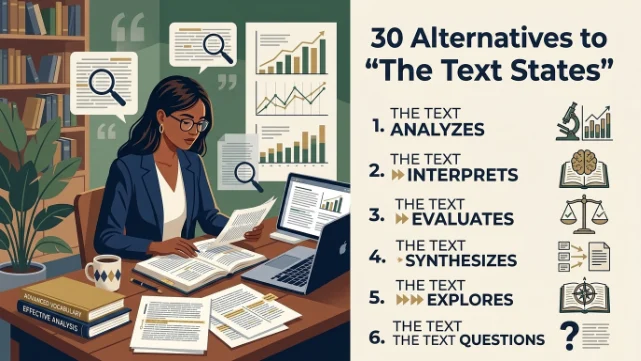
Learning alternatives to the text states transforms your academic and professional writing from mechanical summary into insightful analysis. When you express excitement in English through precise analytical language, you demonstrate mastery of both content and communication. This guide provides 30 powerful alternatives to help you reference source material with nuance, precision, and professional flair.
Quick Categories
- Academic & Formal alternatives
- Argumentative & Analytical alternatives
- Objective & Neutral alternatives
- Interpretive & Subjective alternatives
- Author Focused alternatives
- Evidence Based alternatives
What Does “The Text States” Mean?
“The text states” is a phrase used to introduce or refer to information, claims, or ideas presented within a written source. It functions as a signal phrase that attributes information to its original context, helping writers maintain academic integrity while incorporating external material into their own work.
Example Sentence: “The text states that climate change poses significant risks to coastal communities.”
Grammar Note: This phrase typically functions as a reporting verb phrase, often followed by a “that” clause. It can appear in past tense (“the text stated”) or present tense (“the text states”) depending on the context and style guide preferences.
When to Use Alternatives to “The Text States”
- Academic essays: Citing sources in literature reviews and research papers
- Literary analysis: Discussing themes, characters, and authorial intent
- Professional reports: Referencing data, findings, and expert opinions
- Journalistic writing: Attributing information to sources
- Critical reviews: Evaluating arguments and evidence
- Policy documents: Citing regulations, laws, and official statements
- Dissertations and theses: Building theoretical frameworks
- Business communication: Referencing market research and reports
Spoken vs Written: These alternatives are primarily used in written academic and professional contexts. Some formal options work in presentations, but most are best suited for formal writing.
Formal vs Informal: The majority of these alternatives are formal and academic. Casual alternatives are rarely appropriate for scholarly work.
“The language you choose to reference sources reveals your relationship with the material—are you simply reporting, or are you engaging critically?”
Is “The Text States” Professional or Polite?
Polite? ✔️ Yes
Professional? ✔️ Yes (but overuse is unprofessional)
While perfectly acceptable in academic and professional writing, overusing this phrase signals limited vocabulary and superficial engagement with sources. Sophisticated writers deploy varied professional reaction phrases to demonstrate critical thinking and analytical depth.
Academic Example: “The text states that economic growth correlates with environmental degradation.”
Better Alternative: “The author contends that economic growth correlates with environmental degradation.”
Pros and Cons of Using “The Text States”
Pros
- Clear attribution – Explicitly identifies the source
- Simple and direct – Easy to understand
- Commonly accepted – Widely used in academic writing
- Neutral tone – Avoids emotional or judgmental language
Cons
- Overused and repetitive – Becomes monotonous
- Lacks analytical depth – Fails to show critical engagement
- Weak signal phrase – Doesn’t convey the author’s intent
- Limited meaning – Ignores nuance in how information is presented
30 Powerful Alternatives to “The Text States” (With Examples)
These alternatives will help you write more engaging, precise, and academically sophisticated analysis. Use them according to the author’s intent, your argument’s purpose, and the nature of the source material.
Academic & Formal Alternatives
1. Phrase: The Text Asserts
Meaning: The text presents a claim with confidence and authority
Explanation: Implies the author is making a strong, confident declaration
Example Sentence: “The text asserts that sustainable development requires systemic economic restructuring.”
Best Use: Confident claims
Worst Use: Tentative ideas
Tone: Confident, authoritative
Context Variability: Formal: “The text asserts this position without supporting evidence.”
2. Phrase: The Author Argues
Meaning: The writer presents a reasoned position supported by evidence
Explanation: Suggests a persuasive, evidence based approach
Example Sentence: “The author argues that educational reform must prioritize teacher training.”
Best Use: Persuasive writing
Worst Use: Factual statements
Tone: Persuasive, analytical
Context Variability: Formal: “The author argues convincingly for policy reform.”
3. Phrase: The Passage Indicates
Meaning: The text points toward or suggests a particular interpretation
Explanation: Implies evidence that supports a conclusion
Example Sentence: “The passage indicates a shift in the protagonist’s moral framework.”
Best Use: Interpretive analysis
Worst Use: Direct statements
Tone: Suggestive, interpretive
Context Variability: Formal: “The passage indicates multiple possible interpretations.”
4. Phrase: The Writing Suggests
Meaning: The text implies or hints at a particular meaning
Explanation: Less direct than “states,” leaving room for interpretation
Example Sentence: “The writing suggests that social structures perpetuate inequality.”
Best Use: Subtle implications
Worst Use: Explicit claims
Tone: Tentative, interpretive
Context Variability: Formal: “The writing suggests this conclusion without explicitly stating it.”
5. Phrase: The Source Claims
Meaning: The text presents a statement as true, often requiring verification
Explanation: Implies the claim may be disputed or requires examination
Example Sentence: “The source claims that technological innovation reduces employment rates.”
Best Use: Questionable assertions
Worst Use: Established facts
Tone: Critical, evaluative
Context Variability: Formal: “The source claims this finding, but evidence suggests otherwise.”
6. Phrase: The Document Reveals
Meaning: The text discloses or makes known previously hidden information
Explanation: Suggests discovery or exposure of significant content
Example Sentence: “The document reveals systematic failures in regulatory oversight.”
Best Use: Important disclosures
Worst Use: Routine information
Tone: Significant, impactful
Context Variability: Formal: “The document reveals critical findings.”
7. Phrase: The Manuscript Displays
Meaning: The text exhibits particular characteristics or patterns
Explanation: Focuses on observable features rather than explicit statements
Example Sentence: “The manuscript displays remarkable attention to historical detail.”
Best Use: Stylistic or thematic analysis
Worst Use: Factual reporting
Tone: Observational, analytical
Context Variability: Formal: “The manuscript displays characteristics of modernist literature.”
8. Phrase: The Chapter Outlines
Meaning: The text presents a structured overview or framework
Explanation: Suggests organization and systematic presentation
Example Sentence: “The chapter outlines the key principles of behavioral economics.”
Best Use: Summarizing structure
Worst Use: Specific details
Tone: Structured, organizational
Context Variability: Formal: “The chapter outlines the methodology clearly.”
9. Phrase: The Section Highlights
Meaning: The text draws attention to particularly important points
Explanation: Emphasizes key elements worth noting
Example Sentence: “The section highlights the importance of early childhood intervention.”
Best Use: Emphasizing key points
Worst Use: Routine information
Tone: Emphatic, focused
Context Variability: Formal: “The section highlights the most critical findings.”
10. Phrase: The Study Proposes
Meaning: The research suggests a new approach or hypothesis
Explanation: Implies forward thinking contribution to knowledge
Example Sentence: “The study proposes an innovative framework for sustainable urban planning.”
Best Use: Research papers
Worst Use: Established theories
Tone: Forward looking, innovative
Context Variability: Formal: “The study proposes a novel solution to this challenge.”
“Precision in source attribution isn’t just academic formality—it’s intellectual honesty.”
Argumentative & Analytical Alternatives
11. Phrase: The Author Contends
Meaning: The writer argues forcefully for a particular position
Explanation: Stronger than “argues,” implies vigorous position taking
Example Sentence: “The author contends that economic growth must be balanced with environmental protection.”
Best Use: Debated topics
Worst Use: Uncontroversial facts
Tone: Strong, argumentative
Context Variability: Formal: “The author contends against prevailing orthodoxy.”
12. Phrase: The Writer Posits
Meaning: The author puts forward a theory or idea as a basis for discussion
Explanation: Suggests a starting point for further reasoning
Example Sentence: “The writer posits that human behavior is shaped by unconscious motivations.”
Best Use: Theoretical frameworks
Worst Use: Factual reporting
Tone: Theoretical, exploratory
Context Variability: Formal: “The writer posits this theory as a foundation for analysis.”
13. Phrase: The Text Postulates
Meaning: The text suggests something as a basis for reasoning or assumption
Explanation: Often used in scientific or philosophical contexts
Example Sentence: “The text postulates a direct relationship between investment and innovation.”
Best Use: Hypothesis formation
Worst Use: Confirmed findings
Tone: Hypothetical, theoretical
Context Variability: Formal: “The text postulates this connection without empirical evidence.”
14. Phrase: The Author Maintains
Meaning: The writer continues to support a position consistently
Explanation: Implies ongoing, sustained argumentation
Example Sentence: “The author maintains that education is the primary driver of social mobility.”
Best Use: Consistent arguments
Worst Use: Passing comments
Tone: Persistent, committed
Context Variability: Formal: “The author maintains this position throughout the text.”
15. Phrase: The Analysis Demonstrates
Meaning: The text provides clear evidence supporting a conclusion
Explanation: Emphasizes proof and logical demonstration
Example Sentence: “The analysis demonstrates that policy intervention reduces inequality.”
Best Use: Evidence backed claims
Worst Use: Unsupported assertions
Tone: Evidentiary, conclusive
Context Variability: Formal: “The analysis demonstrates the effectiveness of this approach.”
16. Phrase: The Interpretation Reveals
Meaning: A particular reading uncovers deeper meaning
Explanation: Focuses on the interpretive process
Example Sentence: “The interpretation reveals tensions between social and economic priorities.”
Best Use: Literary or qualitative analysis
Worst Use: Quantitative data
Tone: Interpretive, insightful
Context Variability: Formal: “The interpretation reveals complexity beneath the surface.”
17. Phrase: The Framework Asserts
Meaning: The theoretical structure makes a specific claim
Explanation: Moves beyond content to theoretical implications
Example Sentence: “The framework asserts that all social systems are inherently political.”
Best Use: Theoretical analysis
Worst Use: Practical examples
Tone: Theoretical, abstract
Context Variability: Formal: “The framework asserts foundational principles.”
“Great academic writing isn’t about what sources say—it’s about what you do with what they say.”
Objective & Neutral Alternatives
18. Phrase: The Text Presents
Meaning: The text offers or shows information in a straightforward way
Explanation: Neutral and descriptive
Example Sentence: “The text presents three main arguments for constitutional reform.”
Best Use: Listing or summarizing
Worst Use: Complex analysis
Tone: Neutral, descriptive
Context Variability: Formal: “The text presents data from multiple sources.”
19. Phrase: The Passage Notes
Meaning: The text observes or mentions something briefly
Explanation: Suggests a minor or parenthetical point
Example Sentence: “The passage notes that cultural factors influence consumer behavior.”
Best Use: Supporting points
Worst Use: Main arguments
Tone: Observational, brief
Context Variability: Formal: “The passage notes this in passing.”
20. Phrase: The Section Describes
Meaning: The text provides a detailed account or explanation
Explanation: Focuses on depiction rather than argument
Example Sentence: “The section describes the methodology used in the clinical trial.”
Best Use: Process or method descriptions
Worst Use: Argumentative content
Tone: Descriptive, explanatory
Context Variability: Formal: “The section describes the experimental procedure.”
21. Phrase: The Writing Explains
Meaning: The text provides clarification or reasoning
Explanation: Emphasizes understanding and elucidation
Example Sentence: “The writing explains the relationship between poverty and educational outcomes.”
Best Use: Clarifying concepts
Worst Use: Asserting claims
Tone: Instructional, clarifying
Context Variability: Formal: “The writing explains complex concepts clearly.”
22. Phrase: The Source Reports
Meaning: The text conveys information from research or investigation
Explanation: Often used for data driven or journalistic content
Example Sentence: “The source reports a significant increase in renewable energy adoption.”
Best Use: Research findings
Worst Use: Opinion pieces
Tone: Factual, reporting
Context Variability: Formal: “The source reports findings from extensive fieldwork.”
23. Phrase: The Document States
Meaning: A more formal version of “the text states”
Explanation: Suggests official, authoritative content
Example Sentence: “The document states that all employees must complete the training.”
Best Use: Official documents
Worst Use: Informal sources
Tone: Official, authoritative
Context Variability: Formal: “The document states clear compliance requirements.”
24. Phrase: The Article Conveys
Meaning: The text communicates or transmits information
Explanation: Focuses on communication rather than statement
Example Sentence: “The article conveys a sense of urgency about climate action.”
Best Use: Tone and attitude
Worst Use: Specific facts
Tone: Communicative, expressive
Context Variability: Formal: “The article conveys complex ideas accessibly.”
“The words you choose to reference sources reflect your relationship with knowledge—are you a passive recipient or an active interpreter?”
Interpretive & Subjective Alternatives
25. Phrase: The Reader Understands
Meaning: Focus on how the text is perceived or interpreted
Explanation: Shifts from source to reader’s interpretation
Example Sentence: “The reader understands the protagonist’s isolation as a critique of modern society.”
Best Use: Reader response analysis
Worst Use: Objective facts
Tone: Interpretive, subjective
Context Variability: Formal: “The reader understands this passage metaphorically.”
26. Phrase: The Passage Conveys
Meaning: The text communicates emotions, ideas, or messages
Explanation: Broader than “states,” includes emotional and tonal elements
Example Sentence: “The passage conveys profound anxiety about technological change.”
Best Use: Emotional or thematic content
Worst Use: Explicit statements
Tone: Expressive, interpretive
Context Variability: Formal: “The passage conveys meaning through metaphor.”
27. Phrase: The Text Implies
Meaning: The text suggests meaning without explicit statement
Explanation: Focus on what is hinted at rather than directly said
Example Sentence: “The text implies that institutional change requires grassroots support.”
Best Use: Subtext and underlying meaning
Worst Use: Direct statements
Tone: Suggestive, inferential
Context Variability: Formal: “The text implies this conclusion through careful analysis.”
28. Phrase: The Writing Demonstrates
Meaning: The text shows clear evidence of a particular point
Explanation: Emphasizes proof and illustration
Example Sentence: “The writing demonstrates how systemic inequality perpetuates poverty.”
Best Use: Illustration through evidence
Worst Use: Simple assertion
Tone: Demonstrative, evidentiary
Context Variability: Formal: “The writing demonstrates this principle through case studies.”
Author Focused Alternatives
29. Phrase: The Author Writes
Meaning: Direct attribution to the author’s writing
Explanation: Simplest way to reference the author’s words
Example Sentence: “The author writes that ‘democracy requires active citizen participation.'”
Best Use: Direct quotations
Worst Use: Paraphrased content
Tone: Direct, straightforward
Context Variability: Formal: “The author writes passionately about social justice.”
30. Phrase: The Scholar Suggests
Meaning: An expert proposes or recommends a particular view
Explanation: Emphasizes authority and scholarly contribution
Example Sentence: “The scholar suggests that traditional methods need revision.”
Best Use: Expert opinions
Worst Use: Student writing
Tone: Authoritative, expert
Context Variability: Formal: “The scholar suggests a different interpretation.”
Evidence Based Alternatives
31. Phrase: The Evidence Shows
Meaning: The provided information indicates a particular finding
Explanation: Shifts focus from text to evidence it contains
Example Sentence: “The evidence shows that economic diversification reduces risk.”
Best Use: Data driven claims
Worst Use: Opinion pieces
Tone: Evidentiary, conclusive
Context Variability: Formal: “The evidence shows statistically significant results.”
32. Phrase: The Data Indicates
Meaning: Numerical or factual information points to a conclusion
Explanation: Specific to quantitative research
Example Sentence: “The data indicates a clear correlation between education and health outcomes.”
Best Use: Statistical analysis
Worst Use: Qualitative evidence
Tone: Quantitative, analytical
Context Variability: Formal: “The data indicates trends worth exploring.”
Common Mistakes Using “The Text States”
1. Mistake: Using “states” for complex interpretations
Example: ❌ “The text states that the metaphor represents freedom.”
Fix: Use “suggests” or “implies”—“The text suggests the metaphor represents freedom.”
2. Mistake: Overusing the same signal phrase
Example: ❌ “The text states X. The text states Y. The text states Z.”
Fix: Vary your language—“The text asserts X. It also argues Y. Furthermore, it suggests Z.”
3. Mistake: Using “states” when “argues” is more appropriate
Example: ❌ “The text states that climate change is the greatest threat.” (passive)
Fix: Use “argues” for persuasive content—“The text argues that climate change is the greatest threat.”
4. Mistake: Attributing neutral statements when the author is passionate
Example: ❌ “The text states that we must take immediate action.”
Fix: Use “urges” or “demands”—“The text urges immediate action on this issue.”
5. Mistake: Using “states” for quoted material in literary analysis
Example: ❌ “The text states ‘It was the best of times, it was the worst of times.'”
Fix: Use “writes” or “opens with”—“The novel opens with ‘It was the best of times…'”
Comparison Table: Top Alternatives
| Phrase | Tone | Best Use |
| The Text Asserts | Confident, authoritative | Strong claims |
| The Author Argues | Persuasive, analytical | Position papers |
| The Passage Indicates | Suggestive, interpretive | Textual analysis |
| The Source Claims | Critical, evaluative | Questionable assertions |
| The Document Reveals | Significant, impactful | Important disclosures |
| The Author Contends | Strong, argumentative | Debate contexts |
| The Writer Posits | Theoretical, exploratory | Hypothesis formation |
| The Analysis Demonstrates | Evidentiary, conclusive | Proof based writing |
| The Text Presents | Neutral, descriptive | Summarizing content |
| The Evidence Shows | Evidentiary, conclusive | Data driven writing |
Mini Quiz / Self Check
1. You’re writing a literary analysis and want to suggest that the author is making a strong but unsupported claim. Which phrase is MOST appropriate?
- A) The text states
- B) The author contends
- C) The passage indicates
- D) The writing explains
Answer: B) The author contends
2. You’re describing data from a scientific study showing a clear result. Which phrase fits BEST?
- A) The author argues
- B) The text suggests
- C) The evidence shows
- D) The interpretation reveals
Answer: C) The evidence shows
3. You’re analyzing subtext in a novel and want to describe what the text hints at without stating directly. Which phrase is MOST suitable?
- A) The text states
- B) The text implies
- C) The text asserts
- D) The text describes
Answer: B) The text implies
4. You’re summarizing a neutral, descriptive passage in a technical manual. Which phrase is BEST for this purpose?
- A) The author argues
- B) The section describes
- C) The writer posits
- D) The text contends
Answer: B) The section describes
“Every source deserves more than generic attribution—it deserves language that acknowledges its unique contribution to your argument.”
FAQs
Q1: When should I avoid using “the text states”?
Avoid this phrase when you need to convey the author’s intent, attitude, or degree of certainty. Use more specific language to show whether the author is arguing, suggesting, or merely reporting.
Q2: What is the difference between “states” and “argues”?
“States” implies a neutral presentation of information, while “argues” suggests the author is making a persuasive case. Use “states” for factual reporting and “argues” for debatable positions
Q3: How can I make my source attribution more academic?
Use varied signal phrases that match the author’s intent: “contends” for strong positions, “suggests” for implications, “demonstrates” for evidence based claims, and “proposes” for new hypotheses.
Q4: Is it appropriate to use these alternatives in professional writing?
Yes, these alternatives enhance professional writing, especially in reports, policy documents, and formal analyses. They demonstrate sophistication and critical engagement with sources.
Q5: How many variations should I use in one essay?
Aim for 3 5 different signal phrases throughout your writing. Repeating the same phrase signals limited vocabulary; varied language demonstrates linguistic competence and analytical depth.
Conclusion
Mastering alternatives to “the text states” elevates your academic and professional writing from adequate to outstanding. By choosing precise language that reflects the author’s intent and your analytical position, you demonstrate critical thinking and sophisticated engagement with source material.
Start incorporating these 30 alternatives into your next writing project. Pay attention to the nuance each phrase brings, and watch your analysis become more precise, professional, and persuasive. Remember, great writing isn’t just about what you say it’s about how you frame what others have said before you.