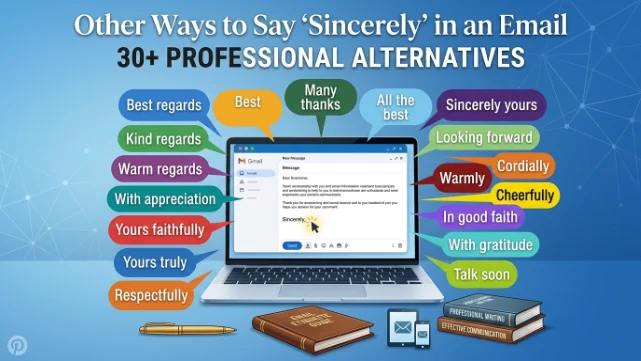
Looking for alternatives to “sincerely”? Here are the top 5 professional email closings: Best regards, Yours faithfully, With appreciation, Respectfully, and Warm regards. Each works best in different contexts choose based on your relationship with the recipient and the tone of your message.
“Sincerely” has long been the go-to email closing for professional communication. It’s safe, traditional, and widely understood. But here’s the truth: using the same sign-off repeatedly can make your emails feel robotic and impersonal. Learning alternatives to “sincerely” helps you match your tone to each unique situation.
Whether you’re writing to a potential employer, a long-time client, or a colleague across the globe, having a rich vocabulary of professional email closings makes you sound more fluent and emotionally intelligent. In this guide, you’ll discover 30 powerful alternatives that will transform your email communication from generic to genuinely impactful.
“The right closing line does more than end an email—it leaves a lasting impression of who you are and how you communicate.”
Quick Categories
Formal Alternatives to “Sincerely”
- Yours faithfully
- Yours truly
- With utmost respect
- Respectfully yours
- Very truly yours
Casual Alternatives
- Cheers
- Thanks
- All the best
- Take care
- Until next time
Professional Alternatives
- Best regards
- Kind regards
- With appreciation
- Warm regards
- Respectfully
Informal Expressions
- Talk soon
- Catch you later
- Have a great day
- Peace out
- Later gator
Common Mistakes Using “Sincerely”
Even native English speakers make these common errors when using “sincerely” in emails:
- Using it with someone you know well
❌ “Sincerely, Sarah” to your best friend - Forgetting the comma
❌ “Sincerely John” (Missing punctuation after “Sincerely”) - Capitalizing incorrectly
❌ “sincerely” (Should be “Sincerely” as a closing) - Using it in informal emails
❌ “Sincerely” in a quick team Slack message - Not matching the tone of the email
❌ “Sincerely” after a complaint email (Sounds passive-aggressive)
What Does “Sincerely” Mean?
Sincerely means “in a genuine, honest, and heartfelt manner.” When used as an email closing, it signals that you’re being truthful and authentic in your message.
Grammar note: “Sincerely” functions as an adverb but appears as a standalone sign-off. It’s typically followed by a comma and your name on the next line.
Example:
“Thank you for considering my application. I look forward to hearing from you.
Sincerely,
James Wilson”
When to Use “Sincerely”
Use “sincerely” in these contexts:
- Formal business letters (not typically for emails)
- Cover letters and job applications
- First-time correspondence with unknown recipients
- Official documents and complaint letters
- When you don’t know the recipient’s name
Spoken vs Written: “Sincerely” is almost exclusively written—you’d never say it aloud as a closing.
Formal vs Informal: Highly formal. Avoid in casual or friendly communication.
Is It Professional or Polite to Say “Sincerely”?
Polite? ✔️ Yes – It shows respect and consideration for the recipient.
Professional? ❌ No (in most modern contexts) – While it’s not unprofessional, it’s increasingly seen as outdated for email correspondence. Most professionals now prefer “Best regards” or “Kind regards” for everyday business communication.
Business-style Example:
“We appreciate your continued partnership and look forward to growing our relationship.
Sincerely,
Michael Chen”
Pros and Cons of Using “Sincerely”
Pros ✅
- Simple and natural – Easy to use without overthinking
- Friendly tone – Conveys warmth and authenticity
- Common usage – Universally understood by all English speakers
- Easy to understand – No confusion about its meaning
Cons ❌
- Too formal for work – Can feel stiff in modern workplace emails
- Overused – Lacks personality and stands out as generic
- Limited emotional range – Doesn’t express specific sentiments like gratitude or enthusiasm
- Not suitable for all writing – Feels out of place in casual or creative communication
Other Ways to Say “Sincerely” (With Examples)
These alternatives will help you sound more fluent, confident, and natural in different situations. Use them according to tone, context, and audience to express professionalism, warmth, or appreciation.
Formal Alternatives (Best for Official Correspondence)
1. Phrase: Yours faithfully
Meaning: A formal closing used when you don’t know the recipient’s name.
Explanation: This is the traditional British English equivalent to “sincerely” for “Dear Sir/Madam” letters.
Example Sentence: “I await your response to this matter. Yours faithfully, Robert Thornton”
Best Use: Unknown recipient
Worst Use: Known colleague
Tone: Formal, traditional, respectful
Context Variability: Professional (British English formal letters)
2. Phrase: Yours truly
Meaning: A slightly formal closing that emphasizes honesty and authenticity.
Explanation: Though traditionally formal, it’s now somewhat old-fashioned but still appropriate for formal contexts.
Example Sentence: “I remain at your service regarding this inquiry. Yours truly, Amanda Foster”
Best Use: Formal business letters
Worst Use: Casual team communication
Tone: Formal, trustworthy, classic
Context Variability: Professional (formal documents)
3. Phrase: With utmost respect
Meaning: Expresses highest regard and deference to the recipient.
Explanation: Use when writing to someone in a significantly higher position or whom you deeply admire.
Example Sentence: “I value your guidance on this important project. With utmost respect, Daniel Kim”
Best Use: Senior executives
Worst Use: Peers or subordinates
Tone: Deferential, honored, formal
Context Variability: Professional (formal business)
4. Phrase: Respectfully yours
Meaning: Shows deep respect while maintaining a personal connection.
Explanation: Slightly less stiff than “respectfully,” this closing balances formality with warmth.
Example Sentence: “Thank you for your time and consideration. Respectfully yours, Laura Bennett”
Best Use: Job applications
Worst Use: Friendly emails
Tone: Formal, courteous, respectful
Context Variability: Professional (formal)
5. Phrase: Very truly yours
Meaning: One of the most formal closings in American English.
Explanation: Often used in legal documents or highly formal correspondence.
Example Sentence: “Please find the signed documents attached. Very truly yours, Attorney Mark Sullivan”
Best Use: Legal documents
Worst Use: Everyday emails
Tone: Extremely formal, legal, proper
Context Variability: Professional (legal/formal)
“Formal closings show respect, but overusing them can make your emails feel distant. Choose wisely based on your relationship.”
Professional Alternatives (Best for Business Emails)
6. Phrase: Best regards
Meaning: A warm but professional closing that’s the modern standard for business emails.
Explanation: Widely accepted in all industries—it’s safe, professional, and friendly.
Example Sentence: “Looking forward to our meeting next week. Best regards, Sarah Mitchell”
Best Use: Most business emails
Worst Use: Extremely formal legal letters
Tone: Professional, warm, standard
Context Variability: Professional/Formal
7. Phrase: Kind regards
Meaning: Adds extra warmth to the professional “regards” family of closings.
Explanation: Slightly more personal than “best regards,” while remaining perfectly professional.
Example Sentence: “Thank you for your quick response to this request. Kind regards, Thomas Wright”
Best Use: Client communication
Worst Use: Casual team chat
Tone: Polite, warm, professional
Context Variability: Professional
8. Phrase: With appreciation
Meaning: Expresses gratitude explicitly in the closing line.
Explanation: Perfect when you want to acknowledge someone’s help, time, or effort.
Example Sentence: “Your support on this project has been invaluable. With appreciation, Natalie Park”
Best Use: Thank-you emails
Worst Use: Neutral business updates
Tone: Grateful, warm, professional
Context Variability: Professional/Personal
9. Phrase: Warm regards
Meaning: A heartfelt and friendly closing that maintains professionalism.
Explanation: Use when you have a positive working relationship but want to stay appropriate.
Example Sentence: “I hope you have a wonderful holiday season. Warm regards, Jessica Liu”
Best Use: Long-term clients
Worst Use: First-time contacts
Tone: Warm, friendly, professional
Context Variability: Professional/Informal
10. Phrase: Respectfully
Meaning: Shows respect and deference in professional communication.
Explanation: Shorter and more modern than “respectfully yours,” this is ideal for professional settings.
Example Sentence: “I await your decision on this matter. Respectfully, David Chen”
Best Use: Senior management
Worst Use: Peers
Tone: Respectful, professional, proper
Context Variability: Professional (formal)
11. Phrase: With gratitude
Meaning: Expresses deep thankfulness and appreciation.
Explanation: More emotional than “with appreciation,” this closing conveys genuine gratitude.
Example Sentence: “I cannot thank you enough for your mentorship this year. With gratitude, Rachel Adams”
Best Use: Thank-you notes
Worst Use: Routine business emails
Tone: Grateful, sincere, heartfelt
Context Variability: Professional/Personal
12. Phrase: Many thanks
Meaning: A warm closing that emphasizes gratitude.
Explanation: Perfect when you want to acknowledge someone’s help without being overly formal.
Example Sentence: “Thanks for the prompt feedback on my proposal. Many thanks, James Rodriguez”
Best Use: Collaborative emails
Worst Use: Formal legal correspondence
Tone: Grateful, friendly, professional
Context Variability: Professional/Casual
13. Phrase: All the best
Meaning: A versatile closing that works in many professional contexts.
Explanation: Friendly, positive, and safe for most business communication.
Example Sentence: “Wishing you a productive week ahead. All the best, Emma Watson”
Best Use: Regular business emails
Worst Use: Extremely formal letters
Tone: Friendly, positive, versatile
Context Variability: Professional/Casual
14. Phrase: With sincere appreciation
Meaning: Combines sincerity with gratitude for maximum impact.
Explanation: Use when you genuinely want to emphasize your appreciation.
Example Sentence: “Your dedication to this project has been remarkable. With sincere appreciation, Dr. Peter Chang”
Best Use: Significant professional gestures
Worst Use: Routine emails
Tone: Highly grateful, sincere, professional
Context Variability: Professional
“Your email closing is your final handshake—make it firm, warm, and appropriate for the relationship.”
Casual Alternatives (Best for Colleagues and Familiar Contacts)
15. Phrase: Cheers
Meaning: A friendly, informal British closing expressing goodwill.
Explanation: Very common in British and Australian English but increasingly used globally in casual settings.
Example Sentence: “Thanks for the quick turnaround on this! Cheers, Oliver”
Best Use: Team communication
Worst Use: Formal proposals
Tone: Casual, friendly, British
Context Variability: Casual/Professional
16. Phrase: Thanks
Meaning: Simple, direct expression of gratitude.
Explanation: The ultimate casual but effective email closing for quick communications.
Example Sentence: “Thanks for confirming the meeting time. Thanks, Maria”
Best Use: Quick internal emails
Worst Use: Formal business letters
Tone: Simple, grateful, casual
Context Variability: Casual/Professional
17. Phrase: Talk soon
Meaning: Indicates you expect to communicate with the recipient again soon.
Explanation: Creates a sense of ongoing connection and informal relationship.
Example Sentence: “Let’s catch up about this at the team lunch. Talk soon, Steve”
Best Use: Close colleagues
Worst Use: External clients
Tone: Friendly, anticipatory, casual
Context Variability: Casual
18. Phrase: Take care
Meaning: Warm, caring closing that shows personal concern.
Explanation: Friendly and nurturing without being overly emotional.
Example Sentence: “Hope you’re feeling better. Take care, Jennifer”
Best Use: Personal situations
Worst Use: Formal business emails
Tone: Caring, warm, personal
Context Variability: Personal/Casual
19. Phrase: Until next time
Meaning: A friendly closing that looks forward to future interaction.
Explanation: Suggests an ongoing relationship and positive anticipation.
Example Sentence: “Great working with you this quarter. Until next time, Robert”
Best Use: Regular professional contacts
Worst Use: Formal letters
Tone: Friendly, forward-looking, casual
Context Variability: Casual/Professional
20. Phrase: Have a great day
Meaning: A warm wish for the recipient’s day ahead.
Explanation: Friendly, positive, and personal—perfect for email interactions.
Example Sentence: “Hope your presentation goes well! Have a great day, Amy”
Best Use: Positive professional relationships
Worst Use: Formal complaint letters
Tone: Positive, friendly, warm
Context Variability: Casual/Professional
21. Phrase: Catch you later
Meaning: Very informal closing common in spoken English and casual written communication.
Explanation: Use only with people you know well—this is too casual for professional settings.
Example Sentence: “I’ll update you after the meeting. Catch you later, Mike”
Best Use: Close colleagues
Worst Use: Any formal context
Tone: Casual, friendly, conversational
Context Variability: Very casual
22. Phrase: Peace out
Meaning: A slang expression originating from 1990s popular culture.
Explanation: Only appropriate in extremely casual contexts with close friends or peers.
Example Sentence: “Great brainstorming session everyone! Peace out, Zoe”
Best Use: Close friends
Worst Use: Any professional setting
Tone: Slang, casual, playful
Context Variability: Very casual
23. Phrase: Later gator
Meaning: A playful rhyming slang phrase.
Explanation: Only use with close friends in humorous, informal contexts.
Example Sentence: “Thanks for the laughs. Later gator, Sam”
Best Use: Close friends
Worst Use: Professional emails
Tone: Playful, slang, informal
Context Variability: Very casual
Specialized Alternatives (Best for Specific Situations)
24. Phrase: In earnest
Meaning: Emphasizes the seriousness and truthfulness of your message.
Explanation: Less common but powerful when you want to stress your sincerity.
Example Sentence: “I truly believe this approach will benefit everyone involved. In earnest, Patricia”
Best Use: Serious matters
Worst Use: Lighthearted communication
Tone: Serious, sincere, heartfelt
Context Variability: Professional/Formal
25. Phrase: In good faith
Meaning: Indicates you’ve acted honestly and without deception.
Explanation: Often used in negotiations, agreements, or when clarifying your intentions.
Example Sentence: “We’ve presented our best offer. In good faith, Thomas Carter”
Best Use: Negotiations
Worst Use: Routine emails
Tone: Honest, trustworthy, formal
Context Variability: Professional (legal/business)
26. Phrase: Trustingly
Meaning: Expresses confidence and faith in the recipient.
Explanation: Shows you’re comfortable relying on the other person’s integrity.
Example Sentence: “I’m confident you’ll handle this matter appropriately. Trustingly, George Baker”
Best Use: Delegation emails
Worst Use: Formal legal correspondence
Tone: Trusting, confident, personal
Context Variability: Professional/Personal
27. Phrase: With heartfelt sincerity
Meaning: Emphasizes genuine emotional honesty in your closing.
Explanation: Use when you want to convey deep, authentic feelings.
Example Sentence: “Your kindness during this difficult time means the world to me. With heartfelt sincerity, Anna”
Best Use: Personal professional relationships
Worst Use: Routine business emails
Tone: Deeply sincere, emotional, warm
Context Variability: Personal/Professional
28. Phrase: With deepest respect
Meaning: Shows profound respect and admiration.
Explanation: Use when writing to someone you genuinely hold in high regard.
Example Sentence: “I’ve always admired your leadership and vision. With deepest respect, Michael”
Best Use: Mentors or senior leaders
Worst Use: Peers
Tone: Deeply respectful, formal
Context Variability: Professional (formal)
29. Phrase: Eagerly awaiting your response
Meaning: Shows enthusiasm and anticipation for the recipient’s reply.
Explanation: Expresses professional excitement in English while maintaining appropriate boundaries.
Example Sentence: “I’m very excited to hear your thoughts on this proposal. Eagerly awaiting your response, Sarah”
Best Use: Important proposals
Worst Use: Casual emails
Tone: Anticipatory, enthusiastic, professional
Context Variability: Professional
30. Phrase: Looking forward to your reply
Meaning: A professional way to indicate you expect a response.
Explanation: One of the most common and accepted professional email closings.
Example Sentence: “Please let me know your availability for next week. Looking forward to your reply, Jennifer”
Best Use: Most business emails
Worst Use: One-way announcements
Tone: Professional, anticipatory, polite
Context Variability: Professional
“The best email closings match your relationship with the recipient—adjust your tone, and your professionalism will shine through.”
Mini Quiz / Self-Check
Test your understanding of when to use different email closings:
1. You’re writing a formal job application to a company you’ve never worked with. Which closing is MOST appropriate?
- A) Cheers
- B) Yours faithfully
- C) Talk soon
- D) Peace out
Answer: B – In formal job applications where you don’t know the recipient, “Yours faithfully” is the traditional and correct choice.
2. You’re emailing a close colleague about a casual team lunch. Which closing would be MOST suitable?
- A) Very truly yours
- B) Respectfully
- C) Talk soon
- D) Yours faithfully
Answer: C – “Talk soon” is appropriately casual and friendly for a colleague you know well.
3. You’ve just received significant help from a client and want to express gratitude professionally. Which closing is BEST?
- A) Later gator
- B) With appreciation
- C) Sincerely
- D) Peace out
Answer: B – “With appreciation” expresses professional gratitude perfectly in this context.
4. You’re sending a formal legal document to a client. Which closing is MOST appropriate?
- A) Cheers
- B) Take care
- C) Very truly yours
- D) All the best
Answer: C – “Very truly yours” is the standard closing for formal legal correspondence.
Comparison Table: Top Alternatives
| Phrase | Tone | Best Use |
|---|---|---|
| Best regards | Professional, warm | Most business emails |
| Kind regards | Polite, professional | Client communication |
| With appreciation | Grateful, warm | Thank-you emails |
| Yours faithfully | Formal, traditional | Unknown recipients |
| Respectfully | Formal, respectful | Senior management |
| Warm regards | Friendly, professional | Long-term clients |
| Cheers | Casual, friendly | Team communication |
| Many thanks | Grateful, professional | Collaborative emails |
| All the best | Positive, versatile | Regular business emails |
| Looking forward to your reply | Professional, anticipatory | Most business emails |
FAQs
1. Is “sincerely” still appropriate for emails?
Yes, “sincerely” remains appropriate for formal emails, particularly when you don’t know the recipient well. However, for most modern professional communication, alternatives like “Best regards” or “Kind regards” are more commonly used and often preferred.
2. What’s the difference between “sincerely” and “yours faithfully”?
“Sincerely” is used when you know the recipient’s name (e.g., “Dear Mr. Smith”), while “Yours faithfully” is used when you don’t know the name (e.g., “Dear Sir/Madam”). This distinction is more common in British English formal correspondence.
3. Can I use “warm regards” in business emails?
Absolutely. “Warm regards” is perfectly acceptable in business emails, especially when you have an established positive relationship with the recipient. It balances professionalism with warmth effectively.
4. What’s the most professional alternative to “sincerely”?
“Best regards” is widely considered the most professional and versatile alternative to “sincerely” in modern business communication. It’s appropriate for almost all professional contexts and is universally understood.
5. Is “cheers” considered professional in American English?
No, “cheers” is generally considered too casual for formal American professional communication. It’s more common in British and Australian workplaces. In American English, stick to “Best regards” or “Kind regards” for professional emails.
Conclusion
Mastering alternatives to “sincerely” transforms your email communication from formulaic to authentic. Each closing carries its own tone, emotional weight, and professional standing. By choosing the right sign-off for each situation, you demonstrate emotional intelligence and communication fluency that sets you apart.
Practice using these 30 alternatives in your daily emails. Pay attention to the tone of the emails you receive and how different closings make you feel as a recipient. With time, selecting the perfect closing will become second nature and your professional communication will become more confident, effective, and genuinely sincere.