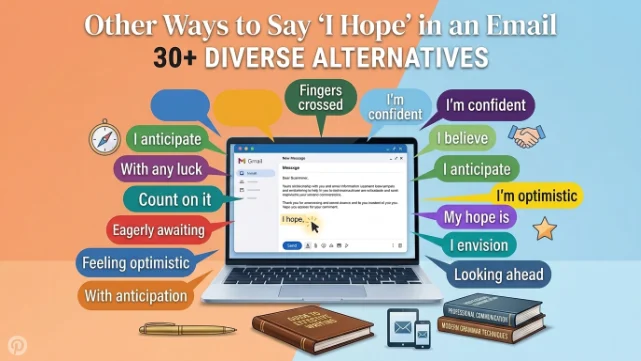
Looking for fresh alternatives to “I hope”? Here are the top 5 professional and fluent options: I trust, I anticipate, I’m confident, I wish, and I look forward to. Each conveys optimism and expectation while matching different tones and relationships.
“I hope” is one of the most common phrases in English we use it to express wishes, expectations, and optimism in countless situations. But relying on this single phrase can make your communication feel repetitive and less impactful. Learning alternatives to “I hope” helps you sound more nuanced, confident, and emotionally intelligent in both spoken and written English.
Whether you’re writing a professional email, giving a presentation, or having a casual conversation, having a rich vocabulary of hopeful expressions allows you to match your tone precisely to the context. In this guide, you’ll discover 30 powerful alternatives that will elevate your English from basic to brilliantly expressive.
“Hope is a beautiful sentiment, but the way you express it reveals your fluency and emotional awareness.”
Quick Categories
Formal Alternatives to “I Hope”
- I trust
- I anticipate
- It is my hope
- I am hopeful
- I remain optimistic
Casual Alternatives
- Hopefully
- Fingers crossed
- Here’s hoping
- Let’s hope
- Cross my fingers
Professional Alternatives
- I’m confident
- I expect
- I look forward to
- I’m optimistic that
- It would be my preference
Informal Expressions
- Keeping my fingers crossed
- Praying for
- Wishful thinking
- Hope springs eternal
- Keeping everything crossed
Common Mistakes Using “I Hope”
Even advanced English learners make these common errors with “I hope”:
- Using the wrong tense
❌ “I hope you will have a great day” (redundant – “hope” already implies future)
✅ “I hope you have a great day” - Confusing “hope” and “wish”
❌ “I hope I was there” (should be “wish” for unreal past)
✅ “I wish I were there” - Forgetting the subject
❌ “Hope you’re well” (informal but acceptable; better to use “I hope” in formal writing)
✅ “I hope you’re well” (formal) - Using it too casually in formal writing
❌ “I hope you consider my application” (weak; use “I trust” or “I am confident”)
✅ “I trust you will give my application due consideration” - Overusing it in a single message
❌ “I hope you’re fine. I hope you can attend. I hope we can meet.” (repetitive)
✅ Vary your expressions for better flow
What Does “I Hope” Mean?
“I hope” means “I feel or express a desire for a particular outcome or event.” It conveys optimism, expectation, or a wish that something will happen or be true.
Grammar note: “Hope” can be followed by:
- A that-clause: “I hope (that) you’re well.”
- A to-infinitive: “I hope to see you soon.”
- A preposition: “I hope for the best.”
Example:
“I hope you enjoy your trip to London.”
When to Use “I Hope”
Use “I hope” in these contexts:
- Expressing wishes about future events
- Showing optimism in uncertain situations
- Polite requests (e.g., “I hope you can help”)
- Well-wishes (e.g., “I hope you feel better”)
- Professional emails when expressing expectations
Spoken vs Written: Very common in both. In writing, it’s slightly informal; formal writing often uses “I trust” or “It is my hope.”
Formal vs Informal: Neutral but leans casual. For formal writing, consider stronger alternatives.
Is It Professional or Polite to Say “I Hope”?
Polite? ✔️ Yes – It shows care and consideration for the recipient’s situation.
Professional? ❌ No (in very formal contexts) – While acceptable in most business emails, it can sound weak or overly personal in highly formal documents. Use “I trust” or “I anticipate” for a more professional tone.
Business-style Example:
“I trust you will find the attached proposal satisfactory.”
Pros and Cons of Using “I Hope”
Pros ✅
- Simple and natural – Easy to use without thinking
- Friendly tone – Conveys warmth and optimism
- Common usage – Understood by everyone
- Versatile – Works in many contexts
Cons ❌
- Overused – Lacks originality and impact
- Can sound weak – Especially in professional settings where certainty is valued
- Limited emotional range – Doesn’t convey confidence or determination
- May seem vague – Less precise than “I expect” or “I’m confident”
Other Ways to Say “I Hope” (With Examples)
These alternatives will help you sound more fluent, confident, and natural in different situations. Use them according to tone, context, and audience to express hope, expectation, or optimism effectively.
Formal Alternatives (Best for Official Correspondence)
1. Phrase: I trust
Meaning: Expresses confident expectation, often in formal or professional settings.
Explanation: “Trust” implies a belief based on reliability, making it stronger than “hope.”
Example Sentence: “I trust you will review my application at your earliest convenience.”
Best Use: Job applications
Worst Use: Casual conversation
Tone: Confident, formal, professional
Context Variability: Professional (formal)
2. Phrase: I anticipate
Meaning: Expects something with some degree of certainty based on evidence.
Explanation: Suggests you have reason to believe the outcome will happen, not just wishful thinking.
Example Sentence: “I anticipate a positive response from the board.”
Best Use: Business forecasts
Worst Use: Personal wishes
Tone: Analytical, forward-looking, formal
Context Variability: Professional
3. Phrase: It is my hope
Meaning: A more formal and impersonal way to express a wish.
Explanation: Often used in official statements, letters, or announcements.
Example Sentence: “It is my hope that this partnership will flourish.”
Best Use: Official letters
Worst Use: Everyday emails
Tone: Formal, diplomatic, refined
Context Variability: Professional (formal)
4. Phrase: I am hopeful
Meaning: States a positive expectation in a measured, confident way.
Explanation: Sounds more thoughtful and less impulsive than “I hope.”
Example Sentence: “I am hopeful that the new policy will address these concerns.”
Best Use: Professional discussions
Worst Use: Casual texts
Tone: Measured, optimistic, professional
Context Variability: Professional/Casual
5. Phrase: I remain optimistic
Meaning: Expresses sustained hope despite challenges.
Explanation: Shows resilience and positive thinking, often in difficult situations.
Example Sentence: “Despite the setbacks, I remain optimistic about our progress.”
Best Use: Challenging projects
Worst Use: Simple daily wishes
Tone: Resilient, positive, formal
Context Variability: Professional
“Formal alternatives project confidence and authority—perfect when you need to sound assured.”
Professional Alternatives (Best for Business Emails)
6. Phrase: I’m confident
Meaning: Expresses strong belief in a positive outcome.
Explanation: More assertive than “hope” – shows certainty based on reasoning.
Example Sentence: “I’m confident our team can deliver this project on time.”
Best Use: Reassuring clients
Worst Use: Expressing wishes without basis
Tone: Confident, assured, professional
Context Variability: Professional
7. Phrase: I expect
Meaning: Indicates a strong likelihood based on normal procedures or agreements.
Explanation: Sounds businesslike and objective, not emotional.
Example Sentence: “I expect the report to be completed by Friday.”
Best Use: Setting expectations
Worst Use: Personal well-wishes
Tone: Objective, businesslike, firm
Context Variability: Professional
8. Phrase: I look forward to
Meaning: Expresses positive anticipation for a specific future event.
Explanation: One of the most common and safe professional alternatives.
Example Sentence: “I look forward to meeting you at the conference.”
Best Use: Meetings and events
Worst Use: Uncertain outcomes
Tone: Anticipatory, professional, polite
Context Variability: Professional/Formal
9. Phrase: I’m optimistic that
Meaning: Shows a positive outlook based on evidence or likelihood.
Explanation: Slightly less strong than “confident,” but more professional than “hope.”
Example Sentence: “I’m optimistic that our proposal will be accepted.”
Best Use: Business updates
Worst Use: Casual chats
Tone: Positive, measured, professional
Context Variability: Professional
10. Phrase: It would be my preference
Meaning: Politely states a desired outcome in a formal way.
Explanation: Softens the directness of “I hope” while maintaining professionalism.
Example Sentence: “It would be my preference that we proceed with the original plan.”
Best Use: Formal decisions
Worst Use: Quick emails
Tone: Polite, diplomatic, formal
Context Variability: Professional (formal)
11. Phrase: I would like to see
Meaning: Expresses a hope or desire indirectly and politely.
Explanation: Common in business writing when making suggestions or requests.
Example Sentence: “I would like to see more collaboration between departments.”
Best Use: Strategic suggestions
Worst Use: Personal wishes
Tone: Suggestive, polite, professional
Context Variability: Professional
12. Phrase: My hope is that
Meaning: A slightly more formal version of “I hope.”
Explanation: Sounds more thoughtful and structured.
Example Sentence: “My hope is that this initiative will benefit all stakeholders.”
Best Use: Formal proposals
Worst Use: Casual conversation
Tone: Formal, reflective, professional
Context Variability: Professional
13. Phrase: I am looking forward to
Meaning: Similar to “I look forward to,” but with present continuous for immediacy.
Explanation: Very common in professional emails, especially before meetings.
Example Sentence: “I am looking forward to discussing this further.”
Best Use: Upcoming meetings
Worst Use: Expressing abstract hope
Tone: Anticipatory, professional, friendly
Context Variability: Professional
14. Phrase: I trust that
Meaning: Expresses confidence and expectation in a formal way.
Explanation: Stronger than “hope” and implies belief in the recipient’s capability.
Example Sentence: “I trust that you will handle this matter with care.”
Best Use: Delegating tasks
Worst Use: Personal matters
Tone: Confident, respectful, formal
Context Variability: Professional
“Professional closings of hope build trust—use them to convey assurance, not just wishful thinking.”
Casual Alternatives (Best for Colleagues and Friends)
15. Phrase: Hopefully
Meaning: An adverb that expresses hope in a casual way.
Explanation: Can be used as a standalone response or to modify a sentence.
Example Sentence: “I’ll see you at the party tonight. Hopefully!”
Best Use: Casual conversations
Worst Use: Formal writing
Tone: Casual, optimistic, friendly
Context Variability: Casual/Informal
16. Phrase: Fingers crossed
Meaning: A colloquial expression of hope, referring to the gesture.
Explanation: Very common in spoken English and informal messages.
Example Sentence: “Fingers crossed we get the contract!”
Best Use: Informal wishes
Worst Use: Professional emails
Tone: Colloquial, hopeful, friendly
Context Variability: Very casual
17. Phrase: Here’s hoping
Meaning: An informal way to express hope, often used at the start of a statement.
Explanation: Suggests a shared hope between speaker and listener.
Example Sentence: “Here’s hoping the weather stays nice for the picnic.”
Best Use: Shared experiences
Worst Use: Formal contexts
Tone: Conversational, inclusive, casual
Context Variability: Casual
18. Phrase: Let’s hope
Meaning: Expresses collective hope or optimism.
Explanation: Encourages a shared positive attitude.
Example Sentence: “Let’s hope the traffic isn’t too bad.”
Best Use: Group situations
Worst Use: Formal correspondence
Tone: Inclusive, optimistic, casual
Context Variability: Casual
19. Phrase: Cross my fingers
Meaning: Similar to “fingers crossed,” but in first person.
Explanation: Indicates you are actively hoping for something.
Example Sentence: “Cross my fingers that I pass the test.”
Best Use: Personal hopes
Worst Use: Professional communication
Tone: Personal, hopeful, casual
Context Variability: Very casual
20. Phrase: Praying for
Meaning: Expresses hope through the act of prayer, often used figuratively.
Explanation: Can be used literally or as a strong expression of hope.
Example Sentence: “Praying for good news about the job.”
Best Use: Personal and emotional contexts
Worst Use: Secular professional settings
Tone: Emotional, sincere, personal
Context Variability: Personal/Casual
21. Phrase: Wishful thinking
Meaning: Expresses hope but acknowledges it may be unrealistic.
Explanation: Used when the hope is more of a fantasy than a realistic expectation.
Example Sentence: “I’d love to win the lottery, but that’s wishful thinking.”
Best Use: Humorous or self-deprecating contexts
Worst Use: Professional optimism
Tone: Playful, realistic, casual
Context Variability: Casual
22. Phrase: Hope springs eternal
Meaning: A literary expression meaning hope is always present.
Explanation: Used in more poetic or reflective contexts.
Example Sentence: “Hope springs eternal – we might still win the championship.”
Best Use: Literary or philosophical conversations
Worst Use: Business emails
Tone: Poetic, reflective, casual
Context Variability: Casual/Literary
23. Phrase: Keeping everything crossed
Meaning: An emphatic version of “fingers crossed.”
Explanation: Shows you are hoping intensely.
Example Sentence: “Keeping everything crossed for your interview tomorrow!”
Best Use: Supporting friends
Worst Use: Professional contexts
Tone: Emphatic, supportive, casual
Context Variability: Very casual
24. Phrase: I’m hoping
Meaning: A slightly more informal version of “I hope.”
Explanation: Often used in spoken English to express a current hope.
Example Sentence: “I’m hoping to catch the early train.”
Best Use: Everyday speech
Worst Use: Formal writing
Tone: Casual, immediate, friendly
Context Variability: Casual/Spoken
Specialized Alternatives (Best for Specific Situations)
25. Phrase: I wish
Meaning: Expresses a desire for something that may be unlikely.
Explanation: Often used for unreal or improbable hopes, unlike “hope.”
Example Sentence: “I wish we had more time to prepare.”
Best Use: Expressing regret or desire
Worst Use: Expecting a likely outcome
Tone: Yearning, reflective, personal
Context Variability: Personal/Casual
26. Phrase: If all goes well
Meaning: Expresses hope conditioned on normal progress.
Explanation: Grounds the hope in a realistic expectation.
Example Sentence: “If all goes well, we’ll launch the product in May.”
Best Use: Project planning
Worst Use: Emotional wishes
Tone: Practical, conditional, professional
Context Variability: Professional/Casual
27. Phrase: With any luck
Meaning: Expresses hope that good fortune will intervene.
Explanation: Common in spoken English for everyday hopes.
Example Sentence: “With any luck, we’ll avoid the traffic.”
Best Use: Everyday situations
Worst Use: Formal writing
Tone: Optimistic, casual, conversational
Context Variability: Casual
28. Phrase: It’s my fervent hope
Meaning: Expresses intense, passionate hope.
Explanation: “Fervent” means very earnest or intense – used in emotional or important contexts.
Example Sentence: “It’s my fervent hope that we find a peaceful resolution.”
Best Use: Important personal or social issues
Worst Use: Routine emails
Tone: Intense, sincere, formal
Context Variability: Formal/Personal
29. Phrase: I hold out hope
Meaning: Expresses continued hope despite difficulties.
Explanation: Suggests perseverance and optimism.
Example Sentence: “I hold out hope that we can still reach an agreement.”
Best Use: Challenging negotiations
Worst Use: Simple wishes
Tone: Persistent, hopeful, formal
Context Variability: Professional/Personal
30. Phrase: May
Meaning: A formal way to express a hope or wish using the subjunctive.
Explanation: Often used in ceremonial or very formal writing.
Example Sentence: “May this collaboration bring mutual success.”
Best Use: Speeches, formal letters, blessings
Worst Use: Everyday emails
Tone: Ceremonial, formal, elevated
Context Variability: Formal/Literary
“Variety in expressing hope makes your English vibrant – choose the shade that fits the moment.”
Mini Quiz / Self-Check
Test your understanding of when to use different alternatives to “I hope”:
1. You’re writing a formal business proposal to a major client. Which alternative is MOST professional?
- A) Fingers crossed
- B) I trust
- C) Hopefully
- D) Here’s hoping
Answer: B – “I trust” conveys professional confidence in formal settings.
2. You’re texting a close friend about a job interview. Which is MOST appropriate?
- A) It is my hope
- B) I remain optimistic
- C) Fingers crossed
- D) I anticipate
Answer: C – “Fingers crossed” is perfect for casual, supportive messages between friends.
3. You’re writing an email to a colleague about an uncertain project timeline. Which alternative shows measured optimism?
- A) I’m optimistic that
- B) Wishful thinking
- C) Let’s hope
- D) May
Answer: A – “I’m optimistic that” is professional and grounded, fitting for a work update.
4. You’re giving a speech at an awards ceremony. Which closing alternative is most suitable?
- A) Hopefully
- B) I expect
- C) May this evening be a celebration of excellence
- D) Cross my fingers
Answer: C – Using “May” is formal, elegant, and appropriate for ceremonial occasions.
Comparison Table: Top Alternatives
| Phrase | Tone | Best Use |
|---|---|---|
| I trust | Formal, confident | Job applications, formal letters |
| I anticipate | Analytical, formal | Business forecasts |
| I’m confident | Assured, professional | Reassuring clients |
| I look forward to | Anticipatory, polite | Meetings and events |
| It is my hope | Formal, diplomatic | Official statements |
| I’m optimistic that | Positive, measured | Professional updates |
| Hopefully | Casual, friendly | Everyday conversation |
| Fingers crossed | Colloquial, hopeful | Informal wishes |
| Let’s hope | Inclusive, optimistic | Group situations |
| May | Ceremonial, elevated | Speeches, formal blessings |
FAQs
1. Is “I hope” considered unprofessional in business emails?
No, “I hope” is not unprofessional, but it can sound less assertive than alternatives like “I trust” or “I’m confident.” In very formal contexts, stronger alternatives are preferred to project authority and certainty.
2. What’s the difference between “hope” and “wish”?
“Hope” is used for possible or likely outcomes (e.g., “I hope you come”), while “wish” is often used for impossible or unlikely situations (e.g., “I wish I could fly”). “Wish” also expresses regret (e.g., “I wish I had studied harder”).
3. Can I use “hopefully” in professional writing?
“Hopefully” is acceptable in casual professional writing (e.g., internal emails), but for formal documents, it’s better to use “I hope” or a more formal alternative. “Hopefully” as a sentence adverb is also criticized by some purists.
4. When should I use “I look forward to” instead of “I hope”?
Use “I look forward to” when you expect a specific future event with anticipation (e.g., meeting, reply, event). Use “I hope” for more general or uncertain wishes. “I look forward to” is more concrete and professional.
5. Is “I trust” too formal for everyday use?
“I trust” is formal and may sound overly stiff in casual conversation. Use it in professional emails, formal letters, or when you need to convey strong confidence. For everyday situations, “I hope” or “Hopefully” are more natural.
Conclusion
Expanding your repertoire of hopeful expressions transforms your English from repetitive to refined. Each alternative carries its own nuance from the confident professionalism of “I trust” to the casual warmth of “fingers crossed.” Choosing the right phrase not only reflects your fluency but also demonstrates your awareness of tone and context.
Practice incorporating these alternatives into your daily communication. Pay attention to how native speakers express hope in different situations, and soon you’ll naturally select the perfect phrase for every occasion making your English more vibrant, precise, and engaging.