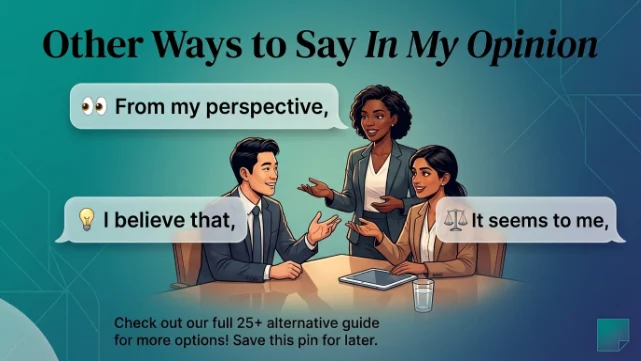
Looking for alternatives to “in my opinion”? Here are the top 5 professional and fluent choices: From my perspective, As I see it, To my mind, It seems to me that, and I believe that. Each adds nuance and confidence to your statements while avoiding overused phrasing.
“In my opinion” is one of the most common phrases in English—and one of the most overused. While it’s perfectly correct, relying on it too often makes your speaking and writing sound repetitive and hesitant. Learning alternatives to “in my opinion” helps you express your views with more nuance, authority, and variety.
Whether you’re contributing to a business meeting, writing an academic essay, or simply sharing your thoughts in conversation, having a rich repertoire of opinion-expressing phrases makes you sound more fluent, confident, and persuasive. In this guide, you’ll discover 30 powerful alternatives that will elevate your communication and help you express excitement in English while maintaining professionalism.
“The way you introduce your opinion shapes how others receive it—choose your words to command respect and invite dialogue.”
Quick Categories
Formal Alternatives to “In My Opinion”
- From my perspective
- In my estimation
- To my understanding
- From where I stand
- According to my analysis
Casual Alternatives
- I reckon
- If you ask me
- As far as I’m concerned
- I’d say
- I figure
Professional Alternatives
- I believe that
- It seems to me that
- My view is that
- I contend that
- In my assessment
Informal Expressions
- In my book
- To my way of thinking
- I’m of the opinion that
- Personally, I think
- The way I see it
Common Mistakes Using “In My Opinion”
Even advanced learners make these common errors when using opinion phrases:
- Using it with obvious facts
❌ “In my opinion, the sky is blue.” (Opinion phrases are for subjective views, not facts) - Redundancy: “In my opinion, I think…”
❌ “In my opinion, I think we should delay.” (Double opinion markers) - Forgetting the comma after introductory phrases
❌ “In my opinion we should wait.” (Should be “In my opinion, we should wait.”) - Overusing it in every sentence
❌ “In my opinion, the report is good. In my opinion, we should approve it.” (Too repetitive) - Using it when your view is already clear
❌ “This is my proposal. In my opinion, it’s the best option.” (Redundant if you’ve already established it’s your view)
What Does “In My Opinion” Mean?
In my opinion means “according to my personal belief, judgment, or viewpoint.” It signals that what follows is subjective and not an objective fact.
Grammar note: This prepositional phrase functions as a sentence adverb or discourse marker. It typically appears at the start of a sentence, followed by a comma. You can also place it mid-sentence or at the end for variety.
Example:
“In my opinion, this marketing strategy will resonate well with younger audiences.”
When to Use “In My Opinion”
Use “in my opinion” in these contexts:
- Expressing personal beliefs in discussions
- Academic essays to signal subjective analysis
- Professional meetings when sharing your viewpoint
- Written articles where you offer your interpretation
- Everyday conversations to share your thoughts politely
Spoken vs Written: Used extensively in both. In spoken English, it’s often shortened to “IMO” in texting but spoken fully in formal settings.
Formal vs Informal: Neutral—works in both but can sound weak or hesitant if overused.
Is It Professional or Polite to Say “In My Opinion”?
Polite? ✔️ Yes – It shows humility and acknowledges that others may disagree.
Professional? ✔️ Yes, but with caution – It’s professional, but overusing it can make you sound uncertain. In high-stakes professional settings, stronger phrases like “I believe” or “From my perspective” often carry more authority.
Business-style Example:
“In my opinion, we should allocate additional resources to the R&D department to accelerate innovation.”
Pros and Cons of Using “In My Opinion”
Pros ✅
- Simple and natural – Easy for learners to use correctly
- Friendly tone – Softens statements and invites discussion
- Common usage – Universally understood by all English speakers
- Easy to understand – No confusion about its meaning
Cons ❌
- Overused – Lacks originality and can sound like a crutch
- Can signal weakness – May make you sound unsure or hesitant
- Limited emotional range – Doesn’t convey passion or conviction
- Not suitable for all contexts – Can feel too humble in persuasive writing
Other Ways to Say “In My Opinion” (With Examples)
These alternatives will help you sound more fluent, confident, and natural in different situations. Use them according to tone, context, and audience to express excitement, admiration, or approval while sharing your views.
Formal Alternatives (Best for Academic & Professional Writing)
1. Phrase: From my perspective
Meaning: Indicates the viewpoint shaped by your unique experiences and position.
Explanation: This phrase emphasizes that your opinion comes from your specific role or background.
Example Sentence: “From my perspective, the new workflow will streamline our operations significantly.”
Best Use: Professional reports
Worst Use: Casual conversation
Tone: Analytical, professional, objective
Context Variability: Professional/Formal
2. Phrase: In my estimation
Meaning: Based on your careful judgment or calculation.
Explanation: Suggests you’ve considered the evidence and arrived at a considered opinion.
Example Sentence: “In my estimation, the project will require at least three more weeks.”
Best Use: Business projections
Worst Use: Personal preferences
Tone: Judicious, measured, professional
Context Variability: Professional
3. Phrase: To my understanding
Meaning: According to what you know or believe to be true.
Explanation: Useful when you want to express an opinion based on information you’ve gathered.
Example Sentence: “To my understanding, the client’s main concern is timeline rather than cost.”
Best Use: Clarifying assumptions
Worst Use: Strong personal beliefs
Tone: Reasonable, informed, cautious
Context Variability: Professional/Formal
4. Phrase: From where I stand
Meaning: Expresses an opinion rooted in your position or situation.
Explanation: Similar to “from my perspective” but slightly more conversational.
Example Sentence: “From where I stand, the current policy doesn’t serve our long-term goals.”
Best Use: Team discussions
Worst Use: Academic papers
Tone: Personal, grounded, professional
Context Variability: Professional/Casual
5. Phrase: According to my analysis
Meaning: Based on your systematic evaluation of information.
Explanation: Adds authority by implying you’ve done research or careful thinking.
Example Sentence: “According to my analysis, we should enter the European market by Q3.”
Best Use: Data-driven recommendations
Worst Use: Personal anecdotes
Tone: Analytical, rigorous, authoritative
Context Variability: Professional (formal)
“Formal opinion phrases convey thoughtfulness—use them to show you’ve considered the facts before speaking.”
Professional Alternatives (Best for Business & Workplace)
6. Phrase: I believe that
Meaning: A strong, confident statement of personal conviction.
Explanation: More assertive than “in my opinion,” this phrase shows you have confidence in your view.
Example Sentence: “I believe that investing in employee training will improve retention rates.”
Best Use: Presentations and proposals
Worst Use: When you’re uncertain
Tone: Confident, persuasive, professional
Context Variability: Professional/Formal
7. Phrase: It seems to me that
Meaning: A softer way to introduce an opinion based on appearances or initial impressions.
Explanation: Useful when you want to be diplomatic or acknowledge you might be wrong.
Example Sentence: “It seems to me that the marketing campaign is underperforming compared to last quarter.”
Best Use: Offering constructive feedback
Worst Use: Strong advocacy
Tone: Tentative, diplomatic, thoughtful
Context Variability: Professional/Casual
8. Phrase: My view is that
Meaning: A direct and clear statement of your personal perspective.
Explanation: More concise and professional than “in my opinion,” this phrase cuts to the chase.
Example Sentence: “My view is that we should prioritize customer satisfaction over short-term profits.”
Best Use: Debates and discussions
Worst Use: Very formal legal documents
Tone: Direct, clear, professional
Context Variability: Professional/Formal
9. Phrase: I contend that
Meaning: A formal and assertive way to state an opinion, often in a debate.
Explanation: Implies you’re ready to defend your position with evidence and arguments.
Example Sentence: “I contend that remote work increases productivity when properly managed.”
Best Use: Academic arguments
Worst Use: Casual chats
Tone: Assertive, argumentative, formal
Context Variability: Professional (formal)
10. Phrase: In my assessment
Meaning: Similar to “in my estimation,” implying careful evaluation.
Explanation: Often used in professional contexts where you’re evaluating performance or risk.
Example Sentence: “In my assessment, the current team structure is hindering collaboration.”
Best Use: Performance reviews
Worst Use: Personal preferences
Tone: Evaluative, professional, measured
Context Variability: Professional
11. Phrase: Personally, I think
Meaning: Emphasizes that this is your individual perspective, not a group consensus.
Explanation: Adds a personal touch while remaining professional.
Example Sentence: “Personally, I think we should test the product for another week before launch.”
Best Use: Team meetings
Worst Use: Formal board reports
Tone: Personal, friendly, professional
Context Variability: Professional/Casual
12. Phrase: I’m of the opinion that
Meaning: A slightly formal way to state your belief.
Explanation: This phrase sounds educated and deliberate, good for written communication.
Example Sentence: “I’m of the opinion that we need a more aggressive social media strategy.”
Best Use: Business emails
Worst Use: Quick chats
Tone: Measured, formal, thoughtful
Context Variability: Professional/Formal
13. Phrase: As far as I’m concerned
Meaning: Emphasizes that the statement reflects your personal view, often implying others may differ.
Explanation: Useful when you want to assert your position while acknowledging alternative views.
Example Sentence: “As far as I’m concerned, the deadline should be extended to Friday.”
Best Use: Negotiations
Worst Use: Collaborative brainstorming
Tone: Assertive, personal, direct
Context Variability: Professional/Casual
14. Phrase: In my judgment
Meaning: Indicates you’ve used your reasoning and experience to form an opinion.
Explanation: Similar to “in my estimation” but slightly more formal.
Example Sentence: “In my judgment, the risks outweigh the potential benefits.”
Best Use: Risk assessments
Worst Use: Routine emails
Tone: Judicious, authoritative, formal
Context Variability: Professional (formal)
15. Phrase: The way I see it
Meaning: A casual but confident way to introduce your perspective.
Explanation: Common in business conversations; it’s direct yet friendly.
Example Sentence: “The way I see it, we have two options: cut costs or increase revenue.”
Best Use: Strategic discussions
Worst Use: Academic writing
Tone: Direct, casual, clear
Context Variability: Professional/Casual
“Strong opinion phrases show conviction—they signal that you’re not just sharing a thought, but advocating for a position.”
Casual Alternatives (Best for Colleagues & Everyday Conversation)
16. Phrase: I reckon
Meaning: A colloquial British/Australian expression for “I think.”
Explanation: Very informal—use only with friends or in very relaxed settings.
Example Sentence: “I reckon we should order pizza for the team lunch.”
Best Use: Friends and close colleagues
Worst Use: Any formal context
Tone: Casual, folksy, conversational
Context Variability: Very casual
17. Phrase: If you ask me
Meaning: Implies you’re giving an honest opinion, often unsolicited.
Explanation: Common in spoken English, it adds a touch of directness and personality.
Example Sentence: “If you ask me, the new design doesn’t match our brand identity.”
Best Use: Informal feedback
Worst Use: Formal reports
Tone: Direct, casual, opinionated
Context Variability: Casual/Professional
18. Phrase: I figure
Meaning: A casual way to say “I think” or “I suppose.”
Explanation: Often used when making a guess or informal assumption.
Example Sentence: “I figure we’ll be done by noon if we all pitch in.”
Best Use: Everyday conversations
Worst Use: Business presentations
Tone: Casual, laid-back, friendly
Context Variability: Casual
19. Phrase: I’d say
Meaning: A shortened, casual version of “I would say.”
Explanation: Very common in spoken English—a quick way to give an opinion.
Example Sentence: “I’d say the design could use more vibrant colors.”
Best Use: Conversations with friends
Worst Use: Professional writing
Tone: Casual, spontaneous, direct
Context Variability: Casual
20. Phrase: To my way of thinking
Meaning: A slightly old-fashioned but still used casual phrase.
Explanation: Emphasizes that your opinion is shaped by your personal thought process.
Example Sentence: “To my way of thinking, honesty is always the best policy.”
Best Use: Personal reflections
Worst Use: Business memos
Tone: Personal, reflective, casual
Context Variability: Casual
21. Phrase: In my book
Meaning: Meaning “according to my personal standards or judgment.”
Explanation: Often used when expressing moral or value-based opinions.
Example Sentence: “In my book, that’s not an acceptable way to treat employees.”
Best Use: Moral judgments
Worst Use: Objective analysis
Tone: Personal, value-driven, casual
Context Variability: Casual
22. Phrase: I’m pretty sure that
Meaning: Indicates a strong opinion with a slight admission of uncertainty.
Explanation: Very common in everyday speech—it’s confident but not overbearing.
Example Sentence: “I’m pretty sure that the meeting was rescheduled to Thursday.”
Best Use: Casual confirmations
Worst Use: Formal assertions
Tone: Confident, casual, friendly
Context Variability: Casual
23. Phrase: It looks to me like
Meaning: A visually-oriented way to express an opinion based on observation.
Explanation: Often used when making a visual or intuitive judgment.
Example Sentence: “It looks to me like we’re going to have a busy quarter ahead.”
Best Use: Observations
Worst Use: Analytical reports
Tone: Observational, casual, intuitive
Context Variability: Casual/Professional
24. Phrase: Off the top of my head
Meaning: Expresses an opinion without deep thought or research.
Explanation: Useful when you’re giving a quick, preliminary opinion.
Example Sentence: “Off the top of my head, I’d say the budget is around $50,000.”
Best Use: Quick estimates
Worst Use: Important decisions
Tone: Spontaneous, casual, approximate
Context Variability: Casual
25. Phrase: As I see it
Meaning: A concise and casual alternative to “in my opinion.”
Explanation: Very common and acceptable in both spoken and written English.
Example Sentence: “As I see it, we have nothing to lose by trying this approach.”
Best Use: General conversations
Worst Use: Very formal legal writing
Tone: Direct, clear, casual
Context Variability: Casual/Professional
Specialized Alternatives (Best for Specific Situations)
26. Phrase: From my vantage point
Meaning: Similar to “from my perspective” but implies a higher or broader view.
Explanation: Often used when you have a comprehensive overview of a situation.
Example Sentence: “From my vantage point, the market trends suggest we should pivot now.”
Best Use: Strategic insights
Worst Use: Personal opinions
Tone: Broad, strategic, professional
Context Variability: Professional
27. Phrase: My take on this is
Meaning: A modern, colloquial way to state your opinion or interpretation.
Explanation: “Take” means “interpretation” — this phrase is common in business and media.
Example Sentence: “My take on this is that we need better communication between departments.”
Best Use: Team discussions
Worst Use: Formal documents
Tone: Modern, confident, friendly
Context Variability: Professional/Casual
28. Phrase: I’m convinced that
Meaning: Shows strong belief and confidence in your opinion.
Explanation: More forceful than “I believe,” this phrase conveys certainty.
Example Sentence: “I’m convinced that investing in AI will transform our customer service.”
Best Use: Persuasive arguments
Worst Use: When uncertain
Tone: Convincing, confident, passionate
Context Variability: Professional/Formal
29. Phrase: It strikes me that
Meaning: Introduces an opinion that comes as a sudden realization or impression.
Explanation: Useful when your opinion is based on an intuitive flash.
Example Sentence: “It strikes me that we’ve been focusing on the wrong metrics.”
Best Use: Insights and epiphanies
Worst Use: Data-driven analysis
Tone: Intuitive, insightful, thoughtful
Context Variability: Professional/Casual
30. Phrase: If I’m honest
Meaning: A phrase that introduces a candid, possibly uncomfortable opinion.
Explanation: Often used when you’re about to say something that might be critical or frank.
Example Sentence: “If I’m honest, I don’t think this plan will work in the long run.”
Best Use: Honest feedback
Worst Use: Compliments
Tone: Candid, honest, personal
Context Variability: Casual/Professional
“The most persuasive opinions are those that balance confidence with humility—show you believe, but stay open to others.”
Mini Quiz / Self-Check
Test your understanding of when to use different opinion phrases:
1. You’re delivering a formal business presentation to the board. Which phrase is MOST appropriate?
- A) I reckon
- B) I believe that
- C) Off the top of my head
- D) If you ask me
Answer: B – “I believe that” is confident and professional, suitable for formal presentations.
2. You’re chatting casually with a friend about which restaurant to choose. Which is MOST suitable?
- A) In my estimation
- B) According to my analysis
- C) I reckon
- D) I contend that
Answer: C – “I reckon” is informal and friendly, perfect for casual chats.
3. You want to give constructive feedback to a colleague but don’t want to sound too forceful. Which phrase is BEST?
- A) I’m convinced that
- B) It seems to me that
- C) My view is that
- D) I contend that
Answer: B – “It seems to me that” is diplomatic and softer, ideal for constructive feedback.
4. You’re writing an academic paper and need to state a controversial argument. Which is MOST appropriate?
- A) I figure
- B) If you ask me
- C) I contend that
- D) My take on this is
Answer: C – “I contend that” is formal and assertive, perfect for academic arguments.
Comparison Table: Top Alternatives
| Phrase | Tone | Best Use |
|---|---|---|
| I believe that | Confident, professional | Presentations & proposals |
| From my perspective | Analytical, formal | Professional reports |
| It seems to me that | Diplomatic, thoughtful | Constructive feedback |
| The way I see it | Direct, casual | Strategic discussions |
| In my estimation | Judicious, measured | Business projections |
| I contend that | Assertive, formal | Academic arguments |
| Personally, I think | Personal, friendly | Team meetings |
| As far as I’m concerned | Assertive, direct | Negotiations |
| I reckon | Casual, folksy | Friends & close colleagues |
| If you ask me | Direct, informal | Informal feedback |
FAQs
1. Is “in my opinion” considered unprofessional?
No, “in my opinion” is not unprofessional, but it can sound weak or repetitive. In professional contexts, stronger alternatives like “I believe” or “From my perspective” often carry more authority and clarity.
2. What’s the best alternative for academic writing?
“In my estimation,” “I contend that,” and “From my perspective” are excellent for academic writing because they signal thoughtful analysis without sounding too casual.
3. Can I use “I reckon” in British business emails?
Generally, no. “I reckon” is very informal and is typically reserved for spoken conversation. Even in British workplaces, stick to “I believe” or “From my perspective” for written professional communication.
4. How can I sound more confident when giving my opinion?
Use phrases like “I’m convinced that,” “I believe that,” or “My view is that.” These convey conviction. Avoid overusing hedging phrases like “I think” or “maybe” if you want to appear confident.
5. Is it okay to start every sentence with “in my opinion”?
No, that’s repetitive and sounds unnatural. Vary your phrases using the alternatives in this guide to keep your language fresh and engaging.
Conclusion
Mastering alternatives to “in my opinion” transforms your communication from hesitant to confident. Each phrase carries a distinct tone—from the authoritative “I contend” to the diplomatic “It seems to me.” By choosing the right expression for each context, you’ll sound more fluent, persuasive, and professionally aware.
Start practicing these 30 alternatives today. In meetings, in emails, and in casual conversations, challenge yourself to avoid “in my opinion” and reach for a more precise alternative. With practice, expressing your views will become more natural, nuanced, and impactful and your English will shine.