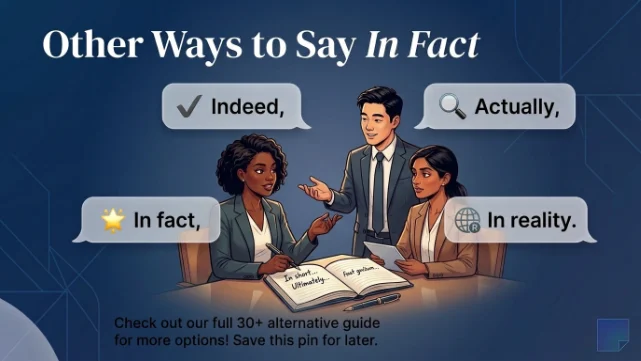
Looking for alternatives to “in fact”? Here are the top 5 powerful options: Actually, As a matter of fact, In reality, Indeed, and In truth. Each adds emphasis and clarity to your statements in different contexts and tones.
“In fact” is one of the most common English phrases used to add emphasis, clarify a point, or introduce surprising information. It’s versatile, widely understood, and useful in both spoken and written English. But here’s the reality: overusing “in fact” can make your communication feel repetitive and predictable. Learning alternatives to “in fact” helps you express excitement in English more naturally and adds variety to your professional and personal communication.
Whether you’re writing a business report, giving a presentation, or having a casual conversation, knowing multiple ways to emphasize your point makes you sound more fluent and sophisticated. In this comprehensive guide, you’ll discover 30 powerful alternatives that will transform how you express certainty, clarification, and emphasis in English.
“The words you choose to emphasize your point can make the difference between sounding repetitive and sounding remarkably articulate.”
Quick Categories
Formal Alternatives to “In Fact”
- Indeed
- In actuality
- In reality
- In truth
- As a matter of fact
Casual Alternatives
- Actually
- Honestly
- To be honest
- The truth is
- To tell you the truth
Professional Alternatives
- In practice
- In essence
- In effect
- It is worth noting that
- Significantly
Informal Expressions
- For real
- No kidding
- Believe it or not
- Would you believe
- As it happens
Common Mistakes Using “In Fact”
Many English learners make these common errors when using “in fact”:
- Using it with contradictory statements incorrectly
❌ “The meeting was cancelled. In fact, it was postponed.” (Actually, these aren’t contradictory) - Overusing it in a single paragraph
❌ “The project is on time. In fact, we’re ahead. In fact, we might finish early. In fact, the client is impressed.” - Using it to state obvious information
❌ “Water is wet. In fact, it’s liquid.” - Forgetting to use commas
❌ “In fact he was there.” (Missing comma after “In fact”) - Using it when “actually” would be more natural
❌ “I thought it was Tuesday. In fact, it’s Wednesday.” (Actually works better here)
What Does “In Fact” Mean?
In fact means “in reality,” “actually,” or “as a matter of truth.” It’s used to emphasize that what you’re saying is true, often to correct a misconception, add surprising information, or strengthen a point.
Grammar note: “In fact” is a prepositional phrase functioning as an adverbial discourse marker. It typically appears at the beginning of a clause, followed by a comma. It can also appear mid-sentence.
Example:
“Everyone assumed she was from Brazil. In fact, she was born in Portugal.”
“The results were not what we expected. In fact, they were even better.”
When to Use “In Fact”
Use “in fact” in these contexts:
- Correcting information or clarifying misunderstandings
- Adding surprising emphasis to a statement
- Introducing supporting evidence to strengthen your argument
- Contrasting with previous assumptions or expectations
- Providing additional details that amplify your point
Spoken vs Written: Commonly used in both. In spoken English, it can add dramatic emphasis; in written English, it strengthens formal arguments and clarifies points.
Formal vs Informal: Works in all registers but can feel repetitive in casual speech. Many alternatives exist for specific contexts.
Is It Professional or Polite to Say “In Fact”?
Polite? ✔️ Yes – When used correctly, it shows clarity and precision in communication.
Professional? ✔️ Yes – Widely accepted in professional writing and presentations, though alternatives can add sophistication and variety.
Business-style Example:
“Our initial projections suggested a 10% growth. In fact, the data shows we achieved 15%, significantly exceeding expectations.”
Pros and Cons of Using “In Fact”
Pros ✅
- Adds emphasis – Strengthens your statements effectively
- Clarifies points – Helps distinguish truth from assumption
- Commonly understood – Recognized by all English speakers
- Versatile – Works in formal and informal contexts
Cons ❌
- Easily overused – Can become repetitive and lose impact
- Sounds defensive – Can imply others might not believe you
- Sometimes redundant – May add little to obvious statements
- Can feel confrontational – Might sound like you’re correcting others aggressively
Other Ways to Say “In Fact” (With Examples)
These alternatives will help you sound more fluent, confident, and natural in different situations. Use them according to tone, context, and audience to express certainty, clarification, and emphasis effectively.
Formal Alternatives (Best for Academic and Professional Writing)
1. Phrase: Indeed
Meaning: A strong affirmation that confirms and emphasizes a point.
Explanation: Often used in formal writing to strengthen an argument or agree emphatically with a previous statement.
Example Sentence: “The company has experienced remarkable growth. Indeed, profits have doubled in just two years.”
Best Use: Formal reports
Worst Use: Casual conversation
Tone: Formal, emphatic, affirming
Context Variability: Professional/Formal
2. Phrase: In actuality
Meaning: Indicates the real truth, often contrasting with appearances.
Explanation: More formal than “in fact,” this emphasizes the discrepancy between perception and reality.
Example Sentence: “The project appeared straightforward. In actuality, it required significant coordination across departments.”
Best Use: Formal business documents
Worst Use: Casual spoken English
Tone: Formal, clarifying, precise
Context Variability: Professional (formal)
3. Phrase: In reality
Meaning: States the actual situation, often contrary to expectations.
Explanation: Similar to “in actuality,” but slightly more common in both formal and semi-formal contexts.
Example Sentence: “Many believe the economy is thriving. In reality, small businesses are struggling significantly.”
Best Use: Analytical writing
Worst Use: Personal anecdotes
Tone: Objective, clarifying, factual
Context Variability: Professional/Formal
4. Phrase: In truth
Meaning: Emphasizes honesty and reveals what is genuinely accurate.
Explanation: Often used when revealing an uncomfortable or surprising truth.
Example Sentence: “The presentation appeared successful. In truth, we received critical feedback from several clients.”
Best Use: Honest assessments
Worst Use: Lighthearted conversation
Tone: Honest, revealing, sincere
Context Variability: Professional/Formal
5. Phrase: As a matter of fact
Meaning: A slightly formal way to add additional, often surprising, information.
Explanation: Often used to introduce information that the listener might not know or might find unexpected.
Example Sentence: “I know the CEO personally. As a matter of fact, we studied together at university.”
Best Use: Professional conversations
Worst Use: Formal documents
Tone: Professional, engaging, conversational
Context Variability: Professional/Formal
6. Phrase: In practice
Meaning: Contrasts theory with actual implementation or reality.
Explanation: Used to discuss how things actually work versus how they should work in theory.
Example Sentence: “The policy sounds excellent on paper. In practice, implementation has proven challenging.”
Best Use: Business analysis
Worst Use: Personal conversations
Tone: Analytical, practical, professional
Context Variability: Professional (formal)
7. Phrase: In essence
Meaning: States the fundamental or most important truth of a matter.
Explanation: Simplifies complex ideas to their core truth, adding emphasis to the essential point.
Example Sentence: “The proposal includes many details. In essence, we’re asking for a 20% budget increase.”
Best Use: Executive summaries
Worst Use: Casual conversation
Tone: Concise, essential, professional
Context Variability: Professional/Formal
8. Phrase: In effect
Meaning: Describes the actual result or practical consequence.
Explanation: Often used to explain outcomes or implications rather than intentions.
Example Sentence: “The company didn’t officially merge. In effect, operations have been completely integrated.”
Best Use: Business reporting
Worst Use: Personal stories
Tone: Practical, professional, clear
Context Variability: Professional (formal)
9. Phrase: It is worth noting that
Meaning: Draws attention to important information that adds to the main point.
Explanation: A formal phrase used to emphasize significant details or facts.
Example Sentence: “Sales have improved this quarter. It is worth noting that this growth comes despite increased competition.”
Best Use: Formal reports
Worst Use: Daily conversation
Tone: Formal, analytical, important
Context Variability: Professional (formal)
10. Phrase: Significantly
Meaning: Highlights the importance or relevance of the information being added.
Explanation: Used to emphasize that the added information is meaningful and should be considered.
Example Sentence: “The research has limitations. Significantly, the sample size was much smaller than initially planned.”
Best Use: Academic writing
Worst Use: Casual speech
Tone: Formal, important, analytical
Context Variability: Professional (formal)
11. Phrase: In point of fact
Meaning: A formal way to correct a misconception or add precise truth.
Explanation: More elaborate than “in fact,” this is used in legal or very formal contexts.
Example Sentence: “The defendant claimed innocence. In point of fact, the evidence clearly proves otherwise.”
Best Use: Legal documents
Worst Use: Everyday conversation
Tone: Extremely formal, legal, precise
Context Variability: Professional (legal/formal)
12. Phrase: As it happens
Meaning: Introduces a coincidental or surprising fact in a formal-sounding way.
Explanation: Often used to reveal unexpectedly relevant information.
Example Sentence: “The marketing director is unavailable. As it happens, the CEO will be joining our call instead.”
Best Use: Professional meetings
Worst Use: Formal documents
Tone: Professional, engaging, interesting
Context Variability: Professional/Formal
“Formal alternatives add sophistication to your writing, but choose them based on your audience and the context.”
Professional Alternatives (Best for Business Communication)
13. Phrase: Actually
Meaning: The most common and versatile alternative to “in fact.”
Explanation: Gentle correction or added emphasis, widely used in both spoken and written professional English.
Example Sentence: “The meeting was scheduled for 2 PM. Actually, I’ve just confirmed it’s been moved to 3 PM.”
Best Use: Most professional contexts
Worst Use: Extremely formal legal documents
Tone: Professional, clear, conversational
Context Variability: Professional/Casual
14. Phrase: In the real world
Meaning: Contrasts theory, assumptions, or idealized expectations with practical reality.
Explanation: Emphasizes practical, real-life application versus theoretical concepts.
Example Sentence: “The strategy looks perfect in presentations. In the real world, we’ll need to adapt constantly.”
Best Use: Practical business discussions
Worst Use: Formal documents
Tone: Practical, realistic, professional
Context Variability: Professional/Casual
15. Phrase: The reality is
Meaning: Introduces the honest, sometimes difficult truth of a situation.
Explanation: Used when the truth might be uncomfortable or surprising.
Example Sentence: “We’d like to expand globally. The reality is, we don’t have the budget for international operations.”
Best Use: Strategic discussions
Worst Use: Formal reports
Tone: Honest, direct, professional
Context Variability: Professional
16. Phrase: In truth be told
Meaning: A slightly more formal version of “to be honest.”
Explanation: Reveals a truth that might have been hidden or overlooked.
Example Sentence: “The partnership seems ideal. In truth be told, we’ve had significant challenges with this vendor before.”
Best Use: Professional honesty
Worst Use: Formal legal writing
Tone: Honest, revealing, professional
Context Variability: Professional/Casual
17. Phrase: Given that
Meaning: Introduces a fact that supports or explains a position.
Explanation: Adds emphasis while explaining rationale or context.
Example Sentence: “We’ve already invested heavily in this project. Given that, we should continue rather than abandon it.”
Best Use: Persuasive business writing
Worst Use: Casual conversation
Tone: Logical, persuasive, professional
Context Variability: Professional
18. Phrase: Considering
Meaning: Introduces a relevant fact that should influence judgment.
Explanation: Draws attention to important contextual information.
Example Sentence: “The results are remarkable. Considering the budget constraints, they’ve actually exceeded expectations.”
Best Use: Business analysis
Worst Use: Formal documents
Tone: Analytical, thoughtful, professional
Context Variability: Professional/Formal
19. Phrase: It should be noted
Meaning: A formal way to draw attention to important additional information.
Explanation: Used to emphasize that the following information is significant and shouldn’t be overlooked.
Example Sentence: “Our quarterly performance is strong. It should be noted that these results reflect significant staff overtime.”
Best Use: Formal business reports
Worst Use: Casual conversation
Tone: Formal, important, official
Context Variability: Professional (formal)
20. Phrase: What is more
Meaning: Adds an additional point that strengthens the argument.
Explanation: Used to introduce supporting information that builds on what was already said.
Example Sentence: “The candidate has excellent qualifications. What is more, they have exactly the industry experience we need.”
Best Use: Persuasive writing
Worst Use: Casual conversation
Tone: Persuasive, strong, professional
Context Variability: Professional/Formal
21. Phrase: In particular
Meaning: Highlights a specific aspect or example of a broader point.
Explanation: Used to emphasize a specific detail within a larger context.
Example Sentence: “Several departments contributed to this success. In particular, the marketing team exceeded all targets.”
Best Use: Recognition and reporting
Worst Use: General statements
Tone: Specific, highlighting, professional
Context Variability: Professional/Formal
“Professional alternatives demonstrate your mastery of business English and show you can adapt your tone to any situation.”
Casual Alternatives (Best for Everyday Conversation)
22. Phrase: Honestly
Meaning: Emphasizes that you’re telling the truth, often when it might be surprising.
Explanation: Very common in casual speech to express genuine feelings or opinions.
Example Sentence: “I thought the movie was overrated. Honestly, the first one was much better.”
Best Use: Casual conversation
Worst Use: Formal business reports
Tone: Honest, casual, direct
Context Variability: Very casual
23. Phrase: To be honest
Meaning: Introduces a truthful statement, often one that might be unexpected or unwelcome.
Explanation: Commonly used to soften a potentially negative or surprising truth.
Example Sentence: “The proposal has some good ideas. To be honest, it’s not quite ready for presentation.”
Best Use: Gentle honesty
Worst Use: Formal legal documents
Tone: Honest, gentle, casual
Context Variability: Casual/Professional
24. Phrase: The truth is
Meaning: A direct way to state the real situation.
Explanation: Often introduces a difficult or surprising fact that contradicts assumptions.
Example Sentence: “Everyone expects the project to succeed. The truth is, we’re facing significant challenges.”
Best Use: Honest conversations
Worst Use: Formal reports
Tone: Direct, honest, revealing
Context Variability: Casual/Professional
25. Phrase: To tell you the truth
Meaning: An intimate way to share honest thoughts, often when revealing something personal.
Explanation: Creates a sense of trust and openness between speakers.
Example Sentence: “To tell you the truth, I never really enjoyed working in finance. I prefer creative roles.”
Best Use: Personal conversations
Worst Use: Professional emails
Tone: Personal, honest, intimate
Context Variability: Very casual
26. Phrase: For real
Meaning: A slang expression that emphasizes something is genuine or true.
Explanation: Used to express surprise or to confirm truth, especially among younger speakers.
Example Sentence: “I just won the employee of the month award. For real, I wasn’t expecting it!”
Best Use: Informal conversations
Worst Use: Any professional context
Tone: Slang, emphatic, casual
Context Variability: Very casual
27. Phrase: No kidding
Meaning: A casual expression of agreement or emphasis.
Explanation: Often shows that the information is surprising or confirms something the speaker suspected.
Example Sentence: “The weather is terrible today. No kidding, I heard it’s the coldest day of the year.”
Best Use: Casual conversations
Worst Use: Professional emails
Tone: Casual, informal, conversational
Context Variability: Very casual
28. Phrase: Would you believe
Meaning: A rhetorical expression introducing surprising or hard-to-believe information.
Explanation: Engages the listener while introducing an unexpected fact.
Example Sentence: “He moved to Tokyo last month. Would you believe, he’s already fluent in Japanese?”
Best Use: Storytelling
Worst Use: Formal writing
Tone: Engaging, surprising, casual
Context Variability: Casual
29. Phrase: Believe it or not
Meaning: Introduces information that might seem unbelievable but is actually true.
Explanation: Similar to “would you believe,” but more common in informal speech.
Example Sentence: “I’ve never traveled outside the country. Believe it or not, I’ve lived in the same town my whole life.”
Best Use: Storytelling and anecdotes
Worst Use: Professional reports
Tone: Surprising, conversational, engaging
Context Variability: Casual
30. Phrase: The funny thing is
Meaning: Introduces an ironic, amusing, or unexpected fact.
Explanation: Adds a personal, anecdotal feel while emphasizing an interesting point.
Example Sentence: “I studied economics for five years. The funny thing is, I ended up working as an artist.”
Best Use: Personal conversations
Worst Use: Formal business writing
Tone: Humorous, personal, engaging
Context Variability: Very casual
“The most effective speakers vary their language to keep listeners engaged. Don’t just say ‘in fact’—choose the phrase that adds the right nuance.”
Mini Quiz / Self-Check
Test your understanding of these alternatives to “in fact”:
1. You’re writing a formal business report and need to add an important detail. Which option is MOST appropriate?
- A) For real
- B) No kidding
- C) In essence
- D) The funny thing is
Answer: C – “In essence” is formal and professional, perfect for business reports.
2. You’re having a casual conversation and want to add a surprising detail about your past. Which phrase works BEST?
- A) In actuality
- B) To tell you the truth
- C) In point of fact
- D) It should be noted
Answer: B – “To tell you the truth” is personal and casual, ideal for sharing surprising information in conversation.
3. You need to clarify a misunderstanding in a professional email. Which alternative is MOST appropriate?
- A) For real
- B) Actually
- C) The funny thing is
- D) No kidding
Answer: B – “Actually” is perfect for gentle clarification in professional emails without being too formal or too casual.
4. You’re giving a presentation and want to emphasize an important point. Which option is BEST?
- A) Would you believe
- B) To be honest
- C) Significantly
- D) The truth is
Answer: C – “Significantly” is a strong, professional way to highlight important points in presentations.
Comparison Table: Top Alternatives
| Phrase | Tone | Best Use |
|---|---|---|
| Indeed | Formal, emphatic | Academic and professional writing |
| Actually | Professional, clear | Most professional contexts |
| In reality | Objective, factual | Analytical and business writing |
| In essence | Concise, essential | Executive summaries |
| As a matter of fact | Professional, engaging | Professional conversations |
| In practice | Analytical, practical | Business analysis |
| The reality is | Honest, direct | Strategic discussions |
| Honestly | Casual, direct | Everyday conversations |
| To be honest | Gentle, casual | Softening difficult truths |
| Believe it or not | Conversational, engaging | Storytelling |
FAQs
1. What’s the difference between “in fact” and “actually”?
“In fact” is often used to add new information or strengthen a point, while “actually” is more commonly used to correct a misconception or gently contradict something. For example: “I thought he was American. Actually, he’s Canadian.” (Correction) vs. “The restaurant has many options. In fact, there are over 50 dishes.” (Adding information)
2. Can I use “in fact” at the beginning of a sentence?
Yes, “in fact” can start a sentence. Always follow it with a comma. Example: “In fact, the data supports our original hypothesis.” It can also appear mid-sentence: “The results, in fact, exceeded all expectations.”
3. Is “as a matter of fact” more formal than “in fact”?
Yes, “as a matter of fact” is generally considered more formal and slightly more elaborate than “in fact.” It’s often used in professional conversations and interviews, while “in fact” works in all contexts.
4. Can I use “in truth” in business writing?
Yes, but sparingly. “In truth” works well when you want to emphasize honesty about a situation, especially in strategic discussions or client communications. However, for most business writing, “in reality” or “in practice” might be more appropriate.
5. What’s the most professional alternative to “in fact”?
“In essence” is highly professional and appropriate for executive communications and formal reports. “Indeed” is also excellent for academic and formal professional writing. “In practice” works well for business analysis and strategic documents.
Conclusion
Mastering alternatives to “in fact” significantly enhances your English communication skills. You’ll sound more fluent, varied, and appropriately formal or casual depending on the situation. These 30 alternatives give you the flexibility to emphasize points, clarify information, and express excitement in English with confidence and precision.
Start practicing these alternatives in your daily communication. Pay attention to the context and choose the phrase that best matches your audience and purpose. With consistent practice, selecting the right alternative will become second nature, and your English will sound more sophisticated and engaging.