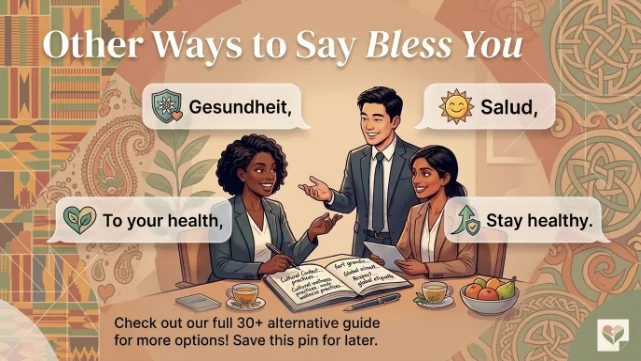
Looking for alternatives to “bless you”? Here are the top 5 responses to someone sneezing: Gesundheit, Salud, To your health, Excuse you, and God bless you. Each offers a different cultural or personal touch choose based on your audience and the setting.
“Bless you” is the traditional English response to someone sneezing, but it carries religious origins that not everyone feels comfortable using. Whether you’re in a multicultural workplace, speaking with non religious friends, or simply want to expand your conversational vocabulary, learning alternatives to “bless you” shows cultural awareness and communication flexibility.
In professional settings, social gatherings, and casual conversations, having a variety of responses at your disposal demonstrates emotional intelligence. This guide presents 30 thoughtful alternatives from secular to humorous, formal to friendly that will help you respond to sneezes with confidence and cultural sensitivity.
“The way you respond to a sneeze says more about your cultural awareness than you might think.”
Quick Categories
Religious Alternatives to “Bless You”
- God bless you
- May God bless you
- Blessings upon you
- The Lord bless you
- God’s blessings
Secular Alternatives
- Gesundheit
- Salud
- To your health
- Good health
- Stay healthy
Humorous Alternatives
- You sneezed!
- Excuse you
- Stop it
- That was a big one
- Wow, impressive!
Professional Alternatives
- Are you alright?
- Take care
- Feel better soon
- Hope you’re okay
- Stay well
Casual Alternatives
- Bless you (still fine!)
- Excuse me
- Sorry
- Oops, bless you
- You okay?
Common Mistakes Using “Bless You”
Even fluent English speakers make these common errors when responding to sneezes:
- Assuming everyone is religious
❌ “God bless you” to a known atheist colleague - Ignoring cultural differences
❌ Using English responses exclusively in international settings - Responding too loudly
❌ Shouting “BLESS YOU!” in a quiet professional meeting - Saying it multiple times
❌ “Bless you, bless you, bless you!” after each sneeze in a sneezing fit - Using inappropriate humor
❌ Making jokes about sneezing in serious professional contexts
What Does “Bless You” Mean?
“Bless you” is a shortened form of “God bless you,” originally used as a response to sneezing. The tradition dates back to ancient times when sneezing was believed to be a spiritual event—some cultures thought sneezing could release evil spirits or that the soul could escape the body.
Grammar note: “Bless you” functions as an imperative phrase (blessing directed at the person who sneezed). It’s always used in the present tense and doesn’t change form for different subjects.
Example:
Someone sneezes
You respond: “Bless you!”
Person sneezing: “Thank you.”
When to Use “Bless You”
Use “bless you” in these contexts:
- Traditional social settings where religion is not a concern
- Among family members and close friends
- At religious gatherings or with religious individuals
- When no cultural sensitivity is required
- As the default response when you don’t know the person well
Spoken vs Written: “Bless you” is almost exclusively spoken—it’s rarely used in written communication except in dialogue or texting.
Formal vs Informal: Generally informal, though acceptable in most social settings. In professional contexts, secular alternatives may be preferred.
Is It Professional or Polite to Say “Bless You”?
Polite? ✔️ Yes – It’s culturally ingrained as a polite response to sneezing in English-speaking countries.
Professional? ⚠️ Depends – In diverse or secular workplaces, “bless you” might be considered religiously loaded. Secular alternatives like “Gesundheit” or “To your health” are often more appropriate in professional environments.
Business-style Example:
A colleague sneezes
Professional response: “Gesundheit. Are you feeling alright?”
Pros and Cons of Using “Bless You”
Pros ✅
- Universally understood – Everyone knows what it means
- Automatic and natural – It’s the default response in English
- Politeness marker – Shows you’re considerate of others
- Non-awkward – Everyone knows the social script
Cons ❌
- Religious connotation – May not suit everyone’s beliefs
- Overused – It’s literally the only response many people know
- Automatic response – Sometimes said without genuine concern
- Cultural baggage – May not translate well in international contexts
Other Ways to Say “Bless You” (With Examples)
These alternatives will help you respond to sneezes in more culturally aware, personal, and varied ways. Use them according to setting, audience, and relationship to express consideration and adaptability.
Religious Alternatives (Best for Faith-Based Contexts)
1. Phrase: God bless you
Meaning: The full, original form of the common response to sneezing.
Explanation: While “bless you” is the shortened version, saying “God bless you” explicitly acknowledges the religious origin.
Example Sentence: At a family gathering: “God bless you, Grandma!”
Best Use: Religious households
Worst Use: Secular workplaces
Tone: Religious, traditional, respectful
Context Variability: Religious/Formal
2. Phrase: May God bless you
Meaning: A formal religious blessing with a more respectful tone.
Explanation: The “may” makes it feel more like a genuine prayer than a reflexive response.
Example Sentence: After someone sneezes in church: “May God bless you, my friend.”
Best Use: Religious services
Worst Use: Professional settings
Tone: Prayerful, respectful, formal
Context Variability: Religious
3. Phrase: Blessings upon you
Meaning: A broad, warm blessing without explicit mention of God.
Explanation: Slightly more inclusive than “God bless you” while maintaining spiritual warmth.
Example Sentence: At a spiritual gathering: “Blessings upon you, sister.”
Best Use: Spiritual communities
Worst Use: Corporate environments
Tone: Spiritual, warm, inclusive
Context Variability: Spiritual/Formal
4. Phrase: The Lord bless you
Meaning: Explicitly Christian language with traditional religious significance.
Explanation: Appropriate among Christians who share this faith background.
Example Sentence: To a friend from church: “The Lord bless you, Sarah.”
Best Use: Christian communities
Worst Use: Mixed-religion settings
Tone: Christian, traditional, warm
Context Variability: Religious
5. Phrase: God’s blessings
Meaning: A shortened, casual religious blessing.
Explanation: Less formal than full sentences, this works in casual religious contexts.
Example Sentence: To a family member: “God’s blessings, sweetie.”
Best Use: Religious families
Worst Use: Professional settings
Tone: Religious, casual, warm
Context Variability: Religious/Casual
“In multicultural settings, secular responses to sneezing show respect for all beliefs.”
Secular Alternatives (Best for Inclusive Settings)
6. Phrase: Gesundheit
Meaning: German for “health,” this is the most common secular alternative in English.
Explanation: Borrowed from German, it literally means “health” and expresses a wish for good health.
Example Sentence: In any professional setting: “Gesundheit! Are you feeling okay?”
Best Use: Diverse workplaces
Worst Use: Religious contexts
Tone: Neutral, polite, international
Context Variability: Professional/Casual
7. Phrase: Salud
Meaning: Spanish for “health,” used similarly to “Gesundheit” in many cultures.
Explanation: Widely understood among Spanish speakers and increasingly common in multicultural English.
Example Sentence: In a diverse classroom: “Salud, Miguel.”
Best Use: Spanish-speaking contexts
Worst Use: Religious services
Tone: Friendly, international, warm
Context Variability: Casual/Professional
8. Phrase: To your health
Meaning: A direct translation of European responses to sneezing.
Explanation: This English version maintains the “good health” wish without religious connotations.
Example Sentence: At a dinner party: “To your health! Now, where were we?”
Best Use: Elegant social settings
Worst Use: Very casual contexts
Tone: Formal, polite, classic
Context Variability: Formal/Casual
9. Phrase: Good health
Meaning: A simple, secular wish for the sneezer’s wellbeing.
Explanation: Directly conveys your hope that the person stays healthy.
Example Sentence: To a colleague: “Good health! Do you need a tissue?”
Best Use: Professional environments
Worst Use: Religious communities
Tone: Caring, professional, neutral
Context Variability: Professional/Casual
10. Phrase: Stay healthy
Meaning: A caring response that focuses on ongoing wellness.
Explanation: Perfect for flu season or when someone seems under the weather.
Example Sentence: In winter: “Stay healthy! It’s going around this season.”
Best Use: Health-conscious settings
Worst Use: Formal religious contexts
Tone: Caring, preventative, warm
Context Variability: Professional/Casual
11. Phrase: Take care of yourself
Meaning: A caring response that extends beyond the sneeze itself.
Explanation: Shows genuine concern for the person’s overall wellbeing.
Example Sentence: To a colleague who seems unwell: “Take care of yourself. Have you seen a doctor?”
Best Use: When someone appears sick
Worst Use: Casual friendly contexts
Tone: Caring, concerned, personal
Context Variability: Professional/Personal
12. Phrase: Wishing you wellness
Meaning: A thoughtful, inclusive wish for good health.
Explanation: Avoids religious language while still feeling warm and intentional.
Example Sentence: In a wellness-focused workplace: “Wishing you wellness, everyone.”
Best Use: Holistic/wellness settings
Worst Use: Traditional contexts
Tone: Mindful, inclusive, warm
Context Variability: Professional/Casual
13. Phrase: Excuse you
Meaning: A casual, slightly playful response that acknowledges the sneeze.
Explanation: Common in informal settings, this treats the sneeze as a minor social disruption.
Example Sentence: To a friend: “Excuse you! That was loud.”
Best Use: Close friends
Worst Use: Professional contexts
Tone: Playful, casual, familiar
Context Variability: Very casual
14. Phrase: You’re excused
Meaning: Similar to “excuse you,” but slightly more formal and humorous.
Explanation: Plays with the idea that sneezing requires social forgiveness.
Example Sentence: To a friend after a loud sneeze: “Well, you’re excused!”
Best Use: Casual contexts with humor
Worst Use: Formal professional settings
Tone: Humorous, playful, casual
Context Variability: Casual
15. Phrase: Sorry
Meaning: An ironic or humorous response that acts as if you sneezed.
Explanation: Sometimes the sneezer apologizes, and the responder says “sorry” back humorously.
Example Sentence: After someone sneezes: “Sorry!” Person sneezing: “For what? I sneezed!”
Best Use: Friendly, playful contexts
Worst Use: Professional settings
Tone: Humorous, ironic, casual
Context Variability: Very casual
“Sometimes the best response to a sneeze is simply acknowledging it without religious or cultural awkwardness.”
Humorous Alternatives (Best for Friends and Family)
16. Phrase: You sneezed!
Meaning: An obvious, playful observation that replaces a traditional response.
Explanation: Points out the obvious in a way that can be funny among friends.
Example Sentence: To a friend: “You sneezed! I heard that across the room.”
Best Use: Playful friendships
Worst Use: Professional environments
Tone: Playful, obvious, humorous
Context Variability: Very casual
17. Phrase: That was a big one!
Meaning: Comments on the intensity of the sneeze humorously.
Explanation: Appropriate when someone has an unusually powerful sneeze.
Example Sentence: After a powerful sneeze: “Whoa! That was a big one! You okay?”
Best Use: Friendly contexts
Worst Use: Formal settings
Tone: Humorous, observational, warm
Context Variability: Casual
18. Phrase: Wow, impressive!
Meaning: Playful admiration of the sneeze’s power or volume.
Explanation: Turns the sneeze into something entertaining rather than needing a blessing.
Example Sentence: To a friend with a loud sneeze: “Wow, impressive! You could wake the neighbors.”
Best Use: Close relationships
Worst Use: Any professional context
Tone: Humorous, admiring, playful
Context Variability: Very casual
19. Phrase: Stop it!
Meaning: An ironic command telling the person to stop sneezing.
Explanation: The humor comes from the fact that sneezing is involuntary.
Example Sentence: To a close friend: “Stop it! You’re making me sneeze too.”
Best Use: Playful friendships
Worst Use: Any serious context
Tone: Playful, ironic, familiar
Context Variability: Very casual
20. Phrase: Bless you (said repeatedly)
Meaning: Saying “bless you” over and over during a sneezing fit.
Explanation: This becomes humorous when someone sneezes multiple times.
Example Sentence: During a sneezing fit: “Bless you, bless you, bless you! Okay, I’m done.”
Best Use: Casual settings with friends
Worst Use: Professional meetings
Tone: Playful, repetitive, affectionate
Context Variability: Casual
21. Phrase: Need a tissue?
Meaning: A practical, caring response that shows actual concern.
Explanation: Moves beyond the traditional response to genuine helpfulness.
Example Sentence: To a colleague: “Bless you—and need a tissue? I have some.”
Best Use: Any setting where you want to help
Worst Use: When you don’t actually have a tissue
Tone: Helpful, caring, practical
Context Variability: Professional/Casual
International Alternatives (Best for Global Settings)
22. Phrase: Santé
Meaning: French for “health,” used across many French-speaking cultures.
Explanation: Pronounced “sahn-TAY,” this is elegant and widely recognized.
Example Sentence: In an international meeting: “Santé! Hope you’re not catching a cold.”
Best Use: International contexts
Worst Use: Religious settings
Tone: Elegant, international, polite
Context Variability: Professional/Casual
23. Phrase: Prosit
Meaning: Latin for “may it benefit,” used in some European cultures.
Explanation: While more common as a toast, it’s also used for sneezes in some regions.
Example Sentence: In a German-speaking context: “Prosit! You okay?”
Best Use: German/European settings
Worst Use: Non-European contexts
Tone: Traditional, European, polite
Context Variability: Casual/Professional
24. Phrase: À tes souhaits
Meaning: French for “to your wishes,” the more common French response to sneezing.
Explanation: This is the standard French response, pronounced “ah tay sweh.”
Example Sentence: To a French colleague: “À tes souhaits! That sounded powerful.”
Best Use: French-speaking contexts
Worst Use: Non-French settings
Tone: French, warm, proper
Context Variability: Casual/Professional
25. Phrase: Nasz draug
Meaning: Yiddish for “our love,” a warm cultural response.
Explanation: Used in Jewish communities as a loving response to sneezing.
Example Sentence: In a Jewish household: “Nasz draug, bubbaleh!”
Best Use: Jewish cultural contexts
Worst Use: Non-Jewish settings
Tone: Cultural, warm, affectionate
Context Variability: Cultural
26. Phrase: For health
Meaning: A direct English translation of many European responses.
Explanation: Simple, clear, and completely secular—”for health” is universally understood.
Example Sentence: In a diverse office: “For health! You’ve been sneezing all morning.”
Best Use: Multicultural workplaces
Worst Use: Religious contexts
Tone: Neutral, inclusive, caring
Context Variability: Professional/Casual
27. Phrase: Health and happiness
Meaning: A warm response that extends beyond physical health.
Explanation: Broader and more personal than just health, this feels genuinely caring.
Example Sentence: To a friend: “Health and happiness! You deserve both.”
Best Use: Friendly, personal contexts
Worst Use: Formal professional environments
Tone: Warm, caring, personal
Context Variability: Personal/Professional
28. Phrase: Live long
Meaning: A blessing of longevity, common in some cultures.
Explanation: While it sounds like a blessing, it’s actually a cultural wish for long life.
Example Sentence: In a traditional setting: “Live long! We need you around.”
Best Use: Cultural settings
Worst Use: Professional corporate contexts
Tone: Traditional, warm, cultural
Context Variability: Cultural/Casual
29. Phrase: May you have health
Meaning: A caring, secular wish for continued good health.
Explanation: A gentler version of “good health” that feels more personal.
Example Sentence: To a colleague who sneezed: “May you have health! It’s that time of year.”
Best Use: Professional and personal contexts
Worst Use: Religious contexts
Tone: Caring, professional, warm
Context Variability: Professional/Casual
30. Phrase: Are you alright?
Meaning: A concerned response that completely bypasses the traditional formula.
Explanation: This response shows genuine care for the person, not just acknowledgment of the sneeze.
Example Sentence: To a colleague in a meeting: “Are you alright? That was a rough one.”
Best Use: Professional settings
Worst Use: Casual, familiar contexts
Tone: Concerned, caring, professional
Context Variability: Professional/Personal
“The best response to a sneeze is one that makes the other person feel cared for, regardless of the words you choose.”
Mini Quiz / Self-Check
Test your understanding of when to use different responses to sneezing:
1. You’re in a diverse workplace meeting, and a colleague sneezes. Which response is MOST appropriate?
- A) God bless you
- B) Gesundheit
- C) Stop it!
- D) May God bless you
Answer: B – “Gesundheit” is secular, respectful, and appropriate in professional multicultural settings.
2. Your close friend sneezes dramatically at dinner. Which response is MOST appropriate?
- A) Gesundheit
- B) May God bless you
- C) Wow, impressive!
- D) The Lord bless you
Answer: C – With close friends, a playful response like “Wow, impressive!” is completely appropriate.
3. You’re in a formal religious ceremony, and the person next to you sneezes. Which response is BEST?
- A) To your health
- B) God bless you
- C) Excuse you
- D) Are you alright?
Answer: B – In a religious context, “God bless you” is the natural and expected response.
4. A colleague has been sneezing repeatedly throughout the day and seems unwell. Which is the MOST appropriate response?
- A) Bless you each time
- B) Are you alright?
- C) Gesundheit (each time)
- D) Stop it!
Answer: B – Moving beyond the automatic response to show genuine concern is most appropriate here.
Comparison Table: Top Alternatives
| Phrase | Tone | Best Use |
|---|---|---|
| Gesundheit | Neutral, professional | Diverse workplaces |
| God bless you | Religious, traditional | Religious contexts |
| To your health | Formal, classic | Elegant social settings |
| Salud | Friendly, international | Spanish-speaking contexts |
| Bless you | Traditional, polite | Default English response |
| Stay healthy | Caring, preventative | Flu season/health concerns |
| Excuse you | Playful, casual | Close friends |
| Are you alright? | Concerned, caring | Professional settings |
| À tes souhaits | French, warm | French-speaking contexts |
| With appreciation | Grateful, warm | Thank-you emails |
FAQs
1. Is it rude not to say “bless you” when someone sneezes?
No, it’s not rude, though some people may expect a response. In many cultures, no response is perfectly normal. What matters more is your overall politeness and demeanor.
2. What should I say instead of “bless you” at work?
“Gesundheit” is the most common secular alternative in professional settings. You can also say “To your health,” “Stay healthy,” or simply ask, “Are you alright?” These options maintain professionalism without religious references.
3. Do people say “bless you” in other countries?
Different cultures have their own traditions. German speakers say “Gesundheit,” Spanish speakers say “Salud,” French speakers say “À tes souhaits,” and many Asian cultures don’t have a specific response to sneezing at all.
4. What’s the origin of saying “bless you” after a sneeze?
The tradition dates back to ancient times when sneezing was believed to be a spiritual event—the soul could escape the body, or evil spirits could enter. “God bless you” was meant to protect the sneezer from these dangers.
5. Is it okay to say nothing when someone sneezes?
Absolutely. In many cultures, there is no traditional response to sneezing, and saying nothing is perfectly acceptable. In professional settings, you might simply acknowledge with a smile or brief eye contact.
Conclusion
Mastering alternatives to “bless you” enriches your social vocabulary and demonstrates cultural sensitivity. Whether you choose secular responses like “Gesundheit,” religious blessings like “God bless you,” or caring questions like “Are you alright?”—the key is to be thoughtful and considerate of your audience.
Practice using these 30 alternatives in your daily interactions. Notice how different people respond and what feels natural in various settings. With time, you’ll develop an intuitive sense of the perfect response for every sneeze, making your communication more adaptable and culturally aware.