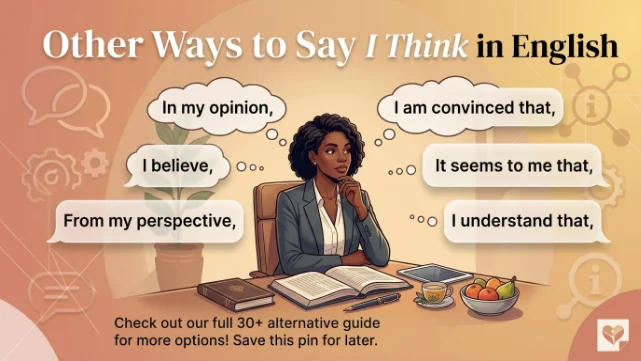
Looking for alternatives to “I think”? Here are the top 5 professional phrases: In my opinion, From my perspective, I believe, It seems to me, and As I see it. Each helps you express opinions with varying levels of confidence and formality.
“I think” is one of the most overused phrases in English. While it’s perfectly correct, relying on it constantly makes your speech and writing sound repetitive and uncertain. Learning alternatives to “I think” transforms your communication, helping you express opinions with greater precision, confidence, and sophistication.
Whether you’re participating in business meetings, writing professional emails, or engaging in academic discussions, having a rich vocabulary of opinion phrases makes you sound more articulate and persuasive. In this guide, you’ll discover 30 powerful alternatives to “I think” that will elevate your English communication in any context.
“The way you express an opinion reveals as much about your confidence as the opinion itself.”
Quick Categories
Formal Alternatives to “I Think”
- In my opinion
- From my perspective
- To my mind
- As far as I’m concerned
- In my view
Professional Alternatives
- I believe
- I consider
- It seems to me
- My assessment is
- I’m of the opinion that
Casual Alternatives
- I guess
- I reckon
- If you ask me
- I’d say
- In my book
Academic Alternatives
- From my standpoint
- To my way of thinking
- It’s my contention that
- I posit that
- My hypothesis is
Common Mistakes Using “I Think”
Even advanced English speakers make these common errors when using “I think”:
- Overusing it in every sentence
❌ “I think we should meet. I think Tuesday works. I think we can finish by Friday.” - Using it when stating facts
❌ “I think the Earth orbits the sun” (This is a fact, not an opinion) - Adding “that” unnecessarily
❌ “I think that that is a good idea” (Double “that” is awkward) - Using it in formal academic writing
❌ “I think the data suggests…” (Too informal for academic papers) - Not varying the phrase
❌ Starting every paragraph with “I think” makes you sound unsure
What Does “I Think” Mean?
“I think” means “I have an opinion or belief about something.” It introduces a personal viewpoint rather than a statement of fact. The phrase signals that what follows is subjective and based on your own reasoning or feelings.
Grammar note: “I think” is followed by a clause (subject + verb). You can optionally add “that” after “think” (e.g., “I think that…”).
Example:
“I think we should postpone the meeting until everyone has reviewed the proposal.”
When to Use “I Think”
Use “I think” in these contexts:
- Casual conversations with friends and family
- Brainstorming sessions where ideas are being shared
- When you’re genuinely unsure about a topic
- Offering personal opinions without strong evidence
- Expressing preferences or subjective judgments
Spoken vs Written: Common in both, but written English often requires more formal alternatives.
Formal vs Informal: Generally informal. Use sparingly in professional and academic settings.
Is It Professional or Polite to Say “I Think”?
Polite? ✔️ Yes – It softens your statements and shows you respect others’ opinions.
Professional? ❌ No (in most cases) – While it’s not impolite, “I think” can make you sound uncertain or unconfident in professional settings. Stronger alternatives like “I believe” or “In my view” project more authority.
Business-style Example:
“I think we should consider expanding into the Asian market.” (Sounds hesitant)
“I believe we should consider expanding into the Asian market.” (Sounds confident)
Pros and Cons of Using “I Think”
Pros ✅
- Simple and natural – Everyone understands it immediately
- Humble and polite – Doesn’t sound arrogant or pushy
- Common usage – Widely accepted in everyday conversation
- Easy to understand – No confusion about your meaning
Cons ❌
- Overused – Becomes repetitive and loses impact
- Lacks confidence – Can make you sound uncertain
- Not suitable for formal writing – Too casual for academic or professional documents
- Limited precision – Doesn’t convey the strength of your conviction
Other Ways to Say “I Think” (With Examples)
These alternatives will help you sound more fluent, confident, and natural in different situations. Use them according to tone, context, and audience to express opinions with appropriate conviction.
Formal Alternatives (Best for Official and Written Communication)
1. Phrase: In my opinion
Meaning: A formal way to introduce your personal view.
Explanation: One of the most common formal alternatives—widely accepted in professional and academic writing.
Example Sentence: “In my opinion, the current marketing strategy needs to be revised.”
Best Use: Formal writing
Worst Use: Casual conversation
Tone: Formal, measured, professional
Context Variability: Professional/Academic
2. Phrase: From my perspective
Meaning: Indicates you’re sharing a viewpoint based on your unique position or experience.
Explanation: Emphasizes that your opinion is shaped by your particular circumstances.
Example Sentence: “From my perspective, the team has been working exceptionally well together.”
Best Use: Professional discussions
Worst Use: Quick casual chats
Tone: Professional, thoughtful, subjective
Context Variability: Professional/Formal
3. Phrase: To my mind
Meaning: A formal expression meaning “in my opinion” or “as I see it.”
Explanation: Slightly old-fashioned but still used in formal English writing.
Example Sentence: “To my mind, the proposal requires further revision before submission.”
Best Use: Formal essays
Worst Use: Daily conversation
Tone: Formal, reflective, measured
Context Variability: Formal/Academic
4. Phrase: As far as I’m concerned
Meaning: Indicates that this is your personal opinion, regardless of what others think.
Explanation: Can sound slightly defensive but is useful for expressing personal boundaries.
Example Sentence: “As far as I’m concerned, we should proceed with the original plan.”
Best Use: Professional meetings
Worst Use: Sensitive discussions
Tone: Assertive, personal, professional
Context Variability: Professional/Formal
5. Phrase: In my view
Meaning: A formal alternative that’s similar to “in my opinion.”
Explanation: Slightly more concise and direct than “in my opinion.”
Example Sentence: “In my view, the data clearly supports our initial hypothesis.”
Best Use: Research writing
Worst Use: Casual conversation
Tone: Formal, professional, clear
Context Variability: Professional/Academic
6. Phrase: To my way of thinking
Meaning: A slightly formal phrase that introduces your personal reasoning.
Explanation: Emphasizes the thought process behind your opinion.
Example Sentence: “To my way of thinking, we need to prioritize customer satisfaction above all else.”
Best Use: Formal discussions
Worst Use: Quick informal chats
Tone: Reflective, formal, thoughtful
Context Variability: Formal/Professional
“Formal opinion phrases build credibility—they show you’ve thought deeply about your position.”
Professional Alternatives (Best for Business and Workplace Communication)
7. Phrase: I believe
Meaning: Expresses a strong personal conviction or opinion.
Explanation: More confident than “I think” while remaining professional and respectful.
Example Sentence: “I believe this approach will significantly improve our conversion rates.”
Best Use: Business proposals
Worst Use: When you’re genuinely uncertain
Tone: Confident, professional, strong
Context Variability: Professional/Formal
8. Phrase: I consider
Meaning: Indicates thoughtful reflection and evaluation.
Explanation: Suggests you’ve given the matter careful thought.
Example Sentence: “I consider this partnership to be one of our most valuable assets.”
Best Use: Strategic discussions
Worst Use: Casual opinions
Tone: Thoughtful, professional, measured
Context Variability: Professional/Formal
9. Phrase: It seems to me
Meaning: Softens your opinion while still making it clear.
Explanation: Useful when you want to express an opinion without sounding dogmatic.
Example Sentence: “It seems to me that the market is shifting toward more sustainable products.”
Best Use: Tentative opinions
Worst Use: Strongly held beliefs
Tone: Gentle, reflective, professional
Context Variability: Professional/Casual
10. Phrase: My assessment is
Meaning: Indicates a professional evaluation or judgment.
Explanation: Sounds analytical and professional—ideal for work contexts.
Example Sentence: “My assessment is that we can complete this project within three months.”
Best Use: Professional reports
Worst Use: Casual conversation
Tone: Analytical, professional, precise
Context Variability: Professional
11. Phrase: I’m of the opinion that
Meaning: A formal way of stating your personal view.
Explanation: Sounds authoritative and well-considered.
Example Sentence: “I’m of the opinion that we should invest more heavily in digital transformation.”
Best Use: Formal business communication
Worst Use: Quick emails
Tone: Formal, authoritative, professional
Context Variability: Professional/Formal
12. Phrase: My perspective is
Meaning: Emphasizes your unique viewpoint or position.
Explanation: Professional and widely accepted in business discussions.
Example Sentence: “My perspective is that we need to balance innovation with operational stability.”
Best Use: Team discussions
Worst Use: Formal letters
Tone: Professional, balanced, clear
Context Variability: Professional
13. Phrase: It’s my view that
Meaning: A formal alternative for introducing a considered opinion.
Explanation: Useful for presentations, reports, and formal emails.
Example Sentence: “It’s my view that customer feedback should guide our product development.”
Best Use: Presentations
Worst Use: Casual chats
Tone: Formal, confident, professional
Context Variability: Professional/Formal
14. Phrase: I would suggest
Meaning: A polite, professional way to propose an idea.
Explanation: Softens your opinion while still offering a clear suggestion.
Example Sentence: “I would suggest conducting a market analysis before finalizing our strategy.”
Best Use: Offering recommendations
Worst Use: Strong personal opinions
Tone: Polite, professional, helpful
Context Variability: Professional
15. Phrase: I feel that
Meaning: Expresses an opinion that’s based on intuition or emotion.
Explanation: More emotional than “I think” or “I believe.”
Example Sentence: “I feel that we could improve team morale with more recognition programs.”
Best Use: People-focused discussions
Worst Use: Data-driven decisions
Tone: Emotional, personal, warm
Context Variability: Professional/Personal
“In business, ‘I believe’ sounds confident while ‘I consider’ sounds thoughtful—choose based on your goal.”
Casual Alternatives (Best for Everyday Conversation)
16. Phrase: I guess
Meaning: Indicates a tentative opinion or mild uncertainty.
Explanation: Very common in everyday speech when you’re not entirely sure.
Example Sentence: “I guess we could try the new restaurant downtown.”
Best Use: Daily conversation
Worst Use: Professional communication
Tone: Tentative, casual, relaxed
Context Variability: Very casual
17. Phrase: I reckon
Meaning: A casual expression meaning “I think” or “I suppose.”
Explanation: Very common in British, Australian, and Southern American English.
Example Sentence: “I reckon we’ll be there by about 7 o’clock.”
Best Use: Casual regional speech
Worst Use: Professional writing
Tone: Casual, folksy, regional
Context Variability: Very casual
18. Phrase: If you ask me
Meaning: Introduces your opinion, often implying that others might disagree.
Explanation: Can sound a bit blunt or opinionated in some contexts.
Example Sentence: “If you ask me, the manager should have handled that situation differently.”
Best Use: Casual opinions
Worst Use: Professional discussions
Tone: Opinionated, casual, direct
Context Variability: Casual
19. Phrase: I’d say
Meaning: A casual contraction of “I would say.”
Explanation: Common in spoken English when offering a quick opinion.
Example Sentence: “I’d say that’s the best option we have right now.”
Best Use: Conversations
Worst Use: Formal writing
Tone: Casual, confident, conversational
Context Variability: Casual
20. Phrase: In my book
Meaning: Means “according to my way of thinking.”
Explanation: Informal but common in everyday English.
Example Sentence: “In my book, honesty is the most important quality in a colleague.”
Best Use: Informal opinions
Worst Use: Professional emails
Tone: Casual, personal, friendly
Context Variability: Casual
21. Phrase: The way I see it
Meaning: Introduces your personal interpretation of a situation.
Explanation: Common in spoken English when sharing a viewpoint.
Example Sentence: “The way I see it, we have two good options to choose from.”
Best Use: Group discussions
Worst Use: Formal documents
Tone: Friendly, conversational, clear
Context Variability: Casual/Professional
22. Phrase: From where I stand
Meaning: Indicates an opinion based on your position or experience.
Explanation: Personal and slightly informal.
Example Sentence: “From where I stand, the project is progressing well despite the challenges.”
Best Use: Workplace discussions
Worst Use: Formal writing
Tone: Personal, conversational, clear
Context Variability: Casual/Professional
23. Phrase: I suppose
Meaning: Expresses a cautious or reluctant opinion.
Explanation: Often used when you’re not completely convinced.
Example Sentence: “I suppose we could extend the deadline if absolutely necessary.”
Best Use: Reluctant agreement
Worst Use: Strong opinions
Tone: Cautious, reluctant, casual
Context Variability: Casual
24. Phrase: It seems to me
Meaning: A softer way to express an opinion.
Explanation: Useful when you want to offer your view without being pushy.
Example Sentence: “It seems to me that we’re focusing on the wrong priorities.”
Best Use: Team discussions
Worst Use: Formal reports
Tone: Gentle, reflective, conversational
Context Variability: Casual/Professional
25. Phrase: As I see it
Meaning: A direct, personal way to introduce your opinion.
Explanation: Common in both conversation and informal writing.
Example Sentence: “As I see it, the biggest challenge is our marketing approach.”
Best Use: Everyday conversation
Worst Use: Formal business letters
Tone: Personal, direct, casual
Context Variability: Casual/Professional
26. Phrase: Off the top of my head
Meaning: An opinion given without much time to think.
Explanation: Indicates you’re giving a quick, spontaneous thought.
Example Sentence: “Off the top of my head, I’d say the project will cost about $50,000.”
Best Use: Quick estimates
Worst Use: Formal decisions
Tone: Spontaneous, casual, informal
Context Variability: Casual
“Casual phrases like ‘I guess’ or ‘I reckon’ are fine with friends but undermine your authority in professional settings.”
Academic Alternatives (Best for Research and Scholarly Writing)
27. Phrase: From my standpoint
Meaning: Indicates your opinion based on your specific position or knowledge.
Explanation: More formal than “from my perspective,” suitable for academic work.
Example Sentence: “From my standpoint as a researcher, the methodology could be improved.”
Best Use: Academic writing
Worst Use: Casual conversation
Tone: Academic, professional, precise
Context Variability: Academic/Formal
28. Phrase: To my way of thinking
Meaning: A thoughtful, slightly formal way to introduce an opinion.
Explanation: Suggests careful consideration and reflection.
Example Sentence: “To my way of thinking, the evidence supports a different conclusion.”
Best Use: Academic writing
Worst Use: Daily conversation
Tone: Reflective, academic, measured
Context Variability: Academic/Formal
29. Phrase: It’s my contention that
Meaning: Indicates a strong opinion you’re prepared to defend.
Explanation: A confident academic phrase suggesting you can support your view with evidence.
Example Sentence: “It’s my contention that climate policy must prioritize renewable energy.”
Best Use: Argumentative essays
Worst Use: Casual chats
Tone: Academic, confident, persuasive
Context Variability: Academic/Formal
30. Phrase: I posit that
Meaning: Means “I propose or suggest” in an academic context.
Explanation: Common in research writing when presenting a theory or hypothesis.
Example Sentence: “I posit that social media usage directly affects adolescent self-esteem.”
Best Use: Academic writing
Worst Use: Everyday conversation
Tone: Academic, formal, precise
Context Variability: Academic
31. Phrase: My hypothesis is
Meaning: Indicates a theoretical opinion or educated guess.
Explanation: Very formal, specifically used in research contexts.
Example Sentence: “My hypothesis is that the treatment will significantly reduce symptoms.”
Best Use: Scientific writing
Worst Use: Casual opinions
Tone: Scientific, academic, formal
Context Variability: Academic
32. Phrase: My analysis suggests
Meaning: Indicates an opinion based on careful study.
Explanation: Sounds authoritative and evidence-based.
Example Sentence: “My analysis suggests that market volatility will increase next quarter.”
Best Use: Professional research
Worst Use: Personal opinions
Tone: Analytical, professional, evidence-based
Context Variability: Professional/Academic
“Academic phrases like ‘I contend that’ and ‘I posit that’ signal you’re making a scholarly argument worth taking seriously.”
Mini Quiz / Self-Check
Test your understanding of when to use different alternatives to “I think”:
1. You’re writing a formal business proposal to a new client. Which phrase is MOST appropriate?
- A) I guess
- B) I believe
- C) I reckon
- D) If you ask me
Answer: B – “I believe” is professional and confident, appropriate for business proposals.
2. You’re casually chatting with friends about where to eat. Which phrase is MOST natural?
- A) I posit that
- B) My hypothesis is
- C) I’d say
- D) It’s my contention
Answer: C – “I’d say” is casual and natural for everyday conversation with friends.
3. You’re writing an academic paper and need to present a strong opinion. Which is BEST?
- A) I guess
- B) It’s my contention that
- C) The way I see it
- D) Off the top of my head
Answer: B – “It’s my contention that” is appropriately academic and confident.
4. You’re offering a quick estimate in a meeting. Which phrase is MOST suitable?
- A) Off the top of my head
- B) I posit that
- C) My hypothesis is
- D) In my opinion
Answer: A – “Off the top of my head” signals you’re giving a spontaneous estimate, not a firm figure.
Comparison Table: Top Alternatives
| Phrase | Tone | Best Use |
|---|---|---|
| In my opinion | Formal, measured | Professional writing |
| I believe | Confident, professional | Business proposals |
| From my perspective | Professional, thoughtful | Team discussions |
| It seems to me | Gentle, reflective | Tentative opinions |
| I guess | Casual, relaxed | Everyday conversation |
| My assessment is | Analytical, precise | Professional reports |
| To my mind | Formal, reflective | Academic writing |
| I feel that | Emotional, personal | People-focused contexts |
| The way I see it | Friendly, conversational | Group discussions |
| It’s my contention that | Academic, strong | Argumentative essays |
FAQs
1. Is “I think” considered unprofessional in emails?
“I think” isn’t unprofessional, but it can sound hesitant. In business emails, alternatives like “I believe” or “In my view” project more confidence and authority.
2. What’s the difference between “I think” and “I believe”?
“I think” often indicates a reasoned opinion, while “I believe” suggests a stronger personal conviction. “I believe” sounds more confident and is generally preferred in professional contexts.
3. Can I use “I feel” instead of “I think” in business meetings?
Yes, but use it sparingly. “I feel” works well for people-centered discussions or when expressing empathy. However, “I believe” or “From my perspective” sound more professional for business decisions.
4. What’s the best alternative for academic writing?
“I contend that,” “I posit that,” “From my standpoint,” and “It’s my view that” are all excellent for academic writing. They sound scholarly and convey confidence in your position.
5. Is “I reckon” appropriate for professional communication?
No, “I reckon” is too casual and regional for professional communication. Reserve it for informal conversations, especially in British or Australian English contexts.
Conclusion
Mastering alternatives to “I think” is essential for fluent English communication. Each alternative carries its own subtle meaning, level of confidence, and appropriate context. By choosing the right phrase, you can express opinions more persuasively, sound more professional in business settings, and vary your language for more engaging conversation.
Start incorporating these alternatives into your daily communication. Pay attention to which phrases native speakers use in different contexts, and practice matching your language to the situation. With time, using varied opinion phrases will become natural—and your English will sound more sophisticated and confident.